Canada's February CPI is expected to rise to 2.1%, drawing market attention and causing the USD/CAD pair to rebound, approaching the key resistance level of 1.3750.
2026-03-16 17:31:50
On Monday, market focus will shift to Canada's upcoming inflation data. Statistics Canada will release the February Consumer Price Index (CPI) at 8:30 PM today. This data is considered a key indicator for assessing inflation trends and could influence the Bank of Canada's upcoming policy meeting. The market widely expects the Bank of Canada to keep its policy rate unchanged at 2.25% at its March 18 meeting, but the inflation data could still affect the future policy path.

Economists expect Canada's overall CPI to rise by about 2.1% year-on-year in February, a slight decrease from 2.3% in January, but still slightly above the central bank's 2% inflation target . Looking at monthly data, the market expects prices to rise 0.4 % month-on-month. Meanwhile, core inflation, excluding food and energy prices, is expected to fall to 2.4% from 2.6% in January. Despite some signs of cooling inflation, core prices remain relatively high, suggesting that the decline in inflation is not yet fully over.
At its most recent policy meeting, the Bank of Canada stated that the current policy interest rate level is broadly sufficient to keep inflation near the target, provided that economic developments meet expectations. However, policymakers also emphasized that the central bank will not automatically maintain the current policy path. If the economic growth outlook weakens significantly, or if there are renewed upside risks to inflation, the central bank will adjust its policy stance accordingly.
From the perspective of inflation structure, although the overall inflation rate has gradually declined, underlying inflation remains above the target level. Data shows that several core inflation indicators closely monitored by the Bank of Canada remain at high levels. Specifically, the CPI-Common is approximately 2.7% , the CPI-Trim is approximately 2.4% , and the CPI-Median is approximately 2.5% , all exceeding the Bank of Canada 's 2% target . This means that while inflationary pressures have eased somewhat, they still exist.
Furthermore, the market remains concerned that global trade anxieties may impact domestic prices in Canada. Some economists believe that if external tariff costs are gradually passed on to businesses and consumers, it could put new upward pressure on inflation. This uncertainty is also causing investors to remain cautious ahead of the data release.
In the foreign exchange market, the Canadian dollar has been relatively volatile recently. Analysts point out that the Canadian dollar has given back most of its gains for the month in recent trading days, which has driven the USD/CAD pair to rebound rapidly from a monthly low of around 1.3530 and approach the 1.3750 area. The rebound reflects the recent overall strength of the US dollar and the market's cautious attitude towards the Canadian economic outlook.
From a technical perspective, the USD/CAD daily chart shows the exchange rate is currently in a phase of rebound. After finding monthly support around 1.3530 , the price has been steadily rising and is currently testing resistance around 1.3750 . If the price breaks through this level, the next target could be the 200-day moving average around 1.3800 , followed by the 100-day moving average around 1.3810 . Further upside could challenge 1.3928 , a significant high formed in January of this year.
From the 4-hour chart, the USD/CAD pair shows slightly bullish short-term momentum. The price is trading above short-term moving averages, and momentum indicators also suggest an upward trend. The Relative Strength Index (RSI) is currently near 59 , indicating bullish momentum, but it hasn't yet entered clearly overbought territory. Meanwhile, the Average Directional Movement Index (ADX) is around 14 , suggesting that the current trend still lacks strong momentum. Therefore, the exchange rate may continue its oscillating upward structure in the short term.
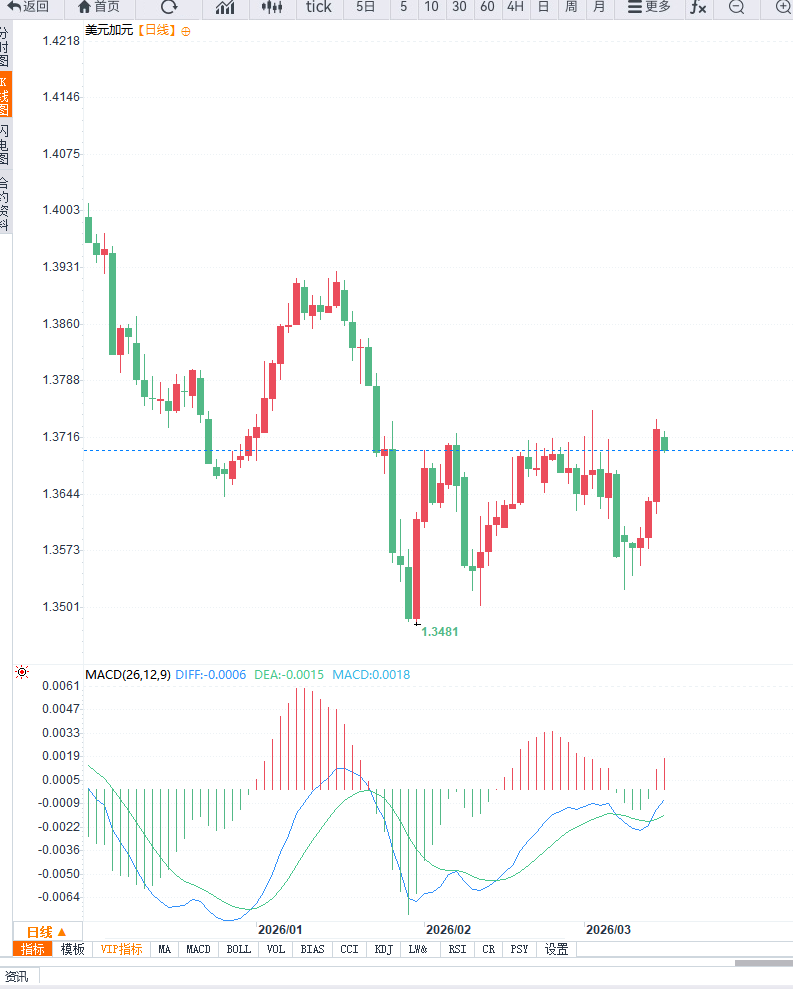
On the downside, the first support level for the exchange rate is around 1.3525 , which is a significant low formed this month. If the price breaks below this area, the next support levels could be around 1.3504 and 1.3481 .
Overall, Canadian inflation data will be a key catalyst for the market in the short term. If inflation is higher than expected, it could prompt the market to reassess the Bank of Canada's policy path and provide some support for the Canadian dollar; however, if inflation data continues to decline, it could strengthen market expectations of policy stability, thereby limiting the Canadian dollar's upside potential.
Editor's Summary : The upcoming Canadian inflation data will be a key event for the foreign exchange market this week. While the market widely expects the Bank of Canada to keep interest rates unchanged in the short term, the inflation trend will still determine future policy direction. If core inflation remains high, the central bank may maintain a more cautious stance. From a technical perspective, the USD/CAD pair is in a short-term rebound phase, with the 1.3750-1.3800 area becoming a key resistance zone. Future exchange rate movements will depend on inflation data performance and a reassessment of the Canadian economic outlook by the market.
Frequently Asked Questions (FAQ)
Question 1: Why is CPI data so important to the foreign exchange market?
The Consumer Price Index (CPI) is one of the most important economic indicators for measuring inflation. For the foreign exchange market, inflation data directly impacts central bank monetary policy decisions. When inflation consistently exceeds the central bank's target, the central bank typically needs to maintain higher interest rates or even further tighten policy to curb price increases. Higher interest rates usually attract international capital inflows, thus pushing up the domestic currency. Conversely, if inflation consistently declines and falls below the target level, the central bank may stimulate the economy through interest rate cuts or other easing policies, which typically weakens the domestic currency. Therefore, CPI data often becomes a crucial basis for market predictions of central bank policy. In Canada's case, the Bank of Canada's inflation target is 2%. If CPI data consistently exceeds this target, the market may perceive that the central bank needs to maintain a tighter policy for a longer period, thereby supporting the Canadian dollar.
Question 2: Why is core inflation more important than overall inflation?
Core inflation typically excludes food and energy prices, as these are often highly volatile and influenced by weather, geopolitical events, or changes in global supply. By removing these short-term fluctuations, core inflation more accurately reflects long-term price trends in the economy. Central banks generally pay closer attention to core inflation when formulating monetary policy because it reflects structural factors such as wage growth, service prices, and business costs. If core inflation remains persistently above the target level, central banks may remain cautious even if overall inflation temporarily declines. In Canada, core inflation is currently above 2%, meaning that while inflationary pressures have eased somewhat, they have not yet fully returned to the central bank's target range. Therefore, the market will closely monitor core inflation data to determine potential policy changes.
Question 3: Why might trade concerns drive up inflation?
Trade concerns typically affect prices through multiple channels. First, if businesses face higher import costs, such as tariffs or supply chain adjustment costs, these expenses are often passed on to consumers, thus pushing up commodity prices. Second, uncertainty in the trade environment may lead businesses to increase inventory or seek new supply channels, which can also increase operating costs. Furthermore, if trade tensions cause currency fluctuations, they can also affect the prices of imported goods. For example, when a domestic currency depreciates, the cost of imported goods increases accordingly, thereby driving domestic inflation. In an economy like Canada, which is highly dependent on international trade, changes in the global trade environment often have a significant impact on inflation. Therefore, the market is generally concerned about whether trade-related policies will affect future inflation trends.
Question 4: Why is the USD/CAD exchange rate so closely related to oil prices?
Canada is a major global energy exporter, particularly in crude oil exports. Energy products account for a significant portion of Canada's export revenue, so fluctuations in oil prices typically have a direct impact on the Canadian economy and the Canadian dollar exchange rate. When oil prices rise, Canada's export revenue increases, which usually improves its trade balance and attracts more foreign investment to the Canadian market, thus supporting the Canadian dollar. Conversely, when oil prices fall, the Canadian economy may face pressure, and the Canadian dollar may weaken. Therefore, the foreign exchange market often considers the Canadian dollar a "commodity currency." In the current context of significant volatility in the global energy market, oil price movements remain a crucial factor influencing the USD/CAD exchange rate.
Economists expect Canada's overall CPI to rise by about 2.1% year-on-year in February, a slight decrease from 2.3% in January, but still slightly above the central bank's 2% inflation target . Looking at monthly data, the market expects prices to rise 0.4 % month-on-month. Meanwhile, core inflation, excluding food and energy prices, is expected to fall to 2.4% from 2.6% in January. Despite some signs of cooling inflation, core prices remain relatively high, suggesting that the decline in inflation is not yet fully over.
At its most recent policy meeting, the Bank of Canada stated that the current policy interest rate level is broadly sufficient to keep inflation near the target, provided that economic developments meet expectations. However, policymakers also emphasized that the central bank will not automatically maintain the current policy path. If the economic growth outlook weakens significantly, or if there are renewed upside risks to inflation, the central bank will adjust its policy stance accordingly.
From the perspective of inflation structure, although the overall inflation rate has gradually declined, underlying inflation remains above the target level. Data shows that several core inflation indicators closely monitored by the Bank of Canada remain at high levels. Specifically, the CPI-Common is approximately 2.7% , the CPI-Trim is approximately 2.4% , and the CPI-Median is approximately 2.5% , all exceeding the Bank of Canada 's 2% target . This means that while inflationary pressures have eased somewhat, they still exist.
Furthermore, the market remains concerned that global trade anxieties may impact domestic prices in Canada. Some economists believe that if external tariff costs are gradually passed on to businesses and consumers, it could put new upward pressure on inflation. This uncertainty is also causing investors to remain cautious ahead of the data release.
In the foreign exchange market, the Canadian dollar has been relatively volatile recently. Analysts point out that the Canadian dollar has given back most of its gains for the month in recent trading days, which has driven the USD/CAD pair to rebound rapidly from a monthly low of around 1.3530 and approach the 1.3750 area. The rebound reflects the recent overall strength of the US dollar and the market's cautious attitude towards the Canadian economic outlook.
From a technical perspective, the USD/CAD daily chart shows the exchange rate is currently in a phase of rebound. After finding monthly support around 1.3530 , the price has been steadily rising and is currently testing resistance around 1.3750 . If the price breaks through this level, the next target could be the 200-day moving average around 1.3800 , followed by the 100-day moving average around 1.3810 . Further upside could challenge 1.3928 , a significant high formed in January of this year.
From the 4-hour chart, the USD/CAD pair shows slightly bullish short-term momentum. The price is trading above short-term moving averages, and momentum indicators also suggest an upward trend. The Relative Strength Index (RSI) is currently near 59 , indicating bullish momentum, but it hasn't yet entered clearly overbought territory. Meanwhile, the Average Directional Movement Index (ADX) is around 14 , suggesting that the current trend still lacks strong momentum. Therefore, the exchange rate may continue its oscillating upward structure in the short term.
On the downside, the first support level for the exchange rate is around 1.3525 , which is a significant low formed this month. If the price breaks below this area, the next support levels could be around 1.3504 and 1.3481 .
Overall, Canadian inflation data will be a key catalyst for the market in the short term. If inflation is higher than expected, it could prompt the market to reassess the Bank of Canada's policy path and provide some support for the Canadian dollar; however, if inflation data continues to decline, it could strengthen market expectations of policy stability, thereby limiting the Canadian dollar's upside potential.
Editor's Summary : The upcoming Canadian inflation data will be a key event for the foreign exchange market this week. While the market widely expects the Bank of Canada to keep interest rates unchanged in the short term, the inflation trend will still determine future policy direction. If core inflation remains high, the central bank may maintain a more cautious stance. From a technical perspective, the USD/CAD pair is in a short-term rebound phase, with the 1.3750-1.3800 area becoming a key resistance zone. Future exchange rate movements will depend on inflation data performance and a reassessment of the Canadian economic outlook by the market.
Frequently Asked Questions (FAQ)
Question 1: Why is CPI data so important to the foreign exchange market?
The Consumer Price Index (CPI) is one of the most important economic indicators for measuring inflation. For the foreign exchange market, inflation data directly impacts central bank monetary policy decisions. When inflation consistently exceeds the central bank's target, the central bank typically needs to maintain higher interest rates or even further tighten policy to curb price increases. Higher interest rates usually attract international capital inflows, thus pushing up the domestic currency. Conversely, if inflation consistently declines and falls below the target level, the central bank may stimulate the economy through interest rate cuts or other easing policies, which typically weakens the domestic currency. Therefore, CPI data often becomes a crucial basis for market predictions of central bank policy. In Canada's case, the Bank of Canada's inflation target is 2%. If CPI data consistently exceeds this target, the market may perceive that the central bank needs to maintain a tighter policy for a longer period, thereby supporting the Canadian dollar.
Question 2: Why is core inflation more important than overall inflation?
Core inflation typically excludes food and energy prices, as these are often highly volatile and influenced by weather, geopolitical events, or changes in global supply. By removing these short-term fluctuations, core inflation more accurately reflects long-term price trends in the economy. Central banks generally pay closer attention to core inflation when formulating monetary policy because it reflects structural factors such as wage growth, service prices, and business costs. If core inflation remains persistently above the target level, central banks may remain cautious even if overall inflation temporarily declines. In Canada, core inflation is currently above 2%, meaning that while inflationary pressures have eased somewhat, they have not yet fully returned to the central bank's target range. Therefore, the market will closely monitor core inflation data to determine potential policy changes.
Question 3: Why might trade concerns drive up inflation?
Trade concerns typically affect prices through multiple channels. First, if businesses face higher import costs, such as tariffs or supply chain adjustment costs, these expenses are often passed on to consumers, thus pushing up commodity prices. Second, uncertainty in the trade environment may lead businesses to increase inventory or seek new supply channels, which can also increase operating costs. Furthermore, if trade tensions cause currency fluctuations, they can also affect the prices of imported goods. For example, when a domestic currency depreciates, the cost of imported goods increases accordingly, thereby driving domestic inflation. In an economy like Canada, which is highly dependent on international trade, changes in the global trade environment often have a significant impact on inflation. Therefore, the market is generally concerned about whether trade-related policies will affect future inflation trends.
Question 4: Why is the USD/CAD exchange rate so closely related to oil prices?
Canada is a major global energy exporter, particularly in crude oil exports. Energy products account for a significant portion of Canada's export revenue, so fluctuations in oil prices typically have a direct impact on the Canadian economy and the Canadian dollar exchange rate. When oil prices rise, Canada's export revenue increases, which usually improves its trade balance and attracts more foreign investment to the Canadian market, thus supporting the Canadian dollar. Conversely, when oil prices fall, the Canadian economy may face pressure, and the Canadian dollar may weaken. Therefore, the foreign exchange market often considers the Canadian dollar a "commodity currency." In the current context of significant volatility in the global energy market, oil price movements remain a crucial factor influencing the USD/CAD exchange rate.
- Risk Warning and Disclaimer
- The market involves risk, and trading may not be suitable for all investors. This article is for reference only and does not constitute personal investment advice, nor does it take into account certain users’ specific investment objectives, financial situation, or other needs. Any investment decisions made based on this information are at your own risk.