Expectations of escort missions in the Strait of Hormuz eased market concerns, and Dow futures rebounded from oversold levels.
2026-03-16 17:25:03
Dow Jones futures strengthened during Monday's European trading session, reflecting a significant improvement in investor risk sentiment compared to the previous session. Dow Jones futures rose approximately 0.33% to around 46,750 points ; S&P 500 futures gained 0.49% to 6,670 points ; and Nasdaq 100 futures climbed 0.51% to 24,520 points . The market rebound was primarily driven by easing investor concerns about the situation in the Middle East, which boosted risk assets in the short term.

Previously, market sentiment was significantly impacted by energy supply risks. The Strait of Hormuz is one of the world's most important energy transport routes, handling approximately 20% of global seaborne crude oil shipments . Any disruption to shipping through this waterway would have a significant impact on global energy supplies and financial markets. Recent news indicates that the United States is considering forming a joint escort force with several other countries to ensure the safety of shipping in the strait. This news has alleviated investor concerns about energy supply disruptions to some extent.
Meanwhile, U.S. Energy Secretary Chris Wright stated that the conflict between the U.S. and Iran could end "within weeks." Markets believe that if the situation gradually eases, global oil supplies are expected to recover, and energy prices may fall, thereby alleviating the recent persistent inflationary pressures. Energy prices are a significant component of global inflation, and their fluctuations often have a direct impact on central bank policy expectations.
However, despite the rebound in the futures market, investors remained relatively cautious. The previous trading day saw all three major U.S. stock indices decline. Data showed that the Dow Jones Industrial Average fell 0.26% , the S&P 500 fell 0.61% , and the Nasdaq 100 fell 0.62% . The market correction was mainly due to rising geopolitical risks and inflation concerns stemming from rising energy prices.
Regarding geopolitical risks, news emerged over the weekend that the US military had struck multiple military targets on Kharg Island, a key energy export hub for Iran. This region accounts for approximately 90% of Iran's oil exports , so any military action could impact global crude oil supplies. Iran subsequently indicated it might retaliate against US-linked energy facilities in the region, keeping markets on high alert.
At the macroeconomic policy level, investors' focus is shifting to the upcoming Federal Reserve interest rate decision this week. The market widely expects the Fed to maintain interest rates at 3.50% to 3.75% at this week's meeting. Previously, rising energy prices had already pushed up inflation expectations again, significantly cooling market expectations for a short-term rate cut. Investors will pay close attention to the Fed's latest statements regarding the future path of interest rates and inflation risks.
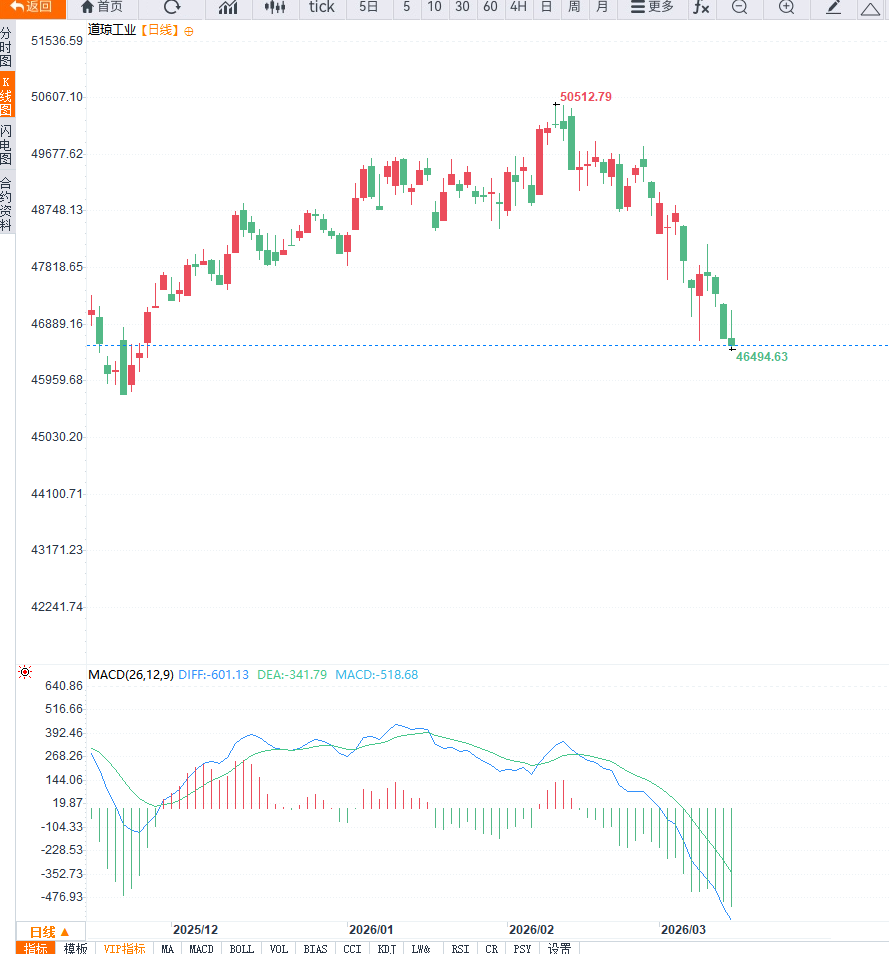
From a technical perspective, Dow Jones futures remain in a high-level consolidation structure. The daily chart shows the index is still operating within an upward trend channel, with short-term support around 46,500 points and key resistance around 47,000 points . If the index can effectively break through this resistance area, the short-term target may be the 47,250-47,500 point range. If it falls below the 46,500 point support, it may retrace to around 46,000 points to find new support.
Overall, risk assets are currently in a phase of intertwined factors. On the one hand, expectations of easing tensions in the Middle East are driving a rebound in risk assets; on the other hand, rising energy prices and inflationary pressures continue to pose potential constraints on the market. Investors are awaiting policy signals from the Federal Reserve while closely monitoring developments in global energy supply and geopolitical situations.
Editor's Summary : The current rebound in index futures is mainly driven by expectations of easing tensions in the Middle East and the possibility of a recovery in energy supply, but overall market sentiment remains cautious. Energy prices, inflation expectations, and the Federal Reserve's policy path remain the core variables influencing market trends. If energy prices continue to rise, the Federal Reserve may be forced to maintain higher interest rates for a longer period, thus putting pressure on valuations. From a technical perspective, Dow Jones futures are still in a high-level consolidation range in the short term, with 47,000 points being a key breakout level. Future market trends will depend on whether geopolitical tensions further ease and the Federal Reserve's latest assessment of inflation risks.
Previously, market sentiment was significantly impacted by energy supply risks. The Strait of Hormuz is one of the world's most important energy transport routes, handling approximately 20% of global seaborne crude oil shipments . Any disruption to shipping through this waterway would have a significant impact on global energy supplies and financial markets. Recent news indicates that the United States is considering forming a joint escort force with several other countries to ensure the safety of shipping in the strait. This news has alleviated investor concerns about energy supply disruptions to some extent.
Meanwhile, U.S. Energy Secretary Chris Wright stated that the conflict between the U.S. and Iran could end "within weeks." Markets believe that if the situation gradually eases, global oil supplies are expected to recover, and energy prices may fall, thereby alleviating the recent persistent inflationary pressures. Energy prices are a significant component of global inflation, and their fluctuations often have a direct impact on central bank policy expectations.
However, despite the rebound in the futures market, investors remained relatively cautious. The previous trading day saw all three major U.S. stock indices decline. Data showed that the Dow Jones Industrial Average fell 0.26% , the S&P 500 fell 0.61% , and the Nasdaq 100 fell 0.62% . The market correction was mainly due to rising geopolitical risks and inflation concerns stemming from rising energy prices.
Regarding geopolitical risks, news emerged over the weekend that the US military had struck multiple military targets on Kharg Island, a key energy export hub for Iran. This region accounts for approximately 90% of Iran's oil exports , so any military action could impact global crude oil supplies. Iran subsequently indicated it might retaliate against US-linked energy facilities in the region, keeping markets on high alert.
At the macroeconomic policy level, investors' focus is shifting to the upcoming Federal Reserve interest rate decision this week. The market widely expects the Fed to maintain interest rates at 3.50% to 3.75% at this week's meeting. Previously, rising energy prices had already pushed up inflation expectations again, significantly cooling market expectations for a short-term rate cut. Investors will pay close attention to the Fed's latest statements regarding the future path of interest rates and inflation risks.
From a technical perspective, Dow Jones futures remain in a high-level consolidation structure. The daily chart shows the index is still operating within an upward trend channel, with short-term support around 46,500 points and key resistance around 47,000 points . If the index can effectively break through this resistance area, the short-term target may be the 47,250-47,500 point range. If it falls below the 46,500 point support, it may retrace to around 46,000 points to find new support.
Overall, risk assets are currently in a phase of intertwined factors. On the one hand, expectations of easing tensions in the Middle East are driving a rebound in risk assets; on the other hand, rising energy prices and inflationary pressures continue to pose potential constraints on the market. Investors are awaiting policy signals from the Federal Reserve while closely monitoring developments in global energy supply and geopolitical situations.
Editor's Summary : The current rebound in index futures is mainly driven by expectations of easing tensions in the Middle East and the possibility of a recovery in energy supply, but overall market sentiment remains cautious. Energy prices, inflation expectations, and the Federal Reserve's policy path remain the core variables influencing market trends. If energy prices continue to rise, the Federal Reserve may be forced to maintain higher interest rates for a longer period, thus putting pressure on valuations. From a technical perspective, Dow Jones futures are still in a high-level consolidation range in the short term, with 47,000 points being a key breakout level. Future market trends will depend on whether geopolitical tensions further ease and the Federal Reserve's latest assessment of inflation risks.
- Risk Warning and Disclaimer
- The market involves risk, and trading may not be suitable for all investors. This article is for reference only and does not constitute personal investment advice, nor does it take into account certain users’ specific investment objectives, financial situation, or other needs. Any investment decisions made based on this information are at your own risk.