Rising expectations of a Reserve Bank of Australia (RBA) rate hike are supporting the Australian dollar, while policy divergence and energy demand may strengthen the foundation for a medium-term upside.
2026-03-16 17:13:30
As major central banks around the world enter a crucial phase in their policies, the focus of the foreign exchange market is gradually shifting to the outlook for Australian monetary policy. On Tuesday, investors will be closely watching the Reserve Bank of Australia's interest rate decision, as the market widely expects the central bank to likely take further tightening action to address persistent inflationary pressures.
Current market pricing indicates a roughly 70% probability of the Reserve Bank of Australia (RBA) raising interest rates by 25 basis points at this meeting. If this expectation materializes, policy rates will rise further, reinforcing market expectations that Australia will maintain a relatively tight monetary policy. For the foreign exchange market, rising interest rates typically increase yields on domestic assets, attracting more capital inflows and supporting the local currency's performance.

However, there is still some disagreement in the market regarding the timing of an interest rate hike. Some institutions believe that against the backdrop of increased global economic uncertainty, the Reserve Bank of Australia (RBA) may choose to wait and see to further assess changes in inflation and economic data. Therefore, if the central bank maintains the current interest rate at this meeting, the Australian dollar may face some downward pressure in the short term.
Meanwhile, some institutions believe the Reserve Bank of Australia (RBA) is likely to maintain its tight monetary policy stance. Analysts point out that the RBA has repeatedly emphasized the still high risk of inflation in its recent policy communications, indicating a relatively hawkish attitude towards controlling prices. Against this backdrop, some institutions predict the RBA may still raise interest rates up to two more times , including at this meeting.
From a macroeconomic perspective, Australian inflation remains above the central bank's target range, meaning policymakers will still need to implement tightening measures to curb price pressures. If inflation declines more slowly than expected, the central bank may need to maintain a high-interest-rate environment for an extended period.
From a fundamental perspective, medium-term support for the Australian dollar remains. Firstly, there are policy differences among major central banks. If the Federal Reserve gradually enters a policy stabilization phase while the Reserve Bank of Australia maintains a tightening stance, the interest rate differential could support the Australian dollar.
Secondly, demand in the commodity market also significantly impacts the Australian dollar. Australia is a major global resource exporter, with liquefied natural gas and iron ore playing crucial roles in the global energy and industrial supply chains. When global energy demand rises, Australian export revenue typically increases, thereby boosting demand for the Australian dollar.
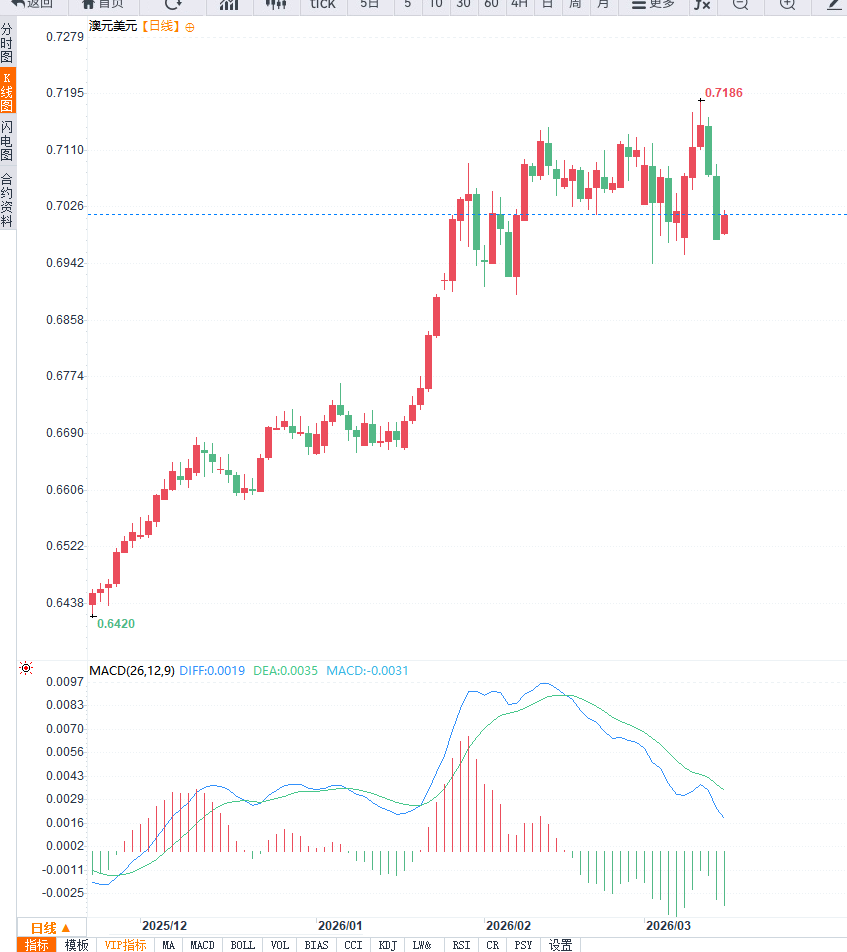
From a technical perspective, the Australian dollar against the US dollar is currently maintaining a range-bound structure on the daily chart. The exchange rate has been fluctuating repeatedly within the 0.6970 to 0.7140 range recently, indicating that the market is awaiting signals from central bank policy. From a trend perspective, short-term moving averages are gradually flattening, suggesting that market momentum is weakening. If the Australian dollar breaks through the 0.7120 resistance level, the upside target may be the 0.7180 area; however, if it falls below the 0.6950 support, the exchange rate may retest the 0.6900 area.
From the 4-hour chart, the Australian dollar against the US dollar is showing a slightly weaker, oscillating pattern in the short term. The price has encountered resistance multiple times when it rebounded to around 0.7100, and the lows are gradually shifting downwards, indicating that selling pressure remains in the short term. In terms of momentum indicators, the Relative Strength Index (RSI) remains in neutral territory, suggesting that the market has not yet formed a clear trend. If the Reserve Bank of Australia releases hawkish signals, the exchange rate may break out of the current consolidation range.
Overall, the Australian dollar's short-term movement will be primarily influenced by the Reserve Bank of Australia's (RBA) policy signals. If the central bank continues to tighten policy, the Australian dollar may receive significant support; however, if the policy stance is less hawkish than the market expects, the exchange rate may experience a short-term pullback.
Editor's Summary : The Reserve Bank of Australia's policy path is becoming a key factor influencing the Australian dollar's performance. The market widely expects the central bank to continue raising interest rates to address persistent inflationary pressures. However, global economic uncertainty and policy changes by major central banks could still impact the Australian dollar's performance.
In the medium term, as a resource-exporting economy, Australia's currency performance remains closely linked to commodity prices. If global demand for energy and raw materials remains strong, the Australian dollar may receive fundamental support. Going forward, the market will focus on the Reserve Bank of Australia's policy signals, global commodity demand, and the differences in monetary policies among major economies.
Frequently Asked Questions (FAQ)
Question 1: Why do interest rate hikes usually lead to an appreciation of the domestic currency?
Raising interest rates typically increases the yield on domestic assets, thereby attracting international capital inflows. When a country's interest rates rise, investors can obtain higher returns on bonds or deposits in that country, increasing demand for that currency. For example, when the Reserve Bank of Australia raises interest rates, Australian bond yields usually rise. International investors need to convert their funds into Australian dollars to purchase these assets, increasing market demand for the Australian dollar and thus pushing up the exchange rate. However, the impact of interest rate hikes on exchange rates is not absolute. If the market has already anticipated the rate hike, the exchange rate may have already risen before the policy announcement. Therefore, the impact of central bank policy on exchange rates often depends on whether it exceeds market expectations.
Question 2: Why is the Australian dollar called a commodity currency?
The Australian dollar is often referred to as a "commodity currency" because the Australian economy is highly dependent on resource exports. Iron ore, coal, liquefied natural gas, and other mineral resources are important Australian export commodities. When global commodity prices rise, Australian export revenue typically increases, thereby improving the trade balance and boosting economic growth. In this situation, market demand for the Australian dollar also increases. Conversely, when commodity prices fall, the Australian economy may be affected, putting pressure on the Australian dollar. Therefore, the Australian dollar exchange rate tends to be strongly correlated with global commodity price movements.
Question 3: Why does the central bank need to raise interest rates to control inflation?
Raising interest rates is one of the important tools central banks use to control inflation. When inflation is too high, central banks typically reduce the flow of funds into the economy by raising interest rates. Higher interest rates increase borrowing costs, thereby reducing business investment and household consumption. For example, rising mortgage rates may reduce demand for real estate, and higher corporate financing costs may reduce expansion plans. These factors all reduce demand pressure in the economy, thus alleviating inflation. However, raising interest rates can also have some negative impacts on economic growth. Therefore, central banks need to strike a balance between controlling inflation and maintaining economic growth when formulating policies.
Question 4: Why does global energy demand affect the Australian dollar's exchange rate?
Australia is one of the world's major energy exporters, holding a particularly important position in the liquefied natural gas (LNG) sector. When global energy demand rises, Australia's export revenue typically increases. Increased energy export revenue means more overseas capital flows into Australia, thereby boosting demand for the Australian dollar. Furthermore, increased revenue in the energy sector can also drive domestic economic growth, further supporting the currency's exchange rate. Therefore, the Australian dollar generally performs well during periods of strong global energy demand.
Question 5: What are the key factors to watch for in the future trend of the Australian dollar?
The future trajectory of the Australian dollar will be primarily influenced by three factors. First, the Reserve Bank of Australia's monetary policy. If the central bank continues to raise interest rates or maintains a relatively high level, the Australian dollar is likely to receive support. Second, the global commodity market. Since the Australian economy relies heavily on resource exports, changes in commodity prices typically have a direct impact on the Australian dollar's performance. Third, the global economic environment. Strong global economic growth and increased demand for resources generally benefit the Australian dollar; however, a global economic slowdown and decreased demand for commodities could put pressure on the Australian dollar.
Current market pricing indicates a roughly 70% probability of the Reserve Bank of Australia (RBA) raising interest rates by 25 basis points at this meeting. If this expectation materializes, policy rates will rise further, reinforcing market expectations that Australia will maintain a relatively tight monetary policy. For the foreign exchange market, rising interest rates typically increase yields on domestic assets, attracting more capital inflows and supporting the local currency's performance.
However, there is still some disagreement in the market regarding the timing of an interest rate hike. Some institutions believe that against the backdrop of increased global economic uncertainty, the Reserve Bank of Australia (RBA) may choose to wait and see to further assess changes in inflation and economic data. Therefore, if the central bank maintains the current interest rate at this meeting, the Australian dollar may face some downward pressure in the short term.
Meanwhile, some institutions believe the Reserve Bank of Australia (RBA) is likely to maintain its tight monetary policy stance. Analysts point out that the RBA has repeatedly emphasized the still high risk of inflation in its recent policy communications, indicating a relatively hawkish attitude towards controlling prices. Against this backdrop, some institutions predict the RBA may still raise interest rates up to two more times , including at this meeting.
From a macroeconomic perspective, Australian inflation remains above the central bank's target range, meaning policymakers will still need to implement tightening measures to curb price pressures. If inflation declines more slowly than expected, the central bank may need to maintain a high-interest-rate environment for an extended period.
From a fundamental perspective, medium-term support for the Australian dollar remains. Firstly, there are policy differences among major central banks. If the Federal Reserve gradually enters a policy stabilization phase while the Reserve Bank of Australia maintains a tightening stance, the interest rate differential could support the Australian dollar.
Secondly, demand in the commodity market also significantly impacts the Australian dollar. Australia is a major global resource exporter, with liquefied natural gas and iron ore playing crucial roles in the global energy and industrial supply chains. When global energy demand rises, Australian export revenue typically increases, thereby boosting demand for the Australian dollar.
From a technical perspective, the Australian dollar against the US dollar is currently maintaining a range-bound structure on the daily chart. The exchange rate has been fluctuating repeatedly within the 0.6970 to 0.7140 range recently, indicating that the market is awaiting signals from central bank policy. From a trend perspective, short-term moving averages are gradually flattening, suggesting that market momentum is weakening. If the Australian dollar breaks through the 0.7120 resistance level, the upside target may be the 0.7180 area; however, if it falls below the 0.6950 support, the exchange rate may retest the 0.6900 area.
From the 4-hour chart, the Australian dollar against the US dollar is showing a slightly weaker, oscillating pattern in the short term. The price has encountered resistance multiple times when it rebounded to around 0.7100, and the lows are gradually shifting downwards, indicating that selling pressure remains in the short term. In terms of momentum indicators, the Relative Strength Index (RSI) remains in neutral territory, suggesting that the market has not yet formed a clear trend. If the Reserve Bank of Australia releases hawkish signals, the exchange rate may break out of the current consolidation range.
Overall, the Australian dollar's short-term movement will be primarily influenced by the Reserve Bank of Australia's (RBA) policy signals. If the central bank continues to tighten policy, the Australian dollar may receive significant support; however, if the policy stance is less hawkish than the market expects, the exchange rate may experience a short-term pullback.
Editor's Summary : The Reserve Bank of Australia's policy path is becoming a key factor influencing the Australian dollar's performance. The market widely expects the central bank to continue raising interest rates to address persistent inflationary pressures. However, global economic uncertainty and policy changes by major central banks could still impact the Australian dollar's performance.
In the medium term, as a resource-exporting economy, Australia's currency performance remains closely linked to commodity prices. If global demand for energy and raw materials remains strong, the Australian dollar may receive fundamental support. Going forward, the market will focus on the Reserve Bank of Australia's policy signals, global commodity demand, and the differences in monetary policies among major economies.
Frequently Asked Questions (FAQ)
Question 1: Why do interest rate hikes usually lead to an appreciation of the domestic currency?
Raising interest rates typically increases the yield on domestic assets, thereby attracting international capital inflows. When a country's interest rates rise, investors can obtain higher returns on bonds or deposits in that country, increasing demand for that currency. For example, when the Reserve Bank of Australia raises interest rates, Australian bond yields usually rise. International investors need to convert their funds into Australian dollars to purchase these assets, increasing market demand for the Australian dollar and thus pushing up the exchange rate. However, the impact of interest rate hikes on exchange rates is not absolute. If the market has already anticipated the rate hike, the exchange rate may have already risen before the policy announcement. Therefore, the impact of central bank policy on exchange rates often depends on whether it exceeds market expectations.
Question 2: Why is the Australian dollar called a commodity currency?
The Australian dollar is often referred to as a "commodity currency" because the Australian economy is highly dependent on resource exports. Iron ore, coal, liquefied natural gas, and other mineral resources are important Australian export commodities. When global commodity prices rise, Australian export revenue typically increases, thereby improving the trade balance and boosting economic growth. In this situation, market demand for the Australian dollar also increases. Conversely, when commodity prices fall, the Australian economy may be affected, putting pressure on the Australian dollar. Therefore, the Australian dollar exchange rate tends to be strongly correlated with global commodity price movements.
Question 3: Why does the central bank need to raise interest rates to control inflation?
Raising interest rates is one of the important tools central banks use to control inflation. When inflation is too high, central banks typically reduce the flow of funds into the economy by raising interest rates. Higher interest rates increase borrowing costs, thereby reducing business investment and household consumption. For example, rising mortgage rates may reduce demand for real estate, and higher corporate financing costs may reduce expansion plans. These factors all reduce demand pressure in the economy, thus alleviating inflation. However, raising interest rates can also have some negative impacts on economic growth. Therefore, central banks need to strike a balance between controlling inflation and maintaining economic growth when formulating policies.
Question 4: Why does global energy demand affect the Australian dollar's exchange rate?
Australia is one of the world's major energy exporters, holding a particularly important position in the liquefied natural gas (LNG) sector. When global energy demand rises, Australia's export revenue typically increases. Increased energy export revenue means more overseas capital flows into Australia, thereby boosting demand for the Australian dollar. Furthermore, increased revenue in the energy sector can also drive domestic economic growth, further supporting the currency's exchange rate. Therefore, the Australian dollar generally performs well during periods of strong global energy demand.
Question 5: What are the key factors to watch for in the future trend of the Australian dollar?
The future trajectory of the Australian dollar will be primarily influenced by three factors. First, the Reserve Bank of Australia's monetary policy. If the central bank continues to raise interest rates or maintains a relatively high level, the Australian dollar is likely to receive support. Second, the global commodity market. Since the Australian economy relies heavily on resource exports, changes in commodity prices typically have a direct impact on the Australian dollar's performance. Third, the global economic environment. Strong global economic growth and increased demand for resources generally benefit the Australian dollar; however, a global economic slowdown and decreased demand for commodities could put pressure on the Australian dollar.
- Risk Warning and Disclaimer
- The market involves risk, and trading may not be suitable for all investors. This article is for reference only and does not constitute personal investment advice, nor does it take into account certain users’ specific investment objectives, financial situation, or other needs. Any investment decisions made based on this information are at your own risk.