March 17th Financial Breakfast: Inflation concerns weigh on gold prices, which hold above the $5,000 mark; supply disruptions ease temporarily; oil prices fall by nearly 3%.
2026-03-17 07:24:24
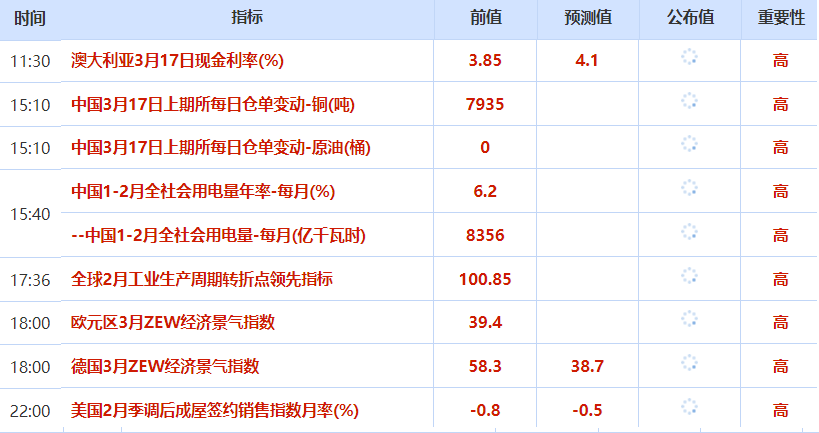
On Tuesday (March 17, Beijing time) in early Asian trading, spot gold was trading around $5,005.87 per ounce. Gold prices fell slightly on Monday as concerns that the ongoing conflict in the Middle East could push up inflation, leading to higher interest rates for an extended period, outweighed support from a weaker dollar. US crude oil was trading around $95.25 per barrel. Oil prices fell on Monday as some ships passed through the crucial Strait of Hormuz, temporarily easing extreme market concerns about supply disruptions, while also being affected by sell-offs ahead of the expiration of near-month contracts.

U.S. stocks closed sharply higher on Monday, with the S&P 500 rising 1.01%, its biggest one-day gain in over a month, the Nasdaq up 1.22%, and the Dow Jones Industrial Average up 0.83%, driven by a strong rebound in artificial intelligence (AI) stocks.
Meta Platforms shares surged 2.3% after the company announced plans to lay off at least 20% of its workforce to optimize AI investment costs, Nvidia shares rose 1.6% after announcing new components at its annual developer conference, and Tesla shares also gained 1.1% as its AI chip project is about to launch.
Meanwhile, geopolitical tensions showed signs of easing, with the United States stating that it had no objection to some ships passing through the Strait of Hormuz, leading to a slight decline in crude oil prices. This further boosted market sentiment and eased concerns about inflation, benefiting sectors such as tourism.
Despite strong market performance, investors have turned their attention to the upcoming Federal Reserve policy meeting, where interest rates are widely expected to remain unchanged. However, factors such as energy price volatility and the approaching end of Fed Chair Jerome Powell's term have added uncertainty to the future policy path.
Gold prices edged lower on Monday, mainly as concerns that ongoing Middle East conflict could push up inflation and keep interest rates high for an extended period outweighed support from a weaker dollar.
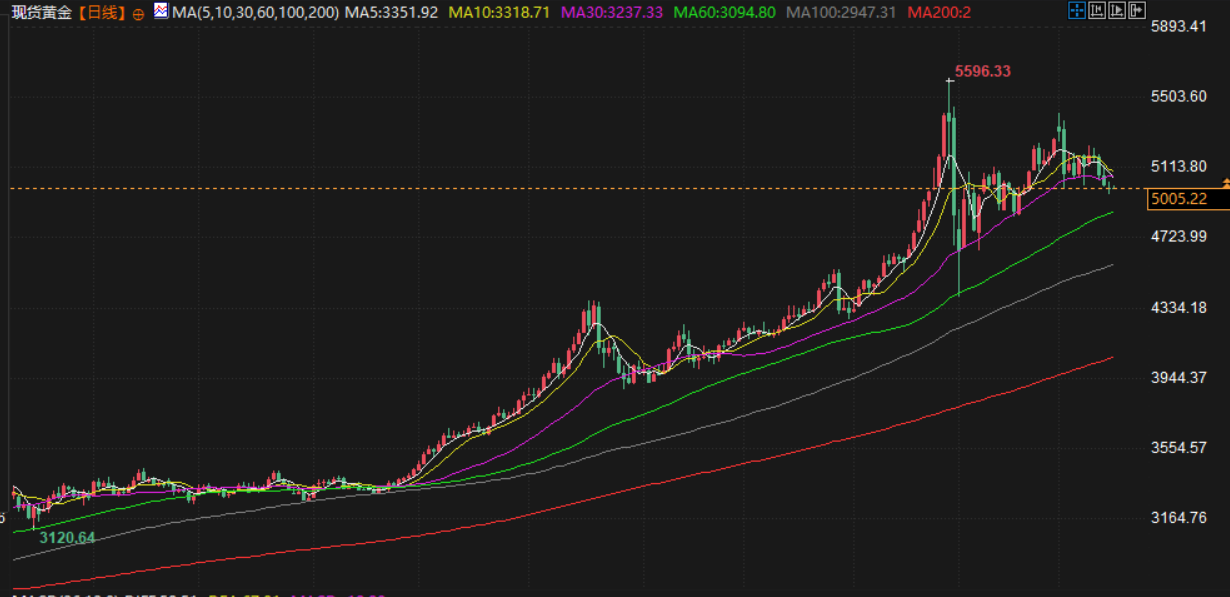
Despite the dollar index retreating from a 10-month high, making dollar-denominated gold more attractive to overseas buyers, Bob Haberkorn, senior market strategist at RJO Futures, pointed out that rising oil prices will push up inflation, thereby weakening central banks' willingness to cut interest rates, which is bearish for gold, a non-interest-bearing asset. Spot gold fell 0.5% to $4,993.42 per ounce, hitting its lowest point since February 19 during the session. However, analysts remain optimistic about the long-term outlook for gold, believing that there is still a large amount of capital on the sidelines and expecting gold prices to reach $6,000.
This week, market focus will shift to the Federal Reserve policy meeting and Chairman Powell's speech, with interest rates widely expected to remain unchanged. In other precious metals, silver was flat, while platinum and palladium rose by nearly 4% and 3.1%, respectively.
Oil prices fell about 3% on Monday, mainly as some ships passed through the crucial Strait of Hormuz, temporarily easing extreme market concerns about supply disruptions, while US allies rejected calls for assistance in clearing the strait. Brent crude futures fell nearly 3% to settle at $100.21 a barrel, while US crude fell even more, by 5.3% to settle at $93.50 a barrel, primarily influenced by near-record US crude production, the impending release of strategic petroleum reserves, and selling ahead of the expiration of near-month contracts.
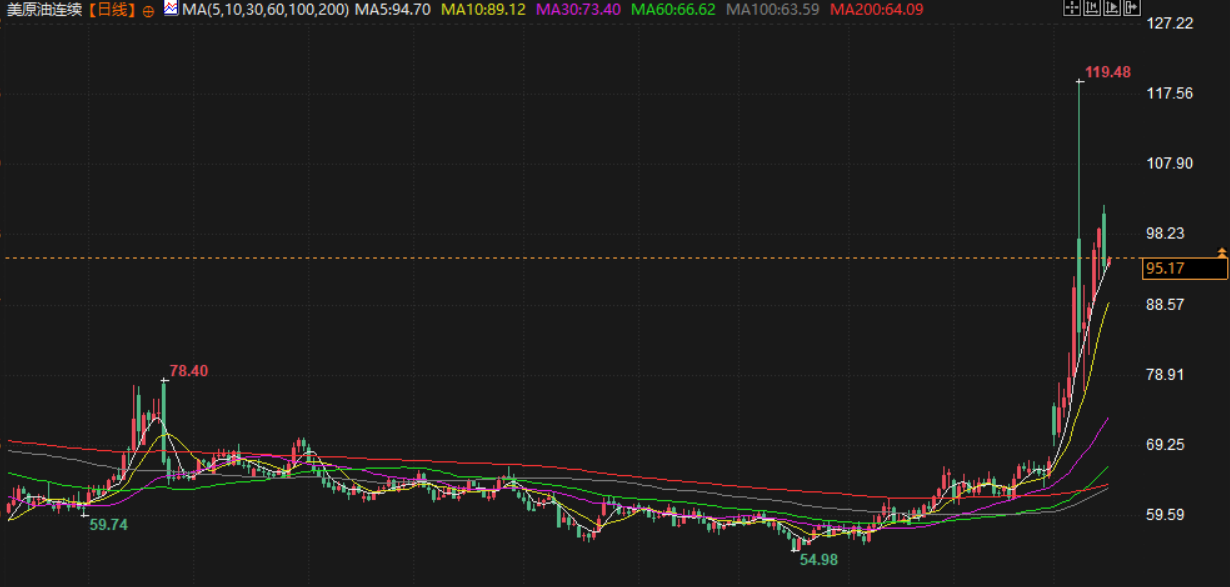
Previously, due to escalating geopolitical conflicts, the prices of the two major oil benchmarks had risen by nearly 40% since the end of February. Despite Trump's call for international assistance in clearing the strait, the EU has made it clear that it currently has no intention of expanding its military presence in the region.
Meanwhile, the US and Iran resumed their first known direct communication since the start of the war, with the US Treasury Secretary stating "no objection" to some ships passing through the Strait and that measures to ease prices would depend on the duration of the conflict. Furthermore, the International Energy Agency (IEA) indicated it might release more oil reserves as needed to curb oil price increases triggered by the Iran war.
The dollar index retreated slightly from a 10-month high on Monday, mainly as some ships passing through the Strait of Hormuz temporarily eased concerns about extreme supply, while traders began to question whether the hawkish expectations based on oil price shocks pushing up inflation were valid. However, the dollar index still hovered near its recent highs.
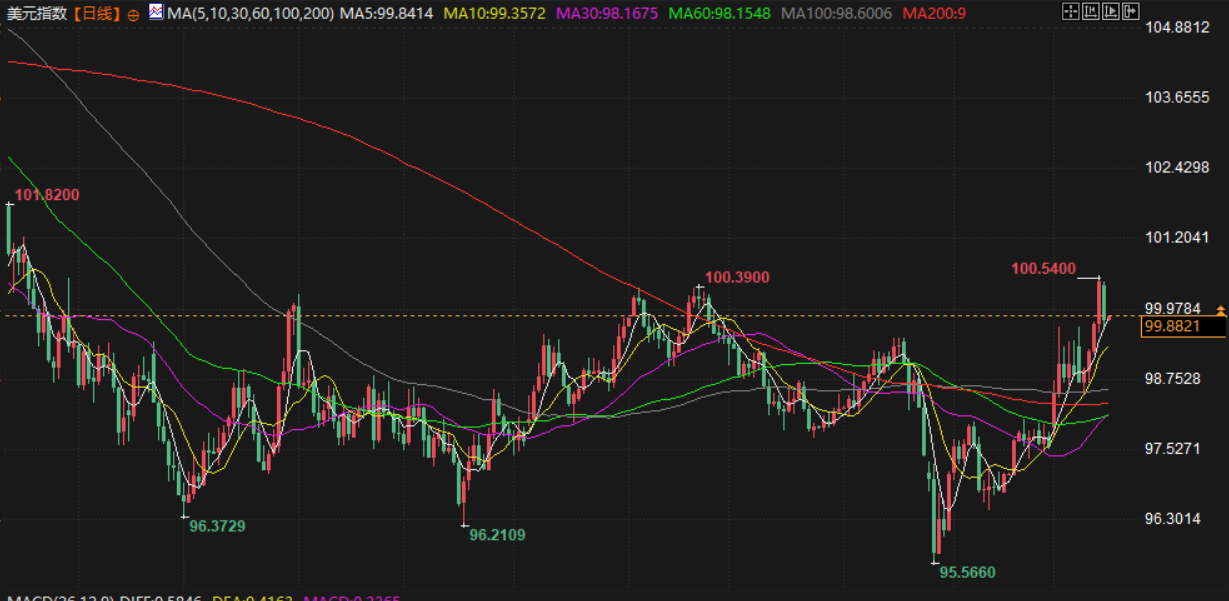
Market focus is shifting to a series of central bank meetings this week, including those of the Federal Reserve, the European Central Bank, the Bank of England, and the Bank of Japan. The Fed is widely expected to keep interest rates unchanged, while the Reserve Bank of Australia is likely to raise rates. The euro and pound have both rebounded from multi-month lows, rising 0.92% and 0.84% respectively, recovering some lost ground.
The yen continued to be under pressure, hovering in the intervention-sensitive zone around 158.97 against the dollar, as Japan’s energy reliance on Middle Eastern imports and the war cast uncertainty on its central bank’s policy outlook; the Australian dollar rose 1.4% to US$0.7077, driven by hawkish domestic expectations of interest rate hikes.
Analysts believe that while geopolitical uncertainty has provided support for the dollar, this week's Federal Reserve meeting is unlikely to be a key turning point for the dollar, and the market will closely watch Powell's comments on inflation and growth risks.
The probability of the Federal Reserve keeping interest rates unchanged this week is 99.1%.
According to CME's "FedWatch": the probability of the Federal Reserve cutting interest rates by 25 basis points this week is 0.9%, while the probability of keeping rates unchanged is 99.1%. The probability of a cumulative 25 basis point rate cut by the Fed by April is 3%, while the probability of keeping rates unchanged is 97%. The probability of a cumulative 25 basis point rate cut by June is 21.9%.
Iranian Armed Forces: If facilities on Kharg Island are attacked, a decisive and forceful response will be taken.
Iranian Armed Forces spokesman Shekarchi stated on the 17th local time that US officials and military commanders have recently made repeated threats of attack and aggression against Kharg Island. On behalf of the Iranian Armed Forces and the Iranian people, Shekarchi warned that if the US launches any aggression or attack on Kharg Island and its oil facilities and hubs, Iran's response will be decisive and forceful. Shekarchi stated that in such a scenario, the oil and gas facilities of all countries that launch attacks against Kharg Island will become targets of the Iranian Armed Forces and will be subjected to strong strikes. (CCTV News)
Five countries, including Germany, France, and the UK, called for de-escalation of the situation in Lebanon and Israel and urged the avoidance of a large-scale ground offensive.
On March 16 local time, the German government issued a statement saying that the leaders of Germany, France, the United Kingdom, Italy, and Canada issued a joint statement on the situation in Lebanon, calling for de-escalation of the escalating conflict between Israel and Hezbollah and promoting a political solution to the crisis. The statement expressed deep concern about the continued deterioration of the situation in Lebanon, calling on Israel and Lebanon to engage in meaningful contact to reach a sustainable political solution, and urging all parties to take immediate measures to de-escalate tensions. The statement warned that a large-scale Israeli ground offensive in Lebanon could have serious humanitarian consequences and lead to a protracted conflict. The statement called on all parties to fully implement UN Security Council Resolution 1701 and support the Lebanese government's efforts to disarm Hezbollah, ban Hezbollah's military activities, and curb its armed hostilities. (CCTV News)
Iranian Parliament Speaker Says Ceasefire Cannot Give Enemies a Breath of Breath
On March 16 local time, Iranian Parliament Speaker Mohammad Ghalibaf stated in an interview that a ceasefire is only reasonable if it is predicated on a cessation of hostilities. Ghalibaf said, "A ceasefire cannot simply create opportunities for the enemy to solve their own problems, such as the destruction of their radar or the shortage of interceptor missiles, and then launch another attack against us." Ghalibaf added, "We will continue to fight—we will not accept a ceasefire until the enemy truly regrets their actions and suitable political and security conditions are established globally and regionally." Ghalibaf also stated that Iran is prepared for a protracted war. He believes that no one now believes the US's claims of "destroying Iran's offensive capabilities." Iran possesses ample stockpiles of missiles and drones, and due to its mastery of independent technology, it can produce them with far greater efficiency and at significantly lower costs than its adversaries. (CCTV International News)
Li Chenggang: China and the US have reached preliminary consensus on some issues.
From March 15 to 16 local time, China and the United States held trade consultations in Paris, France. Li Chenggang, China's Vice Minister of Commerce and International Trade Representative, stated that over the past day and a half, the two teams conducted frank, in-depth, and constructive consultations, reaching preliminary consensus on some issues. The two sides will continue the consultation process. Li Chenggang stated that the topics discussed included bilateral tariff levels under the new circumstances, and possible further extensions of arrangements related to bilateral tariffs and related non-tariff measures. The US side introduced its latest adjustments to tariff measures and its next steps, and China expressed concern about the resulting uncertainty. Both sides agreed to work together to maintain the stability of bilateral trade and economic relations and discussed the idea of establishing a working mechanism to promote bilateral trade and investment cooperation. Regarding the US's restrictive measures on Chinese trade and investment, especially the recent initiation of two Section 301 investigations involving China, Li Chenggang said that China made serious representations and expressed its grave concerns during the consultations. "We oppose such unilateral investigations. We are concerned about the potential disruption and damage that the possible outcomes of these investigations could cause to the hard-won stable economic and trade relations between China and the United States," said Li Chenggang. He added that China is closely monitoring the follow-up developments of these investigations and will take appropriate measures to safeguard China's legitimate rights and interests in due course. "We hope that the US will honor its commitments, meet China halfway, and jointly promote the steady and long-term development of bilateral economic and trade relations between China and the United States," Li Chenggang said. He further noted that during this consultation, China and the United States further recognized that a stable economic and trade relationship benefits both China and the United States, as well as the world. (Xinhua)
Japan considers importing Ukrainian drones.
The Japanese House of Councillors began deliberating on the 2026 budget today (March 16), with the defense budget exceeding 9 trillion yen for the first time, setting a new record. According to Kyodo News, the Japanese government has begun exploring the introduction of Ukrainian-made drones into the Self-Defense Forces to strengthen its defense system; simultaneously, it is considering expanding information sharing with the US military and promoting joint missile production. (CCTV International News)
Sources familiar with the matter say the U.S. military's operational plans for a conflict with Iran already include an "exit option."
On March 16 local time, multiple sources revealed that the US military, in formulating operational plans for a conflict with Iran, has prepared several "exit options" for President Trump, allowing him to end the conflict if necessary. It is understood that with the continued escalation of the situation in the Middle East and Iran's continued control of the crucial Strait of Hormuz, the timeline and conditions for ending the war remain highly uncertain. Some government advisors advocate for an exit strategy, fearing that war would trigger global economic instability; others believe the opportunity should be used to weaken Iran's influence in the region. Sources indicated that these "exit routes" have been incorporated into daily war plans. (CCTV News)
The number of pilot cities for the special action to facilitate cross-border trade will increase to 45 in 2026.
High-quality development of foreign trade cannot be achieved without the continuous improvement of trade facilitation. In response to the latest changes in the international trade environment, the General Administration of Customs, together with 24 departments (units) including the Cyberspace Administration of China, the Ministry of Foreign Affairs, the National Development and Reform Commission, the Ministry of Industry and Information Technology, the Ministry of Transport, and the Ministry of Commerce, jointly launched a six-month special action to facilitate cross-border trade in 2026 on the 16th. Sun Meijun, Director of the General Administration of Customs, stated at the deployment meeting for the 2026 special action on facilitating cross-border trade held that day that compared to last year, the pilot cities for this year's special action have been further expanded, with 20 new cities added, including Hohhot, Changchun, Suzhou, Jinhua, Quanzhou, Nanchang, Yantai, Wuhan, Changsha, Zhuhai, Nanning, Kunming, and Xi'an, bringing the total number of participating cities to 45. (Xinhua News Agency)
Key Focus Today
stock market
U.S. stocks closed sharply higher on Monday, with the S&P 500 rising 1.01%, its biggest one-day gain in over a month, the Nasdaq up 1.22%, and the Dow Jones Industrial Average up 0.83%, driven by a strong rebound in artificial intelligence (AI) stocks.
Meta Platforms shares surged 2.3% after the company announced plans to lay off at least 20% of its workforce to optimize AI investment costs, Nvidia shares rose 1.6% after announcing new components at its annual developer conference, and Tesla shares also gained 1.1% as its AI chip project is about to launch.
Meanwhile, geopolitical tensions showed signs of easing, with the United States stating that it had no objection to some ships passing through the Strait of Hormuz, leading to a slight decline in crude oil prices. This further boosted market sentiment and eased concerns about inflation, benefiting sectors such as tourism.
Despite strong market performance, investors have turned their attention to the upcoming Federal Reserve policy meeting, where interest rates are widely expected to remain unchanged. However, factors such as energy price volatility and the approaching end of Fed Chair Jerome Powell's term have added uncertainty to the future policy path.
Gold Market
Gold prices edged lower on Monday, mainly as concerns that ongoing Middle East conflict could push up inflation and keep interest rates high for an extended period outweighed support from a weaker dollar.
Despite the dollar index retreating from a 10-month high, making dollar-denominated gold more attractive to overseas buyers, Bob Haberkorn, senior market strategist at RJO Futures, pointed out that rising oil prices will push up inflation, thereby weakening central banks' willingness to cut interest rates, which is bearish for gold, a non-interest-bearing asset. Spot gold fell 0.5% to $4,993.42 per ounce, hitting its lowest point since February 19 during the session. However, analysts remain optimistic about the long-term outlook for gold, believing that there is still a large amount of capital on the sidelines and expecting gold prices to reach $6,000.
This week, market focus will shift to the Federal Reserve policy meeting and Chairman Powell's speech, with interest rates widely expected to remain unchanged. In other precious metals, silver was flat, while platinum and palladium rose by nearly 4% and 3.1%, respectively.
oil market
Oil prices fell about 3% on Monday, mainly as some ships passed through the crucial Strait of Hormuz, temporarily easing extreme market concerns about supply disruptions, while US allies rejected calls for assistance in clearing the strait. Brent crude futures fell nearly 3% to settle at $100.21 a barrel, while US crude fell even more, by 5.3% to settle at $93.50 a barrel, primarily influenced by near-record US crude production, the impending release of strategic petroleum reserves, and selling ahead of the expiration of near-month contracts.
Previously, due to escalating geopolitical conflicts, the prices of the two major oil benchmarks had risen by nearly 40% since the end of February. Despite Trump's call for international assistance in clearing the strait, the EU has made it clear that it currently has no intention of expanding its military presence in the region.
Meanwhile, the US and Iran resumed their first known direct communication since the start of the war, with the US Treasury Secretary stating "no objection" to some ships passing through the Strait and that measures to ease prices would depend on the duration of the conflict. Furthermore, the International Energy Agency (IEA) indicated it might release more oil reserves as needed to curb oil price increases triggered by the Iran war.
Foreign exchange market
The dollar index retreated slightly from a 10-month high on Monday, mainly as some ships passing through the Strait of Hormuz temporarily eased concerns about extreme supply, while traders began to question whether the hawkish expectations based on oil price shocks pushing up inflation were valid. However, the dollar index still hovered near its recent highs.
Market focus is shifting to a series of central bank meetings this week, including those of the Federal Reserve, the European Central Bank, the Bank of England, and the Bank of Japan. The Fed is widely expected to keep interest rates unchanged, while the Reserve Bank of Australia is likely to raise rates. The euro and pound have both rebounded from multi-month lows, rising 0.92% and 0.84% respectively, recovering some lost ground.
The yen continued to be under pressure, hovering in the intervention-sensitive zone around 158.97 against the dollar, as Japan’s energy reliance on Middle Eastern imports and the war cast uncertainty on its central bank’s policy outlook; the Australian dollar rose 1.4% to US$0.7077, driven by hawkish domestic expectations of interest rate hikes.
Analysts believe that while geopolitical uncertainty has provided support for the dollar, this week's Federal Reserve meeting is unlikely to be a key turning point for the dollar, and the market will closely watch Powell's comments on inflation and growth risks.
International News
The probability of the Federal Reserve keeping interest rates unchanged this week is 99.1%.
According to CME's "FedWatch": the probability of the Federal Reserve cutting interest rates by 25 basis points this week is 0.9%, while the probability of keeping rates unchanged is 99.1%. The probability of a cumulative 25 basis point rate cut by the Fed by April is 3%, while the probability of keeping rates unchanged is 97%. The probability of a cumulative 25 basis point rate cut by June is 21.9%.
Iranian Armed Forces: If facilities on Kharg Island are attacked, a decisive and forceful response will be taken.
Iranian Armed Forces spokesman Shekarchi stated on the 17th local time that US officials and military commanders have recently made repeated threats of attack and aggression against Kharg Island. On behalf of the Iranian Armed Forces and the Iranian people, Shekarchi warned that if the US launches any aggression or attack on Kharg Island and its oil facilities and hubs, Iran's response will be decisive and forceful. Shekarchi stated that in such a scenario, the oil and gas facilities of all countries that launch attacks against Kharg Island will become targets of the Iranian Armed Forces and will be subjected to strong strikes. (CCTV News)
Five countries, including Germany, France, and the UK, called for de-escalation of the situation in Lebanon and Israel and urged the avoidance of a large-scale ground offensive.
On March 16 local time, the German government issued a statement saying that the leaders of Germany, France, the United Kingdom, Italy, and Canada issued a joint statement on the situation in Lebanon, calling for de-escalation of the escalating conflict between Israel and Hezbollah and promoting a political solution to the crisis. The statement expressed deep concern about the continued deterioration of the situation in Lebanon, calling on Israel and Lebanon to engage in meaningful contact to reach a sustainable political solution, and urging all parties to take immediate measures to de-escalate tensions. The statement warned that a large-scale Israeli ground offensive in Lebanon could have serious humanitarian consequences and lead to a protracted conflict. The statement called on all parties to fully implement UN Security Council Resolution 1701 and support the Lebanese government's efforts to disarm Hezbollah, ban Hezbollah's military activities, and curb its armed hostilities. (CCTV News)
Iranian Parliament Speaker Says Ceasefire Cannot Give Enemies a Breath of Breath
On March 16 local time, Iranian Parliament Speaker Mohammad Ghalibaf stated in an interview that a ceasefire is only reasonable if it is predicated on a cessation of hostilities. Ghalibaf said, "A ceasefire cannot simply create opportunities for the enemy to solve their own problems, such as the destruction of their radar or the shortage of interceptor missiles, and then launch another attack against us." Ghalibaf added, "We will continue to fight—we will not accept a ceasefire until the enemy truly regrets their actions and suitable political and security conditions are established globally and regionally." Ghalibaf also stated that Iran is prepared for a protracted war. He believes that no one now believes the US's claims of "destroying Iran's offensive capabilities." Iran possesses ample stockpiles of missiles and drones, and due to its mastery of independent technology, it can produce them with far greater efficiency and at significantly lower costs than its adversaries. (CCTV International News)
Li Chenggang: China and the US have reached preliminary consensus on some issues.
From March 15 to 16 local time, China and the United States held trade consultations in Paris, France. Li Chenggang, China's Vice Minister of Commerce and International Trade Representative, stated that over the past day and a half, the two teams conducted frank, in-depth, and constructive consultations, reaching preliminary consensus on some issues. The two sides will continue the consultation process. Li Chenggang stated that the topics discussed included bilateral tariff levels under the new circumstances, and possible further extensions of arrangements related to bilateral tariffs and related non-tariff measures. The US side introduced its latest adjustments to tariff measures and its next steps, and China expressed concern about the resulting uncertainty. Both sides agreed to work together to maintain the stability of bilateral trade and economic relations and discussed the idea of establishing a working mechanism to promote bilateral trade and investment cooperation. Regarding the US's restrictive measures on Chinese trade and investment, especially the recent initiation of two Section 301 investigations involving China, Li Chenggang said that China made serious representations and expressed its grave concerns during the consultations. "We oppose such unilateral investigations. We are concerned about the potential disruption and damage that the possible outcomes of these investigations could cause to the hard-won stable economic and trade relations between China and the United States," said Li Chenggang. He added that China is closely monitoring the follow-up developments of these investigations and will take appropriate measures to safeguard China's legitimate rights and interests in due course. "We hope that the US will honor its commitments, meet China halfway, and jointly promote the steady and long-term development of bilateral economic and trade relations between China and the United States," Li Chenggang said. He further noted that during this consultation, China and the United States further recognized that a stable economic and trade relationship benefits both China and the United States, as well as the world. (Xinhua)
Japan considers importing Ukrainian drones.
The Japanese House of Councillors began deliberating on the 2026 budget today (March 16), with the defense budget exceeding 9 trillion yen for the first time, setting a new record. According to Kyodo News, the Japanese government has begun exploring the introduction of Ukrainian-made drones into the Self-Defense Forces to strengthen its defense system; simultaneously, it is considering expanding information sharing with the US military and promoting joint missile production. (CCTV International News)
Sources familiar with the matter say the U.S. military's operational plans for a conflict with Iran already include an "exit option."
On March 16 local time, multiple sources revealed that the US military, in formulating operational plans for a conflict with Iran, has prepared several "exit options" for President Trump, allowing him to end the conflict if necessary. It is understood that with the continued escalation of the situation in the Middle East and Iran's continued control of the crucial Strait of Hormuz, the timeline and conditions for ending the war remain highly uncertain. Some government advisors advocate for an exit strategy, fearing that war would trigger global economic instability; others believe the opportunity should be used to weaken Iran's influence in the region. Sources indicated that these "exit routes" have been incorporated into daily war plans. (CCTV News)
Domestic News
The number of pilot cities for the special action to facilitate cross-border trade will increase to 45 in 2026.
High-quality development of foreign trade cannot be achieved without the continuous improvement of trade facilitation. In response to the latest changes in the international trade environment, the General Administration of Customs, together with 24 departments (units) including the Cyberspace Administration of China, the Ministry of Foreign Affairs, the National Development and Reform Commission, the Ministry of Industry and Information Technology, the Ministry of Transport, and the Ministry of Commerce, jointly launched a six-month special action to facilitate cross-border trade in 2026 on the 16th. Sun Meijun, Director of the General Administration of Customs, stated at the deployment meeting for the 2026 special action on facilitating cross-border trade held that day that compared to last year, the pilot cities for this year's special action have been further expanded, with 20 new cities added, including Hohhot, Changchun, Suzhou, Jinhua, Quanzhou, Nanchang, Yantai, Wuhan, Changsha, Zhuhai, Nanning, Kunming, and Xi'an, bringing the total number of participating cities to 45. (Xinhua News Agency)
- Risk Warning and Disclaimer
- The market involves risk, and trading may not be suitable for all investors. This article is for reference only and does not constitute personal investment advice, nor does it take into account certain users’ specific investment objectives, financial situation, or other needs. Any investment decisions made based on this information are at your own risk.