The Middle East conflict has increased demand for the US dollar as a safe haven, putting pressure on gold prices. Experts say the traditional correlation between gold prices and the US dollar has broken down.
2026-03-17 10:38:15
Amid escalating conflicts between the US and Israel in the Middle East, soaring energy prices, and rising inflation expectations, the gold market faces another test. Gold prices are struggling to maintain support around $5,000 per ounce in the short term, as the market grapples with the potential impact of US and Israeli military actions on the global liquidity crisis and the threat of inflation.
The strengthening of the US dollar as a safe-haven asset has put significant downward pressure on gold. However, Robert Minter, Director of Strategy at Abrdn ETF , points out that investors should no longer value gold solely based on its relationship with the dollar. He believes that the traditional correlation between gold and the dollar has completely broken down since 2022, and future price movements will be driven more by global structural forces and continued central bank gold purchases.
Currently, the Federal Reserve's policy stance remains the main headwind for gold. Inflation remains high, and even with weakening economic growth momentum, the Fed is unlikely to cut interest rates significantly. The prolonged period of high interest rates supports a rising dollar and bond yields, which traditionally puts significant pressure on gold, a non-interest-bearing asset. The US-Israel war in Iran has further exacerbated rising consumer prices, making the Fed more cautious about its easing path.

This dynamic directly explains the recent consolidation in gold prices. Investors who had anticipated a shift towards looser monetary policy are now being forced to adjust their expectations. In the short term, high interest rates increase the opportunity cost of holding gold, limiting upside potential.
Robert Minter emphasizes that the continued expansion of global central bank balance sheets is the most consistent factor in gold's long-term performance. He states, "Look at the extent to which the purchasing power of major currencies has been diluted, and look at the size of central bank balance sheets, which have grown by about 1,000% since 1999, and it's no surprise that gold has performed so well."
He added that this dynamic is becoming increasingly apparent in daily life for many investors: rising living costs are eroding purchasing power. Financial advisors are receiving more and more inquiries from clients about how to protect their portfolios from continued currency devaluation. Robert Minter stated, "Advisors are hearing complaints from clients about the erosion of purchasing power in their daily lives. They are looking for an asset to put into their portfolios to offset this loss, and clearly commodities, especially gold, can play this role."
He further pointed out that the broader macroeconomic backdrop also supports continued growth in gold demand, as governments have little willingness or ability to significantly reduce rising sovereign debt levels. He believes that for substantial downward pressure on gold to be exerted, major fiat currency countries would need to drastically reduce their sovereign debt, a scenario highly unlikely under the current political and economic environment. He added, "There are currently no implemented solutions that can reduce sovereign debt in most major fiat currency countries."
From a technical perspective, gold prices continue to reflect a strong bullish trend, with prices consistently holding above the 50-day moving average , an indicator widely used by institutional investors. Robert Minter stated, "By any objective standard, you're still in a bull market."
He believes that geopolitical tensions and ongoing conflicts will only reinforce current trends, with official central bank demand providing long-term support for gold . Although central bank gold purchases slightly decreased to 863 tons last year (compared to over 1,000 tons annually for the previous three years), the average gold price rose by about 44% compared to the previous year, meaning that governments have actually invested significantly more to maintain their gold purchase pace. He added, "This makes it difficult to say that central bank demand has weakened; they clearly invested heavily last year to achieve their gold accumulation goals."
The abrdn ETF currently maintains its 12-month gold price target of approximately $5,500 per ounce , a target that Robert Minter considers relatively conservative given the increasing macroeconomic risks facing global markets.
Despite the strong rise in gold prices over the past few years, many investors remain hesitant to enter the market. Robert Minter stated, "It may take another surge in gold prices to attract those investors who are still on the sidelines."
Overall, the current short-term pressure on gold is mainly due to the rebound in demand for the US dollar as a safe haven and the high-interest-rate environment, but the traditional correlation between gold prices and the US dollar no longer dominates the trend.
Central bank gold purchases, the sovereign debt crisis, geopolitical uncertainties, and currency devaluation pressures are structural forces providing solid support for a long-term bull market in gold. While short-term volatility and investor frustration may dominate the present, the long-term upward trend remains unchanged.
Robert Minter's analysis reminds market participants that gold is no longer simply an anti-dollar tool, but a strategic asset for combating systemic risks in the global financial system. Against the backdrop of sticky inflation and protracted geopolitical conflicts, gold is expected to regain its strength in the coming months and may even challenge higher prices.
Investors should examine allocation opportunities from a long-term perspective, and short-term pullbacks may present better opportunities to buy on dips.
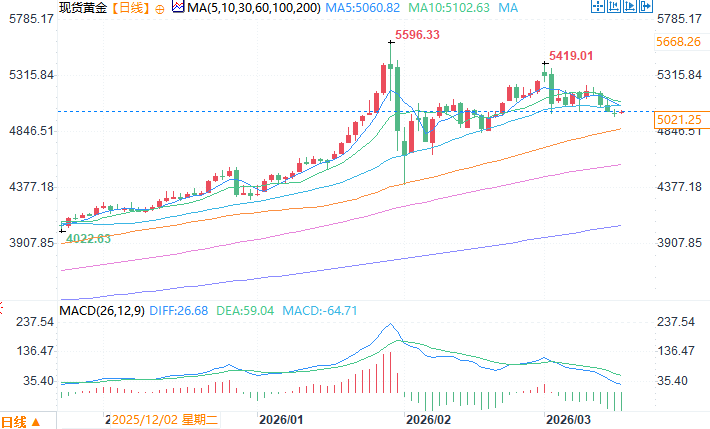
Spot gold daily chart source: EasyForex
At 10:38 AM Beijing time on March 17, spot gold was trading at $5023.25 per ounce.
The strengthening of the US dollar as a safe-haven asset has put significant downward pressure on gold. However, Robert Minter, Director of Strategy at Abrdn ETF , points out that investors should no longer value gold solely based on its relationship with the dollar. He believes that the traditional correlation between gold and the dollar has completely broken down since 2022, and future price movements will be driven more by global structural forces and continued central bank gold purchases.
Short-term headwinds: High interest rates and a strong dollar are suppressing gold prices.
Currently, the Federal Reserve's policy stance remains the main headwind for gold. Inflation remains high, and even with weakening economic growth momentum, the Fed is unlikely to cut interest rates significantly. The prolonged period of high interest rates supports a rising dollar and bond yields, which traditionally puts significant pressure on gold, a non-interest-bearing asset. The US-Israel war in Iran has further exacerbated rising consumer prices, making the Fed more cautious about its easing path.
This dynamic directly explains the recent consolidation in gold prices. Investors who had anticipated a shift towards looser monetary policy are now being forced to adjust their expectations. In the short term, high interest rates increase the opportunity cost of holding gold, limiting upside potential.
Long-term logic reinforced: Central bank gold purchases and sovereign debt crisis become core support.
Robert Minter emphasizes that the continued expansion of global central bank balance sheets is the most consistent factor in gold's long-term performance. He states, "Look at the extent to which the purchasing power of major currencies has been diluted, and look at the size of central bank balance sheets, which have grown by about 1,000% since 1999, and it's no surprise that gold has performed so well."
He added that this dynamic is becoming increasingly apparent in daily life for many investors: rising living costs are eroding purchasing power. Financial advisors are receiving more and more inquiries from clients about how to protect their portfolios from continued currency devaluation. Robert Minter stated, "Advisors are hearing complaints from clients about the erosion of purchasing power in their daily lives. They are looking for an asset to put into their portfolios to offset this loss, and clearly commodities, especially gold, can play this role."
He further pointed out that the broader macroeconomic backdrop also supports continued growth in gold demand, as governments have little willingness or ability to significantly reduce rising sovereign debt levels. He believes that for substantial downward pressure on gold to be exerted, major fiat currency countries would need to drastically reduce their sovereign debt, a scenario highly unlikely under the current political and economic environment. He added, "There are currently no implemented solutions that can reduce sovereign debt in most major fiat currency countries."
The technical uptrend remains intact; short-term fluctuations do not alter the long-term direction.
From a technical perspective, gold prices continue to reflect a strong bullish trend, with prices consistently holding above the 50-day moving average , an indicator widely used by institutional investors. Robert Minter stated, "By any objective standard, you're still in a bull market."
He believes that geopolitical tensions and ongoing conflicts will only reinforce current trends, with official central bank demand providing long-term support for gold . Although central bank gold purchases slightly decreased to 863 tons last year (compared to over 1,000 tons annually for the previous three years), the average gold price rose by about 44% compared to the previous year, meaning that governments have actually invested significantly more to maintain their gold purchase pace. He added, "This makes it difficult to say that central bank demand has weakened; they clearly invested heavily last year to achieve their gold accumulation goals."
The abrdn ETF currently maintains its 12-month gold price target of approximately $5,500 per ounce , a target that Robert Minter considers relatively conservative given the increasing macroeconomic risks facing global markets.
Investors are clearly hesitant, but further gains may attract off-market funds.
Despite the strong rise in gold prices over the past few years, many investors remain hesitant to enter the market. Robert Minter stated, "It may take another surge in gold prices to attract those investors who are still on the sidelines."
Overall, the current short-term pressure on gold is mainly due to the rebound in demand for the US dollar as a safe haven and the high-interest-rate environment, but the traditional correlation between gold prices and the US dollar no longer dominates the trend.
Central bank gold purchases, the sovereign debt crisis, geopolitical uncertainties, and currency devaluation pressures are structural forces providing solid support for a long-term bull market in gold. While short-term volatility and investor frustration may dominate the present, the long-term upward trend remains unchanged.
Robert Minter's analysis reminds market participants that gold is no longer simply an anti-dollar tool, but a strategic asset for combating systemic risks in the global financial system. Against the backdrop of sticky inflation and protracted geopolitical conflicts, gold is expected to regain its strength in the coming months and may even challenge higher prices.
Investors should examine allocation opportunities from a long-term perspective, and short-term pullbacks may present better opportunities to buy on dips.
Spot gold daily chart source: EasyForex
At 10:38 AM Beijing time on March 17, spot gold was trading at $5023.25 per ounce.
- Risk Warning and Disclaimer
- The market involves risk, and trading may not be suitable for all investors. This article is for reference only and does not constitute personal investment advice, nor does it take into account certain users’ specific investment objectives, financial situation, or other needs. Any investment decisions made based on this information are at your own risk.