"Don't give up halfway!" The Gulf states to the US: Without crippling Iran, there will be no peace in the Hormuz.
2026-03-17 14:40:30
The Gulf states are facing a complex strategic dilemma: while they have not actively called for the United States to go to war with Iran, they are now urging the United States not to give up halfway in the face of the reality that Iran has already attacked six Gulf states with missiles and drones and blocked the Strait of Hormuz, so as to thoroughly weaken Iran's offensive weapons capabilities and avoid facing the long-term threat from Tehran alone in the future.
Meanwhile, the United States is pressuring Gulf states to directly participate in the conflict to demonstrate regional unity. The Gulf states, in turn, have drawn a clear red line: if Iran dares to attack major oil facilities or desalination plants, Saudi Arabia may be forced to retaliate. At the heart of this game lies the Gulf states' desire to permanently lift Iran's "Hormuz blockade" capabilities through US intervention, while simultaneously fearing being drawn into an uncontrollable, full-scale war.
Rising energy risks have led to a continued influx of risk premiums into oil prices. On Tuesday (March 17), US crude oil prices fluctuated upwards during the Asian session, currently trading around $97.45 per barrel, with an intraday increase of approximately 4.2%.
Three Gulf sources revealed that the Gulf Arab states did not actively request the United States to go to war with Iran, but many countries are now urging Washington not to back down halfway, lest Iran retain any significant offensive weapons capabilities and continue to threaten the Gulf region's oil transport lifeline and the economies of the Gulf states that depend on it.
If Iran retains capabilities such as missiles, drones, and a network of proxies, any future escalation of tensions could be used to hijack the Strait of Hormuz and global energy supplies.
Iran has launched missile and drone attacks on airports, ports, oil facilities, and business centers in six Gulf states, severely disrupting shipping in the Strait of Hormuz. These attacks have heightened concerns in the Gulf states that unless Iran is significantly weakened, it will continue to exert pressure on the entire region.
The president of the Gulf Studies Center bluntly stated, "If the United States withdraws before its mission is complete, we will have to face Iran alone."
Meanwhile, Washington is pressuring Gulf states to join the war. Diplomatic sources revealed that Trump hopes to demonstrate regional support for the military operation to enhance its international legitimacy and garner domestic support in the United States.
But the Gulf states face a strategic dilemma: they must contend with the imminent threat of an Iranian attack while simultaneously weighing the greater risks of being drawn into a US-led war. They generally adopt a cautious and restrained approach: defending their sovereignty and drawing red lines, but avoiding full involvement in a war they neither initiated nor can control.
The Gulf states have clearly stated their red line: if Iran crosses it and directly attacks major oil facilities or desalination plants, Saudi Arabia may be forced to retaliate.
Experts point out that Iran has proven its ability to block the Strait of Hormuz, and this danger will persist for a long time if left unaddressed.
Saudi Arabia and other countries are unwilling to see Iran retain this "nuclear option"-like deterrent capability, and would rather support the US in completely weakening Iran than face repeated threats alone in the future.
Iran's ability to blockade Hormuz is considered the region's biggest long-term threat. Gulf states fear that even if the current conflict ends, Iran could restart its threat to energy lifelines at any time as long as it retains missiles, drones, and a network of proxies.
Thoroughly weakening Iran's offensive capabilities has become the core demand of the Gulf states, rather than simply ending the current war. They urge the United States not to "withdraw halfway," but to complete its strategic objectives and avoid endless future troubles.
The current US-Gulf rivalry is escalating: Trump is pressuring allies to join the war, while Gulf states are urging the US not to back down. The Gulf states are unwilling to face the long-term threat from Iran alone, but they also fear being drawn into a larger-scale war.
The consensus has been to thoroughly weaken Iran's offensive capabilities, but the path to achieving this is fraught with risks: if the US takes excessive action, it may trigger extreme retaliation from Iran; if it withdraws too early, the Gulf states will be under the shadow of coercion for a long time.
In the short term, the primary goals remain the resumption of air traffic through the Hormuz and de-escalation of the conflict, while in the medium to long term, thoroughly weakening Iran's capabilities will become the new focus of regional security.
While the Gulf states have not actively called for a US-led war against Iran, they are now urging Washington not to withdraw prematurely, lest Iran retain significant offensive weapons capabilities and continue to threaten the Strait of Hormuz and the region's energy lifeline. Iranian missiles and drones have already attacked airports, ports, oil facilities, and commercial centers in the six Gulf states, disrupting shipping through the strait.
The Gulf states face a strategic dilemma: they must address the imminent threat while fearing involvement in a US- and Israeli-led war. The red line is clear: if Iran attacks major oil facilities or desalination plants, Saudi Arabia may be forced to retaliate. The danger will persist long-term unless Iran's ability to blockade the Straits is eliminated.
The Gulf rivalry intensifies: Trump pressures for war, while Gulf states counter with demands for a complete weakening of Iran. Investors should be wary of the risks of a protracted conflict, volatile oil prices at high levels, ongoing energy supply disruptions, and escalating regional retaliation. They should also pay attention to the resumption of air traffic over the Strait of Hormuz and signals from US-Iran negotiations.
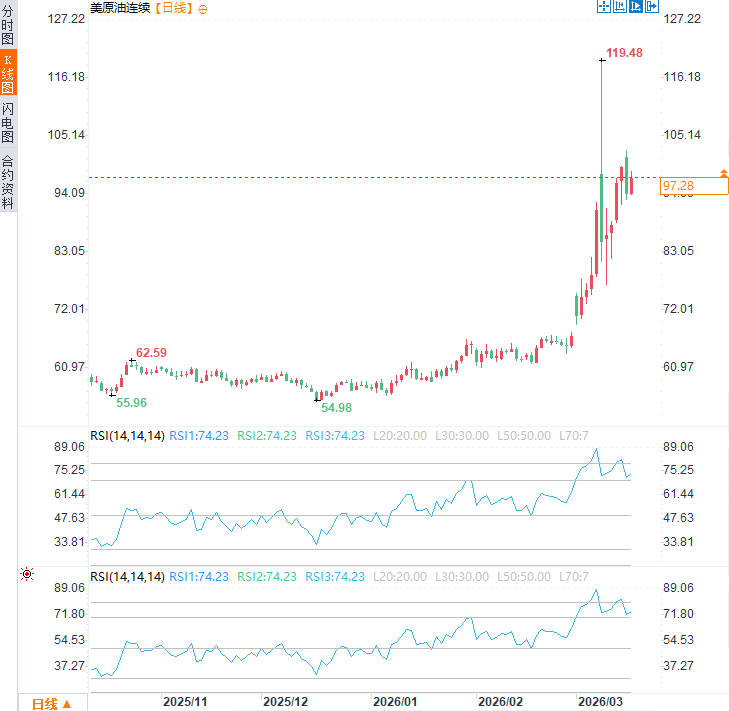
(US crude oil daily chart, source: FX678)
At 14:40 Beijing time, US crude oil futures were trading at $97.31 per barrel.
Meanwhile, the United States is pressuring Gulf states to directly participate in the conflict to demonstrate regional unity. The Gulf states, in turn, have drawn a clear red line: if Iran dares to attack major oil facilities or desalination plants, Saudi Arabia may be forced to retaliate. At the heart of this game lies the Gulf states' desire to permanently lift Iran's "Hormuz blockade" capabilities through US intervention, while simultaneously fearing being drawn into an uncontrollable, full-scale war.
Rising energy risks have led to a continued influx of risk premiums into oil prices. On Tuesday (March 17), US crude oil prices fluctuated upwards during the Asian session, currently trading around $97.45 per barrel, with an intraday increase of approximately 4.2%.
The Gulf states are not seeking war, but are concerned about the US withdrawal halfway through and are urging a complete weakening of Iran.
Three Gulf sources revealed that the Gulf Arab states did not actively request the United States to go to war with Iran, but many countries are now urging Washington not to back down halfway, lest Iran retain any significant offensive weapons capabilities and continue to threaten the Gulf region's oil transport lifeline and the economies of the Gulf states that depend on it.
If Iran retains capabilities such as missiles, drones, and a network of proxies, any future escalation of tensions could be used to hijack the Strait of Hormuz and global energy supplies.
Tehran's missile and drone attacks on six Gulf states disrupted shipping in the Hormuz region.
Iran has launched missile and drone attacks on airports, ports, oil facilities, and business centers in six Gulf states, severely disrupting shipping in the Strait of Hormuz. These attacks have heightened concerns in the Gulf states that unless Iran is significantly weakened, it will continue to exert pressure on the entire region.
The president of the Gulf Studies Center bluntly stated, "If the United States withdraws before its mission is complete, we will have to face Iran alone."
They must address the imminent threat while simultaneously fearing involvement in a US-led war.
Meanwhile, Washington is pressuring Gulf states to join the war. Diplomatic sources revealed that Trump hopes to demonstrate regional support for the military operation to enhance its international legitimacy and garner domestic support in the United States.
But the Gulf states face a strategic dilemma: they must contend with the imminent threat of an Iranian attack while simultaneously weighing the greater risks of being drawn into a US-led war. They generally adopt a cautious and restrained approach: defending their sovereignty and drawing red lines, but avoiding full involvement in a war they neither initiated nor can control.
If Iran crosses the red line and attacks oil facilities or desalination plants, Saudi Arabia may be forced to retaliate.
The Gulf states have clearly stated their red line: if Iran crosses it and directly attacks major oil facilities or desalination plants, Saudi Arabia may be forced to retaliate.
Experts point out that Iran has proven its ability to block the Strait of Hormuz, and this danger will persist for a long time if left unaddressed.
Saudi Arabia and other countries are unwilling to see Iran retain this "nuclear option"-like deterrent capability, and would rather support the US in completely weakening Iran than face repeated threats alone in the future.
The danger will persist long-term unless Iran's ability to blockade the Hormuz region is eliminated.
Iran's ability to blockade Hormuz is considered the region's biggest long-term threat. Gulf states fear that even if the current conflict ends, Iran could restart its threat to energy lifelines at any time as long as it retains missiles, drones, and a network of proxies.
Thoroughly weakening Iran's offensive capabilities has become the core demand of the Gulf states, rather than simply ending the current war. They urge the United States not to "withdraw halfway," but to complete its strategic objectives and avoid endless future troubles.
The escalating US-Gulf rivalry has made the complete weakening of Iran a core demand of the Gulf states.
The current US-Gulf rivalry is escalating: Trump is pressuring allies to join the war, while Gulf states are urging the US not to back down. The Gulf states are unwilling to face the long-term threat from Iran alone, but they also fear being drawn into a larger-scale war.
The consensus has been to thoroughly weaken Iran's offensive capabilities, but the path to achieving this is fraught with risks: if the US takes excessive action, it may trigger extreme retaliation from Iran; if it withdraws too early, the Gulf states will be under the shadow of coercion for a long time.
In the short term, the primary goals remain the resumption of air traffic through the Hormuz and de-escalation of the conflict, while in the medium to long term, thoroughly weakening Iran's capabilities will become the new focus of regional security.
Editor's Summary
While the Gulf states have not actively called for a US-led war against Iran, they are now urging Washington not to withdraw prematurely, lest Iran retain significant offensive weapons capabilities and continue to threaten the Strait of Hormuz and the region's energy lifeline. Iranian missiles and drones have already attacked airports, ports, oil facilities, and commercial centers in the six Gulf states, disrupting shipping through the strait.
The Gulf states face a strategic dilemma: they must address the imminent threat while fearing involvement in a US- and Israeli-led war. The red line is clear: if Iran attacks major oil facilities or desalination plants, Saudi Arabia may be forced to retaliate. The danger will persist long-term unless Iran's ability to blockade the Straits is eliminated.
The Gulf rivalry intensifies: Trump pressures for war, while Gulf states counter with demands for a complete weakening of Iran. Investors should be wary of the risks of a protracted conflict, volatile oil prices at high levels, ongoing energy supply disruptions, and escalating regional retaliation. They should also pay attention to the resumption of air traffic over the Strait of Hormuz and signals from US-Iran negotiations.
(US crude oil daily chart, source: FX678)
At 14:40 Beijing time, US crude oil futures were trading at $97.31 per barrel.
- Risk Warning and Disclaimer
- The market involves risk, and trading may not be suitable for all investors. This article is for reference only and does not constitute personal investment advice, nor does it take into account certain users’ specific investment objectives, financial situation, or other needs. Any investment decisions made based on this information are at your own risk.