Following the Bank of Japan's March meeting, Kazuo Ueda may have hinted at a 25 basis point rate hike in April. Hawkish rhetoric supports the yen, but data and geopolitical factors are needed to offset this.
2026-03-17 16:03:24
According to APP, Gregor Hirt, Global Chief Investment Officer for Multi-Assets at Allianz Global Investors, recently stated that Bank of Japan Governor Kazuo Ueda is likely to hint at a possible policy rate hike at the April meeting through forward guidance following the March monetary policy meeting. Hirt noted that market confidence in an April rate hike is steadily increasing given the continued weakness of the yen and Ueda's recent statements. However, geopolitical uncertainties and upcoming key economic data releases may lead the Bank of Japan to maintain some ambiguity in its policy guidance. Hirt believes Ueda's most likely strategy is to maintain the "live option" of an April rate hike, providing support for the yen through relatively hawkish rhetoric, while adding conditions such as "data-dependent" and "monitoring external shocks" to effectively hedge against potential risks.
The USD/JPY exchange rate has climbed to the 159.20-159.30 range, reaching a near two-year high, indicating extreme weakness in the yen. The Bank of Japan faces a typical stagflation environment that further complicates its decision-making: on the one hand, ongoing geopolitical conflicts in the Middle East continue to push up international oil prices (Brent crude is currently quoted at approximately $ 103.50 per barrel), significantly increasing energy import costs. Core CPI has stabilized in the 2.0% -2.2% range, posing a risk of inflation expectations becoming unanchored; on the other hand, economic growth momentum has slowed significantly, with real GDP growth in some quarters falling below 1% , putting pressure on both consumption and exports. Hilt emphasized that the Bank of Japan must find a balance between anchoring inflation expectations and avoiding a hard landing for the economy, and Kazuo Ueda's statements will be a key indicator.
Kazuo Ueda has recently repeatedly stated that "the impact of exchange rate movements on inflation and the economy cannot be ignored," and that "if necessary, monetary policy will not be adjusted without hesitation." Based on this, Hilt believes that after the March meeting, Ueda is likely to release hawkish signals, such as emphasizing "preparedness to adjust the degree of easing as appropriate" and "close monitoring of exchange rate and price dynamics," thereby boosting market expectations for an April rate hike. At the same time, to prevent the market from over-interpreting this as a hard commitment, he will likely repeatedly reiterate "high data dependence" and "flexible response to rising external uncertainties," thus preserving policy flexibility.
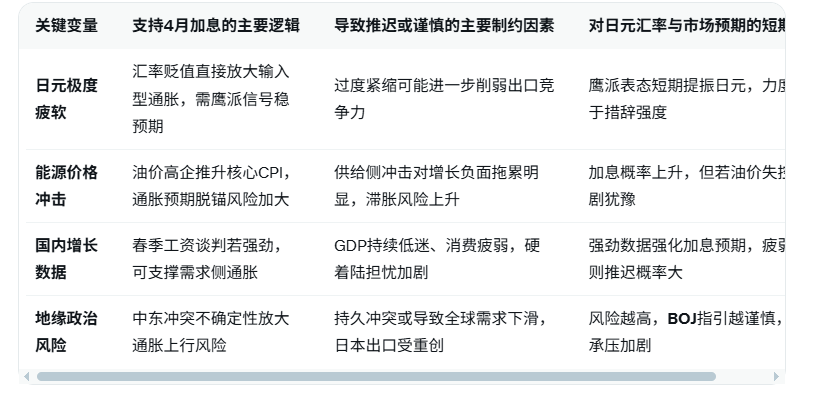
Overall, the policy rate is likely to remain unchanged at 0.50% at the March meeting, but Kazuo Ueda's press conference will be a key window for determining the probability of a rate hike in April. If the hawkish signals are clear and there are few reservations, the market's pricing in a 25 basis point rate hike in April could quickly rise to 70% -85% , and USD/JPY may experience a significant pullback. Conversely, if there is too much emphasis on external risks or data uncertainty, the market may postpone its rate hike expectations, putting further pressure on the yen. Investors should pay close attention to Ueda's direct comments on energy prices, inflation path, exchange rate trends, and economic growth, while also tracking the results of the spring wage negotiations and core CPI data to anticipate the Bank of Japan's true policy inclination in a stagflationary environment.
Editor's Summary:
Under the dual pressures of an extremely weak yen and stagflation, the Bank of Japan is likely to hint at a possible rate hike in April through hawkish forward guidance from Kazuo Ueda after its March meeting, in order to stabilize the exchange rate and inflation expectations. However, geopolitical risks and weak growth force the guidance to retain significant room for caution. Market pricing in the April action will heavily depend on the wording of the press conference and subsequent data confirmation.
Frequently Asked Questions
1. Why does Gregor Hilt believe that Kazuo Ueda will hint at an April rate hike after the March meeting?
Hilt points out that the yen has reached extreme weakness around 159.20 , with imported inflation pressures significantly amplified. Kazuo Ueda has recently emphasized the impact of exchange rates on prices, increasing market confidence in an April rate hike. To prevent inflation expectations from derailing and to support the yen, Ueda is likely to maintain the possibility of an April policy rate hike through hawkish forward guidance, while adding a "data-dependent" condition to avoid being over-interpreted by the market as a hard commitment.
2. What are the core contradictions that the current weak yen and stagflation environment pose to the Bank of Japan's policy decisions?
The weak yen has directly pushed up the cost of imported energy and raw materials, keeping core CPI stable at 2.0% -2.2% , and inflation expectations face upward risks, reinforcing the necessity of interest rate hikes. However, the same energy shock has dragged down economic growth through the supply chain and consumption, with GDP growth falling below 1% in some quarters, forming a typical stagflation pattern. The Bank of Japan needs to make a difficult trade-off between anchoring inflation and avoiding a hard landing; premature or overly aggressive tightening could exacerbate the economic downturn.
3. What is the most likely combination of statements from Kazuo Ueda?
Ueda is highly likely to keep the interest rate unchanged at 0.50% at the March meeting. However, if he releases hawkish signals, such as "being prepared to adjust the degree of easing as appropriate," "the exchange rate trend has a significant impact on inflation," and "closely monitoring price and exchange rate dynamics," while repeatedly emphasizing "high data dependence" and "flexible response to external uncertainties," he could provide short-term support for the yen while retaining policy flexibility to hedge against geopolitical risks and data volatility.
4. How do geopolitical risks affect the Bank of Japan's interest rate hike path?
The Middle East conflict pushed Brent crude oil prices to around $ 103.50 per barrel. As a net energy importer, Japan faces increased imported inflationary pressures, supporting short-term expectations of interest rate hikes. However, a prolonged conflict could lead to a decline in global demand, a severe blow to Japanese exports, and a significant increase in downside risks to growth. Hilt believes this will force Ueda to incorporate more cautious wording into his hawkish statements to avoid locking in action in April.
5. What are the potential impacts of this meeting on the yen exchange rate and market expectations?
If Ueda's hawkish signals are clear and there are few reservations, the market's pricing in a 25 basis point rate hike in April could quickly rise to 70% -85% , with USD/JPY retreating to the 155-157 range in the short term. However, if too much emphasis is placed on external risks and data uncertainty, the rate hike expectation will be delayed, and the yen may further test the 160 level. Investors should pay close attention to the wording of the press conference, the results of the spring wage negotiations, and subsequent CPI data to determine the actual pace and magnitude of the rate hike.
The USD/JPY exchange rate has climbed to the 159.20-159.30 range, reaching a near two-year high, indicating extreme weakness in the yen. The Bank of Japan faces a typical stagflation environment that further complicates its decision-making: on the one hand, ongoing geopolitical conflicts in the Middle East continue to push up international oil prices (Brent crude is currently quoted at approximately $ 103.50 per barrel), significantly increasing energy import costs. Core CPI has stabilized in the 2.0% -2.2% range, posing a risk of inflation expectations becoming unanchored; on the other hand, economic growth momentum has slowed significantly, with real GDP growth in some quarters falling below 1% , putting pressure on both consumption and exports. Hilt emphasized that the Bank of Japan must find a balance between anchoring inflation expectations and avoiding a hard landing for the economy, and Kazuo Ueda's statements will be a key indicator.
Kazuo Ueda has recently repeatedly stated that "the impact of exchange rate movements on inflation and the economy cannot be ignored," and that "if necessary, monetary policy will not be adjusted without hesitation." Based on this, Hilt believes that after the March meeting, Ueda is likely to release hawkish signals, such as emphasizing "preparedness to adjust the degree of easing as appropriate" and "close monitoring of exchange rate and price dynamics," thereby boosting market expectations for an April rate hike. At the same time, to prevent the market from over-interpreting this as a hard commitment, he will likely repeatedly reiterate "high data dependence" and "flexible response to rising external uncertainties," thus preserving policy flexibility.
Overall, the policy rate is likely to remain unchanged at 0.50% at the March meeting, but Kazuo Ueda's press conference will be a key window for determining the probability of a rate hike in April. If the hawkish signals are clear and there are few reservations, the market's pricing in a 25 basis point rate hike in April could quickly rise to 70% -85% , and USD/JPY may experience a significant pullback. Conversely, if there is too much emphasis on external risks or data uncertainty, the market may postpone its rate hike expectations, putting further pressure on the yen. Investors should pay close attention to Ueda's direct comments on energy prices, inflation path, exchange rate trends, and economic growth, while also tracking the results of the spring wage negotiations and core CPI data to anticipate the Bank of Japan's true policy inclination in a stagflationary environment.
Editor's Summary:
Under the dual pressures of an extremely weak yen and stagflation, the Bank of Japan is likely to hint at a possible rate hike in April through hawkish forward guidance from Kazuo Ueda after its March meeting, in order to stabilize the exchange rate and inflation expectations. However, geopolitical risks and weak growth force the guidance to retain significant room for caution. Market pricing in the April action will heavily depend on the wording of the press conference and subsequent data confirmation.
Frequently Asked Questions
1. Why does Gregor Hilt believe that Kazuo Ueda will hint at an April rate hike after the March meeting?
Hilt points out that the yen has reached extreme weakness around 159.20 , with imported inflation pressures significantly amplified. Kazuo Ueda has recently emphasized the impact of exchange rates on prices, increasing market confidence in an April rate hike. To prevent inflation expectations from derailing and to support the yen, Ueda is likely to maintain the possibility of an April policy rate hike through hawkish forward guidance, while adding a "data-dependent" condition to avoid being over-interpreted by the market as a hard commitment.
2. What are the core contradictions that the current weak yen and stagflation environment pose to the Bank of Japan's policy decisions?
The weak yen has directly pushed up the cost of imported energy and raw materials, keeping core CPI stable at 2.0% -2.2% , and inflation expectations face upward risks, reinforcing the necessity of interest rate hikes. However, the same energy shock has dragged down economic growth through the supply chain and consumption, with GDP growth falling below 1% in some quarters, forming a typical stagflation pattern. The Bank of Japan needs to make a difficult trade-off between anchoring inflation and avoiding a hard landing; premature or overly aggressive tightening could exacerbate the economic downturn.
3. What is the most likely combination of statements from Kazuo Ueda?
Ueda is highly likely to keep the interest rate unchanged at 0.50% at the March meeting. However, if he releases hawkish signals, such as "being prepared to adjust the degree of easing as appropriate," "the exchange rate trend has a significant impact on inflation," and "closely monitoring price and exchange rate dynamics," while repeatedly emphasizing "high data dependence" and "flexible response to external uncertainties," he could provide short-term support for the yen while retaining policy flexibility to hedge against geopolitical risks and data volatility.
4. How do geopolitical risks affect the Bank of Japan's interest rate hike path?
The Middle East conflict pushed Brent crude oil prices to around $ 103.50 per barrel. As a net energy importer, Japan faces increased imported inflationary pressures, supporting short-term expectations of interest rate hikes. However, a prolonged conflict could lead to a decline in global demand, a severe blow to Japanese exports, and a significant increase in downside risks to growth. Hilt believes this will force Ueda to incorporate more cautious wording into his hawkish statements to avoid locking in action in April.
5. What are the potential impacts of this meeting on the yen exchange rate and market expectations?
If Ueda's hawkish signals are clear and there are few reservations, the market's pricing in a 25 basis point rate hike in April could quickly rise to 70% -85% , with USD/JPY retreating to the 155-157 range in the short term. However, if too much emphasis is placed on external risks and data uncertainty, the rate hike expectation will be delayed, and the yen may further test the 160 level. Investors should pay close attention to the wording of the press conference, the results of the spring wage negotiations, and subsequent CPI data to determine the actual pace and magnitude of the rate hike.
- Risk Warning and Disclaimer
- The market involves risk, and trading may not be suitable for all investors. This article is for reference only and does not constitute personal investment advice, nor does it take into account certain users’ specific investment objectives, financial situation, or other needs. Any investment decisions made based on this information are at your own risk.