Underground arms factories bring the Pentagon to its knees; the 4.5% oil price surge is just the appetizer.
2026-03-17 17:23:32
On Tuesday (March 17), WTI crude oil futures rose unilaterally during the Asian and European sessions after yesterday's adjustment, with an intraday increase of up to 4.5%. As of now, it is trading at 97.49, with the increase maintained at 4.2%. Iran's control over the Strait of Hormuz, coupled with the risk of supply disruption caused by the protracted war, continues to provide upward momentum for international oil prices. The global energy market is facing a severe test caused by geopolitical conflicts.
As the conflict between the US, Israel, and Iran enters its 18th day, the fighting in the Middle East continues to escalate on multiple fronts, with Iran demonstrating a tough stance and tenacious fighting capabilities.
Early on March 17 local time, the Iranian Islamic Revolutionary Guard Corps launched the 57th wave of Operation True Commitment-4, using multiple types of missiles, including the Haibar Shekan and Imad, to precisely strike command and control facilities and air defense systems in the heart of Israel. At the same time, missiles and attack drones were used to attack the U.S. military base in Al Udeid, continuing the ongoing counterattack against U.S. and Israeli targets.
The day before, an explosion occurred in Tehran, the capital of Iran, at dawn. Israel continued to launch precision strikes against the Iranian leadership and security forces, but Iran's counterattack has not weakened, and the fighting has spread to multiple regions, including Lebanon and the Gulf region.
Faced with the escalating conflict, Iran's top leadership has sent a strong signal of no compromise.
Iranian officials made it clear that the key to ending the war lies in building long-term deterrence, not short-term compromise; the speaker of parliament conveyed the core position to countries in the region, emphasizing that the US military presence cannot bring security and demanding that the US withdraw.
Iranian Foreign Minister Abbas Araqchi went further, drawing a clear line and declaring that while the Strait of Hormuz remains open, the United States, Israel, and their allies have no right to use it. He also refuted the "delusional talk" of a ceasefire and made it clear that Iran "neither seeks a ceasefire nor accepts negotiations."
Regarding the security of energy facilities, Iranian state media issued a stern warning that if the oil infrastructure on Harq Island is attacked, Iran will retaliate with equivalent strikes against the oil and gas facilities of relevant countries.
Iran's ability to maintain its combat capability in high-intensity conflicts is supported by multiple factors.
First, there is the advantage of ample weapons reserves and asymmetric warfare. In Iran's publicly revealed large-scale underground tunnel network, drones and rockets are neatly arrayed. A video released by Fars News Agency shows a long line of "Shahid" drones and various missiles, which vividly demonstrates the enormous scale of its low-cost arsenal.
According to the Global Military Power Index, Iran has entered the ranks of the world's top 20 military powers, possessing the largest missile arsenal in the Middle East, with thousands of ballistic and cruise missiles in service, capable of reaching Israel and parts of southeastern Europe, and having the weapons reserve capacity for at least six months of high-intensity warfare.
Secondly, Iran's operational model creates a significant cost advantage. A single Patriot air defense missile costs as much as $4 million to $5 million, while the cost of an Iranian drone is extremely low. It is estimated that the UAE spent up to $759 million to intercept 506 Iranian drones, which is 30 times the cost of Iran's attack. This "cost asymmetry" puts the adversary under tremendous pressure to run out of air defense munitions.
Furthermore, the adversary's operational shortcomings have become more apparent. The USS Ford, which is participating in military operations against Iraq, has been deployed for 10 months, far exceeding the normal cycle. Last week, a fire lasting more than 30 hours occurred, forcing more than 600 crew members to sleep on the floor and tables. The long-term high-intensity operation has made it difficult for its ships and crew to maintain optimal condition.
The ongoing geopolitical conflict has directly increased the volatility risk in the global crude oil market.
As a crucial passage for one-fifth of the world's oil transportation, shipping in the Strait of Hormuz continues to be disrupted, forcing a large number of merchant ships to stop or divert their routes, plunging the global energy supply into tension.
Despite the International Energy Agency's launch of the largest collective release of reserves in history, with 32 member countries agreeing to release 400 million barrels of strategic oil reserves, and Executive Director Fatih Birol stating that further releases would be made "if necessary," it has been difficult to completely alleviate market concerns.
As a result of these factors, international oil prices will continue to experience wide fluctuations, but the price center will continue to rise.
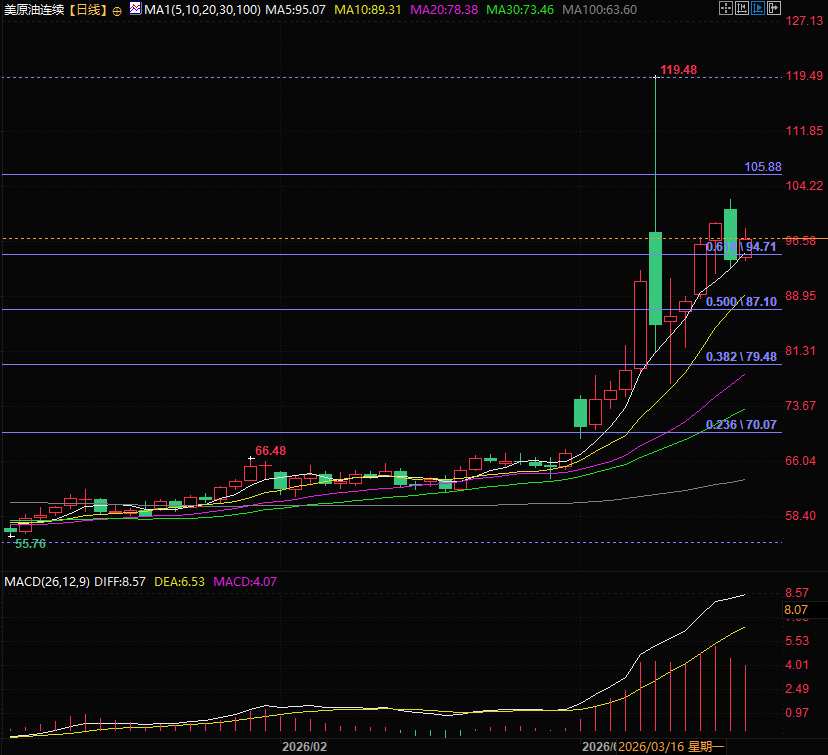
(WTI crude oil futures daily chart, source: EasyForex)
At 17:19 Beijing time, WTI crude oil futures were trading at $96.88 per barrel.
As the conflict between the US, Israel, and Iran enters its 18th day, the fighting in the Middle East continues to escalate on multiple fronts, with Iran demonstrating a tough stance and tenacious fighting capabilities.
Early on March 17 local time, the Iranian Islamic Revolutionary Guard Corps launched the 57th wave of Operation True Commitment-4, using multiple types of missiles, including the Haibar Shekan and Imad, to precisely strike command and control facilities and air defense systems in the heart of Israel. At the same time, missiles and attack drones were used to attack the U.S. military base in Al Udeid, continuing the ongoing counterattack against U.S. and Israeli targets.
The day before, an explosion occurred in Tehran, the capital of Iran, at dawn. Israel continued to launch precision strikes against the Iranian leadership and security forces, but Iran's counterattack has not weakened, and the fighting has spread to multiple regions, including Lebanon and the Gulf region.
Top leadership takes a hard line: refusing to discuss a truce and drawing multiple red lines.
Faced with the escalating conflict, Iran's top leadership has sent a strong signal of no compromise.
Iranian officials made it clear that the key to ending the war lies in building long-term deterrence, not short-term compromise; the speaker of parliament conveyed the core position to countries in the region, emphasizing that the US military presence cannot bring security and demanding that the US withdraw.
Iranian Foreign Minister Abbas Araqchi went further, drawing a clear line and declaring that while the Strait of Hormuz remains open, the United States, Israel, and their allies have no right to use it. He also refuted the "delusional talk" of a ceasefire and made it clear that Iran "neither seeks a ceasefire nor accepts negotiations."
Regarding the security of energy facilities, Iranian state media issued a stern warning that if the oil infrastructure on Harq Island is attacked, Iran will retaliate with equivalent strikes against the oil and gas facilities of relevant countries.
The core support for tenacious fighting: reserves, cost, and the opponent's weaknesses.
Iran's ability to maintain its combat capability in high-intensity conflicts is supported by multiple factors.
First, there is the advantage of ample weapons reserves and asymmetric warfare. In Iran's publicly revealed large-scale underground tunnel network, drones and rockets are neatly arrayed. A video released by Fars News Agency shows a long line of "Shahid" drones and various missiles, which vividly demonstrates the enormous scale of its low-cost arsenal.
According to the Global Military Power Index, Iran has entered the ranks of the world's top 20 military powers, possessing the largest missile arsenal in the Middle East, with thousands of ballistic and cruise missiles in service, capable of reaching Israel and parts of southeastern Europe, and having the weapons reserve capacity for at least six months of high-intensity warfare.
Secondly, Iran's operational model creates a significant cost advantage. A single Patriot air defense missile costs as much as $4 million to $5 million, while the cost of an Iranian drone is extremely low. It is estimated that the UAE spent up to $759 million to intercept 506 Iranian drones, which is 30 times the cost of Iran's attack. This "cost asymmetry" puts the adversary under tremendous pressure to run out of air defense munitions.
Furthermore, the adversary's operational shortcomings have become more apparent. The USS Ford, which is participating in military operations against Iraq, has been deployed for 10 months, far exceeding the normal cycle. Last week, a fire lasting more than 30 hours occurred, forcing more than 600 crew members to sleep on the floor and tables. The long-term high-intensity operation has made it difficult for its ships and crew to maintain optimal condition.
Geopolitical conflicts escalate, causing volatility in the crude oil market to soar.
The ongoing geopolitical conflict has directly increased the volatility risk in the global crude oil market.
As a crucial passage for one-fifth of the world's oil transportation, shipping in the Strait of Hormuz continues to be disrupted, forcing a large number of merchant ships to stop or divert their routes, plunging the global energy supply into tension.
Despite the International Energy Agency's launch of the largest collective release of reserves in history, with 32 member countries agreeing to release 400 million barrels of strategic oil reserves, and Executive Director Fatih Birol stating that further releases would be made "if necessary," it has been difficult to completely alleviate market concerns.
As a result of these factors, international oil prices will continue to experience wide fluctuations, but the price center will continue to rise.
(WTI crude oil futures daily chart, source: EasyForex)
At 17:19 Beijing time, WTI crude oil futures were trading at $96.88 per barrel.
- Risk Warning and Disclaimer
- The market involves risk, and trading may not be suitable for all investors. This article is for reference only and does not constitute personal investment advice, nor does it take into account certain users’ specific investment objectives, financial situation, or other needs. Any investment decisions made based on this information are at your own risk.