A power vacuum, yet holding the key to the Straits, has ushered in a new chapter for oil and gold prices.
2026-03-17 20:26:00
Israeli Defense Minister Katz confirmed that the Secretary of Iran's Supreme National Security Council, Larijani, has died.
Following the assassination of Iran's Supreme Leader Ayatollah Khamenei, Larijani filled the power vacuum and became Iran's de facto wartime administrative leader, responsible for coordinating armed forces, strategic decision-making, and foreign communication. He is a key figure in maintaining political stability and balancing radical forces in Iran.
His death directly led to a vacuum in Iran's decision-making body, a possible gap in the command system, a second reshuffling of internal power, a significant increase in the probability of hardliners in the military taking power, and a sharp rise in the risk of further escalation of the Middle East conflict. As a result, crude oil and gold prices both fell sharply during trading.
Driven by the continued deterioration of the situation in Iran, market demand for safe-haven assets has surged, providing strong support for gold prices.
International gold prices continued to fluctuate at low levels on Tuesday, with spot gold remaining unchanged at $5,005.32 per ounce.
However, at the same time, investors remained cautious ahead of the Federal Reserve's monetary policy decision, and expectations for interest rate cuts continued to cool in a high-inflation environment, significantly limiting the upside potential for gold.
As a non-interest-bearing asset, gold's opportunity cost increases during periods of high interest rates, resulting in a volatile pattern of "safe-haven support and interest rate capping."
Iran launched a new round of attacks on key energy infrastructure in the United Arab Emirates, with fires breaking out at the Shah gas field and the Fujairah oil industrial zone, and oil tankers being attacked near the Strait of Hormuz, bringing this strategic shipping route, which carries about one-fifth of the world's oil shipments, to a near standstill.
International oil prices surged, driven by expectations of supply disruptions: WTI crude oil rose 3.6% to $96.95 per barrel.
Since the outbreak of the conflict, oil prices have risen by 40%, reaching a new high since 2022, becoming a core variable driving global inflation.
Meanwhile, the President of the European Council stated that the EU needs to prepare for dialogue with Russia. Although the EU's primary task at this stage is to increase economic pressure on Russia and support Ukraine through various means, he hinted that if global energy prices continue to remain high, it needs to be prepared to engage in dialogue with Russia.
Crude oil and gold exhibit a clear correlation between inflation, interest rates, and yields: the surge in oil prices has rapidly pushed up global inflation expectations, leading to a significant downward revision of market expectations for a Federal Reserve rate cut, and consequently, a rise in US Treasury yields.
While gold benefits from geopolitical safe-haven demand, as a non-interest-bearing asset, it is highly sensitive to rising yields. Increased holding costs directly suppress its price increases, forming the core trading logic of "surge in oil prices → rising inflation → upward revision of interest rate expectations → downward pressure on gold."
Bank of America's March global fund manager survey showed that the conflict in Iran completely reversed market sentiment, with optimism quickly turning into pessimism.
Inflation expectations surged, expectations for interest rate cuts cooled significantly, and risk sentiment indicators fell sharply.
Institutions generally chose to proactively reduce their risk exposure, putting downward pressure on global stock markets and ending the previous "broad-based rally," with the market entering a defensive mode.
Until the situation in the Middle East becomes clearer, safe-haven and inflation-hedging assets will continue to outperform, while equity assets will still face selling pressure.
The market is still in a game of strategy surrounding the Strait of Hormuz. Regardless of whether the United States ultimately withdraws or declares victory, the side that controls the Strait of Hormuz will be the ultimate winner.
Although Iran's top leader has been killed, Iran still retains control of the Strait of Hormuz. From weapons production to food and drinking water, as well as national sentiments against aggression, Iran demonstrates the potential for a protracted war. This protracted war is itself part of Iran's strategic plan. Therefore, the Strait of Hormuz will most likely remain closed, which will continue to push up oil prices. Meanwhile, as long as US Treasury yields continue to rise, gold will continue to maintain a weak and volatile trend.
Meanwhile, the market is waiting to see whether the new power transition will lead to the collapse of the regime due to internal power struggles, or whether the rise of a new core figure will create new heroes.
From a technical perspective: Spot gold is still trading within an upward channel, currently finding support near the lower trendline and resistance at the 5-day moving average. A break below this level could signal a de-escalation of tensions.
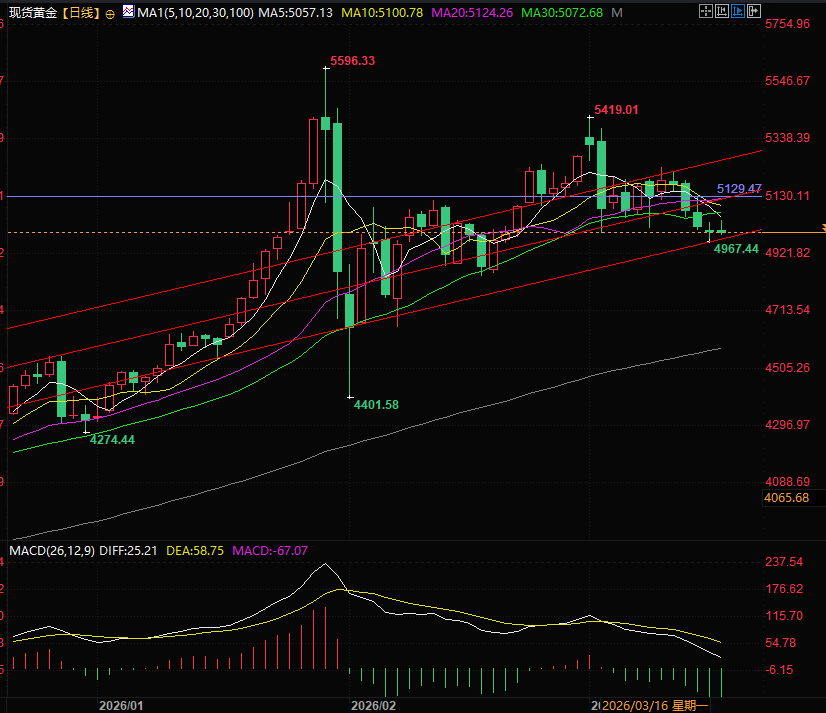
(Spot gold daily chart, source: FX678)
WTI crude oil prices are currently finding support at the 5-day moving average and the 0.618 Fibonacci retracement level, with key support around 87.
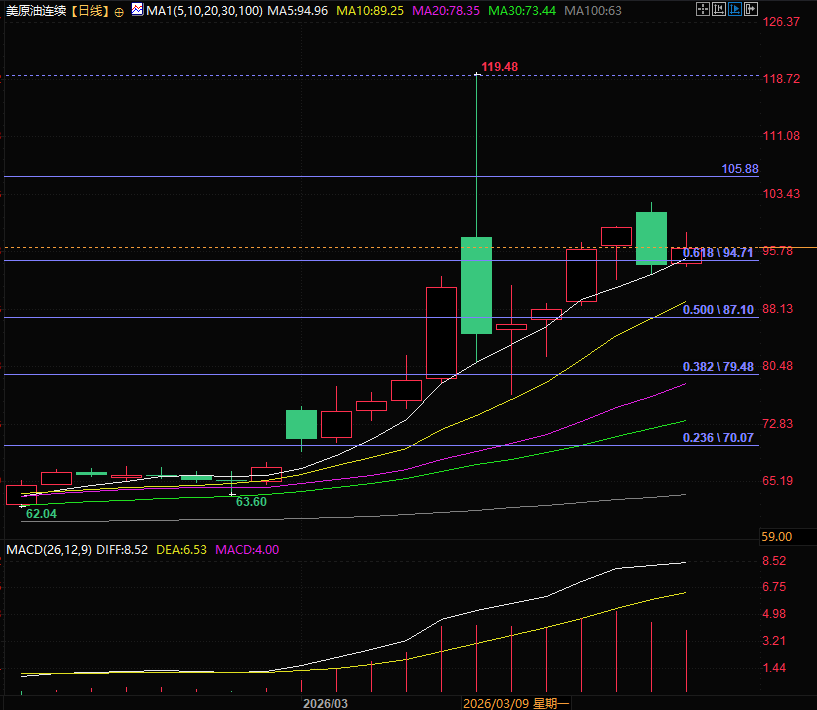
(WTI crude oil futures daily chart, source: EasyForex)
At 20:23 Beijing time, spot gold was trading at $5,015 per ounce, and WTI crude oil futures were trading at $95.45 per barrel.
Following the assassination of Iran's Supreme Leader Ayatollah Khamenei, Larijani filled the power vacuum and became Iran's de facto wartime administrative leader, responsible for coordinating armed forces, strategic decision-making, and foreign communication. He is a key figure in maintaining political stability and balancing radical forces in Iran.
His death directly led to a vacuum in Iran's decision-making body, a possible gap in the command system, a second reshuffling of internal power, a significant increase in the probability of hardliners in the military taking power, and a sharp rise in the risk of further escalation of the Middle East conflict. As a result, crude oil and gold prices both fell sharply during trading.
Gold: Strong safe-haven support, hawkish Fed expectations limit gains.
Driven by the continued deterioration of the situation in Iran, market demand for safe-haven assets has surged, providing strong support for gold prices.
International gold prices continued to fluctuate at low levels on Tuesday, with spot gold remaining unchanged at $5,005.32 per ounce.
However, at the same time, investors remained cautious ahead of the Federal Reserve's monetary policy decision, and expectations for interest rate cuts continued to cool in a high-inflation environment, significantly limiting the upside potential for gold.
As a non-interest-bearing asset, gold's opportunity cost increases during periods of high interest rates, resulting in a volatile pattern of "safe-haven support and interest rate capping."
Crude oil: Attacks on energy facilities send oil prices soaring to new highs.
Iran launched a new round of attacks on key energy infrastructure in the United Arab Emirates, with fires breaking out at the Shah gas field and the Fujairah oil industrial zone, and oil tankers being attacked near the Strait of Hormuz, bringing this strategic shipping route, which carries about one-fifth of the world's oil shipments, to a near standstill.
International oil prices surged, driven by expectations of supply disruptions: WTI crude oil rose 3.6% to $96.95 per barrel.
Since the outbreak of the conflict, oil prices have risen by 40%, reaching a new high since 2022, becoming a core variable driving global inflation.
Meanwhile, the President of the European Council stated that the EU needs to prepare for dialogue with Russia. Although the EU's primary task at this stage is to increase economic pressure on Russia and support Ukraine through various means, he hinted that if global energy prices continue to remain high, it needs to be prepared to engage in dialogue with Russia.
The correlation between gold and oil prices: Rising inflation puts downward pressure on interest rate cuts, and yields influence gold prices.
Crude oil and gold exhibit a clear correlation between inflation, interest rates, and yields: the surge in oil prices has rapidly pushed up global inflation expectations, leading to a significant downward revision of market expectations for a Federal Reserve rate cut, and consequently, a rise in US Treasury yields.
While gold benefits from geopolitical safe-haven demand, as a non-interest-bearing asset, it is highly sensitive to rising yields. Increased holding costs directly suppress its price increases, forming the core trading logic of "surge in oil prices → rising inflation → upward revision of interest rate expectations → downward pressure on gold."
Institutional View: Market sentiment reversed, equity markets experienced concentrated sell-off.
Bank of America's March global fund manager survey showed that the conflict in Iran completely reversed market sentiment, with optimism quickly turning into pessimism.
Inflation expectations surged, expectations for interest rate cuts cooled significantly, and risk sentiment indicators fell sharply.
Institutions generally chose to proactively reduce their risk exposure, putting downward pressure on global stock markets and ending the previous "broad-based rally," with the market entering a defensive mode.
Until the situation in the Middle East becomes clearer, safe-haven and inflation-hedging assets will continue to outperform, while equity assets will still face selling pressure.
Summary and Technical Analysis:
The market is still in a game of strategy surrounding the Strait of Hormuz. Regardless of whether the United States ultimately withdraws or declares victory, the side that controls the Strait of Hormuz will be the ultimate winner.
Although Iran's top leader has been killed, Iran still retains control of the Strait of Hormuz. From weapons production to food and drinking water, as well as national sentiments against aggression, Iran demonstrates the potential for a protracted war. This protracted war is itself part of Iran's strategic plan. Therefore, the Strait of Hormuz will most likely remain closed, which will continue to push up oil prices. Meanwhile, as long as US Treasury yields continue to rise, gold will continue to maintain a weak and volatile trend.
Meanwhile, the market is waiting to see whether the new power transition will lead to the collapse of the regime due to internal power struggles, or whether the rise of a new core figure will create new heroes.
From a technical perspective: Spot gold is still trading within an upward channel, currently finding support near the lower trendline and resistance at the 5-day moving average. A break below this level could signal a de-escalation of tensions.
(Spot gold daily chart, source: FX678)
WTI crude oil prices are currently finding support at the 5-day moving average and the 0.618 Fibonacci retracement level, with key support around 87.
(WTI crude oil futures daily chart, source: EasyForex)
At 20:23 Beijing time, spot gold was trading at $5,015 per ounce, and WTI crude oil futures were trading at $95.45 per barrel.
- Risk Warning and Disclaimer
- The market involves risk, and trading may not be suitable for all investors. This article is for reference only and does not constitute personal investment advice, nor does it take into account certain users’ specific investment objectives, financial situation, or other needs. Any investment decisions made based on this information are at your own risk.