Can the Australian dollar's technical rebound continue? It depends on how risk sentiment develops.
2026-03-17 21:44:58
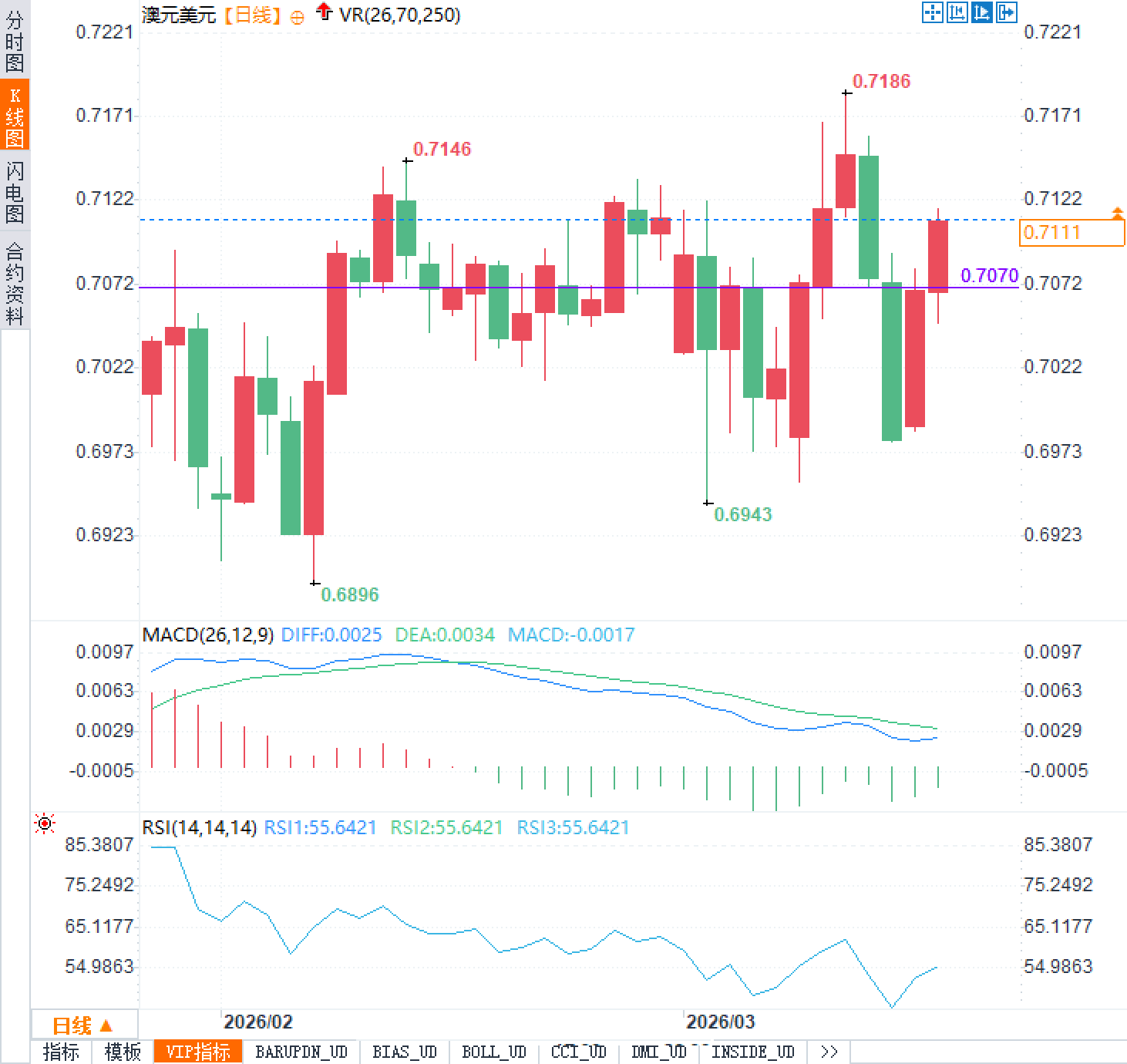
On Tuesday, March 17, the Australian dollar rebounded against the US dollar following the Reserve Bank of Australia's (RBA) interest rate hike, currently trading around 0.7110, finding support after testing key technical support levels. The market is digesting the impact of the RBA's latest monetary policy decision. The RBA raised the cash rate by 25 basis points to 4.1%, in line with broad market expectations, but the board's narrow 5-4 vote indicates growing internal disagreement on the necessity and pace of the rate hike. This decision reflects heightened vigilance regarding resurgent inflationary pressures, coupled with external geopolitical factors pushing up fuel prices, further increasing short-term inflation expectations.

The Reserve Bank of Australia (RBA) set its cash rate target at 4.1% in this rate hike, marking another move following the previous tightening cycle. The board vote was 5-4, highlighting the uncertainty surrounding the policy path. A majority of members believe that strong demand coupled with capacity constraints in the second half of 2025 will lead to a faster recovery in price momentum, posing an upside risk to inflation. The RBA explicitly stated that inflation will persist above the 2% to 3% target range, with risks clearly skewed to the upside. The policy statement specifically mentioned that while financial conditions have tightened, the degree of current policy constraints remains uncertain, and a data-dependent approach will be maintained going forward. While a minority opinion may favor observing more data before acting, the majority's dominance demonstrates the central bank's determination to anchor inflation expectations. Recent comments from RBA officials, with the Governor repeatedly emphasizing that "every meeting is active," indicate that concerns about the stubbornness of inflation exceed some market expectations.
The resurgence of inflation is driven by a confluence of factors. Domestically, persistent pressures on service prices and wages, coupled with a tight labor market, exacerbate cost transmission. Externally, geopolitical tensions in the Middle East have directly pushed up fuel prices, causing short-term inflation expectations to climb rapidly to recent highs. Consumer inflation expectations rose to 5.2% in March 2026, a near three-year high, further increasing from 5.0% the previous month, indicating growing market concerns about price stickiness. The Reserve Bank of Australia assesses that while some price increases are temporary, a significant proportion stems from deep-seated structural factors that, if left unchecked, could evolve into more persistent inflation. Currently, core inflation remains around 3.4%, above the upper limit of the target, and inflation is expected to return to the target level only in the mid-to-late 2027.
Following the policy implementation, the Australian dollar's reaction to the US dollar was ambivalent. Initially, it fluctuated around key moving averages before turning upwards as risk assets recovered. As a typical resource-based currency, the Australian dollar is sensitive to global demand. While current geopolitical factors are pushing up energy prices, they are also amplifying uncertainty. Traders need to pay attention to subsequent data to verify the inflation path. If fuel prices remain high or domestic demand does not show a significant slowdown, the Reserve Bank of Australia's reliance on data may further tighten. In the short term, exchange rate fluctuations will revolve around technical levels; a break or fall below key moving averages will signal a shift in market sentiment.
Details of the Reserve Bank of Australia's decision-making and internal power struggles
The Reserve Bank of Australia (RBA) set its cash rate target at 4.1% in this rate hike, marking another move following the previous tightening cycle. The board vote was 5-4, highlighting the uncertainty surrounding the policy path. A majority of members believe that strong demand coupled with capacity constraints in the second half of 2025 will lead to a faster recovery in price momentum, posing an upside risk to inflation. The RBA explicitly stated that inflation will persist above the 2% to 3% target range, with risks clearly skewed to the upside. The policy statement specifically mentioned that while financial conditions have tightened, the degree of current policy constraints remains uncertain, and a data-dependent approach will be maintained going forward. While a minority opinion may favor observing more data before acting, the majority's dominance demonstrates the central bank's determination to anchor inflation expectations. Recent comments from RBA officials, with the Governor repeatedly emphasizing that "every meeting is active," indicate that concerns about the stubbornness of inflation exceed some market expectations.
Sources of inflationary pressures and external disturbances
The resurgence of inflation is driven by a confluence of factors. Domestically, persistent pressures on service prices and wages, coupled with a tight labor market, exacerbate cost transmission. Externally, geopolitical tensions in the Middle East have directly pushed up fuel prices, causing short-term inflation expectations to climb rapidly to recent highs. Consumer inflation expectations rose to 5.2% in March 2026, a near three-year high, further increasing from 5.0% the previous month, indicating growing market concerns about price stickiness. The Reserve Bank of Australia assesses that while some price increases are temporary, a significant proportion stems from deep-seated structural factors that, if left unchecked, could evolve into more persistent inflation. Currently, core inflation remains around 3.4%, above the upper limit of the target, and inflation is expected to return to the target level only in the mid-to-late 2027.
Market reaction and risk sentiment are linked
Following the policy implementation, the Australian dollar's reaction to the US dollar was ambivalent. Initially, it fluctuated around key moving averages before turning upwards as risk assets recovered. As a typical resource-based currency, the Australian dollar is sensitive to global demand. While current geopolitical factors are pushing up energy prices, they are also amplifying uncertainty. Traders need to pay attention to subsequent data to verify the inflation path. If fuel prices remain high or domestic demand does not show a significant slowdown, the Reserve Bank of Australia's reliance on data may further tighten. In the short term, exchange rate fluctuations will revolve around technical levels; a break or fall below key moving averages will signal a shift in market sentiment.
Frequently Asked Questions
Question 1: Why was the Reserve Bank of Australia's interest rate hike vote so close? What does the 5-4 result mean?
A: The 5-4 vote reflects the Board's internal disagreement on the sustainability of inflation and the strength of policy. The majority believes that inflation risks are skewed upward and that continued tightening is needed to anchor expectations; the minority may be more inclined to observe the temporary impact of geopolitical shocks and avoid excessive tightening. This result indicates that the policy path is not monolithic, and disagreements may still arise in subsequent meetings. The market needs to closely monitor changes in the tone of each statement to determine whether the pace of tightening will exceed expectations or slow down.
Question 2: With current inflation expectations rising to 5.2%, what impact will this have on the Reserve Bank of Australia's future policy path?
A: Inflation expectations have risen rapidly to near-record highs, reinforcing the Reserve Bank of Australia's assessment of persistent price pressures. The central bank has made it clear that inflation will remain above target for an extended period, raising upside risks. Further decoupling of expectations could prompt more sustained tightening action. However, a decline in expectations if geopolitical factors ease or demand cools would provide policy breathing room. Traders are watching subsequent consumer expectations surveys and core price data to assess whether tightening will accelerate into May and beyond.
- Risk Warning and Disclaimer
- The market involves risk, and trading may not be suitable for all investors. This article is for reference only and does not constitute personal investment advice, nor does it take into account certain users’ specific investment objectives, financial situation, or other needs. Any investment decisions made based on this information are at your own risk.