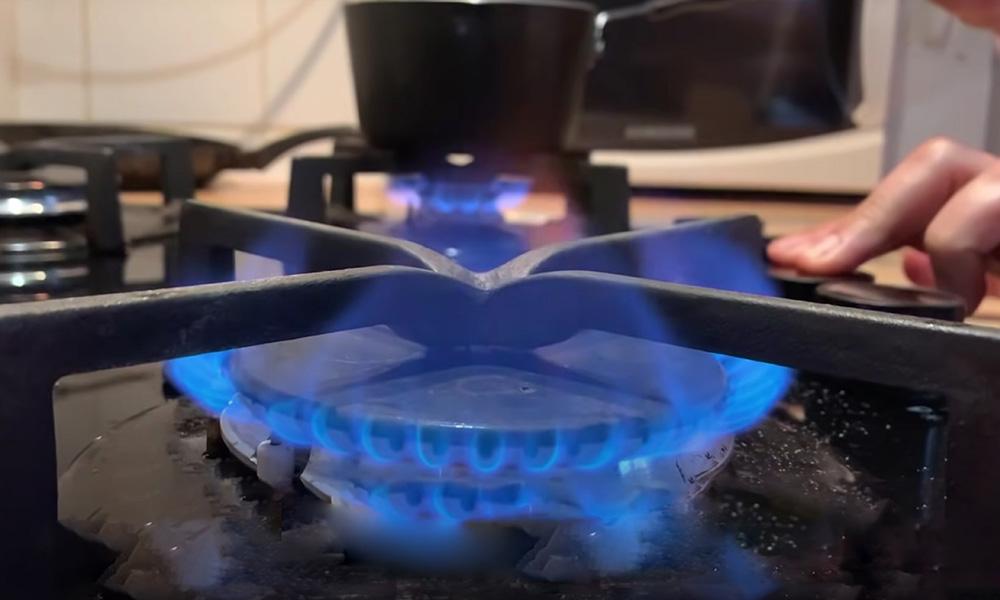
The war between the US and Iran has burned down Indian kitchens, and LPG shortages are leaving 140 million Indian households without fire.
2026-03-17 21:44:16
Iran's recent new round of attacks on the UAE's energy and transportation infrastructure has not only exacerbated fears of a global energy crisis.
This directly impacted India's energy lifeline, plunging it into a double predicament of high oil prices and supply shortages.
Drone attacks caused fires at the Shah gas field and the Fujairah oil industrial area in the UAE, and oil tankers near the Strait of Hormuz were attacked one after another. Since the outbreak of the US-Iran conflict on February 28, shipping in the Strait of Hormuz, a key choke point for global energy transportation, has been almost completely halted.
This waterway is India's "energy lifeline"—before the blockade, India relied on the Middle East for about 50%-53% of its crude oil imports (2.5 million to 2.8 million barrels per day), and the vast majority of these imports had to be transported through this strait. At the same time, as the world's second-largest importer of liquefied petroleum gas (LPG), India also had to transport 90% of its imported LPG through this waterway. The supply risk for its catering industry and household gas was already far higher than that for crude oil.
The ongoing geopolitical conflict has driven international oil prices to soar. Since the outbreak of the conflict between the US and Iran, oil prices have risen by 40% cumulatively, reaching a new high since 2022. Last week, Brent crude oil closed above the $100 per barrel mark for the first time in four years.
Iran had previously warned that oil prices could soar to $200 per barrel, and the repeated attacks on the oil industrial zone of Fujairah in the UAE, a world-class crude oil and fuel storage hub, have highlighted the vulnerability of the energy transportation routes that India relies on. Even though the Habshan-Fujairah pipeline in the UAE (with an average daily oil transport capacity of about 1.5 million barrels) attempts to bypass the Strait of Hormuz, it has failed to withstand the risk of attacks, further compressing India's energy supply space.
For India, the impact of the energy crisis is not simply due to rising oil prices, but also stems from its structural weakness in energy dependence. LPG is an abbreviation for liquefied petroleum gas, a clean fossil fuel with two main sources: one is extraction from natural gas, and the other is a byproduct of oil refining.
The Modi government's large-scale LPG subsidy program, while successfully enabling hundreds of millions of households to abandon traditional firewood and allowing LPG to penetrate every corner of India and establish a huge LPG distribution and recycling system, has also led to a "pathological dependence" on LPG in Indian kitchens. The motivation to switch to electricity or piped gas has been significantly weakened, and the whole country still generally relies on gas cylinders.
This single-dependency structure was fully exposed after the Strait of Hormuz was blocked: India relies on imports for about 60% of its LPG, and the 90% import transport routes were cut off, directly triggering a nationwide energy crisis.
The impact of energy shortages is rapidly spreading to key sectors of the Indian economy, with the food and beverage industry bearing the brunt.
The food and beverage industry is India's second-largest job provider after agriculture. It is not only a core pillar supporting economic growth, social employment, and urbanization, but also a massive industry worth 6.6 trillion rupees.
However, the industry relies on commercial LPG for 75% of its operations, and the blockade of the Strait of Hormuz has disrupted LPG supply, causing operational difficulties for restaurants across India.
A disruption in the supply of commercial liquefied petroleum gas (LPG) cylinders in Bangalore has forced some small restaurants to offer only tea and coffee; in Mumbai, approximately 20% of hotels and restaurants have closed, and industry associations predict that if the situation does not improve, nearly 50% of food and beverage establishments will be forced to shut down within two days. Many small restaurants, unable to secure a stable supply, have been forced to turn to the black market for gas, causing cylinder prices to surge from 1200 rupees to 1400-1500 rupees. Even a single day of supply disruption could result in losses of 12 to 13 billion rupees for the food and beverage industry and the economy.
To alleviate the pressure on residential energy, the Indian government has initiated emergency measures, reducing LPG supply to commercial and industrial sectors, prioritizing residential gas supply, extending the LPG ordering cycle from 21 days to 25 days to combat panic buying, and even ordering domestic refineries to stop plastic production and increase residential LPG production in accordance with the Essential Goods Act, thereby increasing domestic LPG production by 30%.
However, these measures are insufficient to fundamentally address the structural dependence problem. India's Ministry of Environment has had to grant special permission for commercial kitchens to temporarily use firewood and coal in order to avoid a complete collapse of the catering industry.
This energy crisis has not only left India's catering industry in a "no rice to cook" predicament, but also sounded an alarm—its energy security model, which relies too heavily on a single energy source and a single fuel, is no longer sustainable in the context of escalating global geopolitical conflicts.
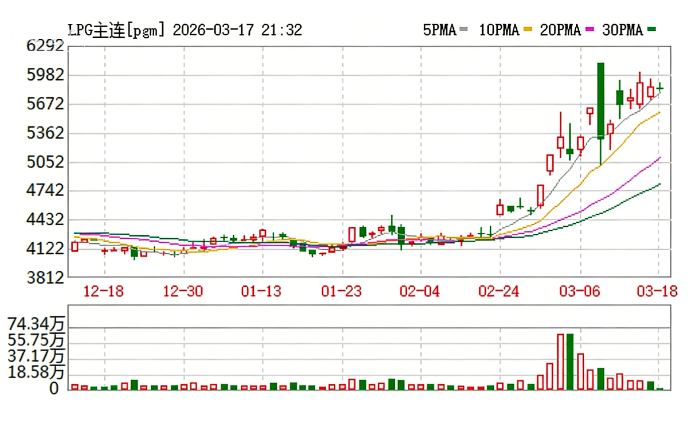
(LPG main contract daily chart)
This directly impacted India's energy lifeline, plunging it into a double predicament of high oil prices and supply shortages.
Drone attacks caused fires at the Shah gas field and the Fujairah oil industrial area in the UAE, and oil tankers near the Strait of Hormuz were attacked one after another. Since the outbreak of the US-Iran conflict on February 28, shipping in the Strait of Hormuz, a key choke point for global energy transportation, has been almost completely halted.
This waterway is India's "energy lifeline"—before the blockade, India relied on the Middle East for about 50%-53% of its crude oil imports (2.5 million to 2.8 million barrels per day), and the vast majority of these imports had to be transported through this strait. At the same time, as the world's second-largest importer of liquefied petroleum gas (LPG), India also had to transport 90% of its imported LPG through this waterway. The supply risk for its catering industry and household gas was already far higher than that for crude oil.
Oil prices surge to record highs in recent years, highlighting the vulnerability of transportation corridors.
The ongoing geopolitical conflict has driven international oil prices to soar. Since the outbreak of the conflict between the US and Iran, oil prices have risen by 40% cumulatively, reaching a new high since 2022. Last week, Brent crude oil closed above the $100 per barrel mark for the first time in four years.
Iran had previously warned that oil prices could soar to $200 per barrel, and the repeated attacks on the oil industrial zone of Fujairah in the UAE, a world-class crude oil and fuel storage hub, have highlighted the vulnerability of the energy transportation routes that India relies on. Even though the Habshan-Fujairah pipeline in the UAE (with an average daily oil transport capacity of about 1.5 million barrels) attempts to bypass the Strait of Hormuz, it has failed to withstand the risk of attacks, further compressing India's energy supply space.
Structural dependence becomes a weakness; LPG "pathological dependence" exposes hidden dangers.
For India, the impact of the energy crisis is not simply due to rising oil prices, but also stems from its structural weakness in energy dependence. LPG is an abbreviation for liquefied petroleum gas, a clean fossil fuel with two main sources: one is extraction from natural gas, and the other is a byproduct of oil refining.
The Modi government's large-scale LPG subsidy program, while successfully enabling hundreds of millions of households to abandon traditional firewood and allowing LPG to penetrate every corner of India and establish a huge LPG distribution and recycling system, has also led to a "pathological dependence" on LPG in Indian kitchens. The motivation to switch to electricity or piped gas has been significantly weakened, and the whole country still generally relies on gas cylinders.
This single-dependency structure was fully exposed after the Strait of Hormuz was blocked: India relies on imports for about 60% of its LPG, and the 90% import transport routes were cut off, directly triggering a nationwide energy crisis.
The catering industry was hit hardest, facing the risk of operational paralysis.
The impact of energy shortages is rapidly spreading to key sectors of the Indian economy, with the food and beverage industry bearing the brunt.
The food and beverage industry is India's second-largest job provider after agriculture. It is not only a core pillar supporting economic growth, social employment, and urbanization, but also a massive industry worth 6.6 trillion rupees.
However, the industry relies on commercial LPG for 75% of its operations, and the blockade of the Strait of Hormuz has disrupted LPG supply, causing operational difficulties for restaurants across India.
A disruption in the supply of commercial liquefied petroleum gas (LPG) cylinders in Bangalore has forced some small restaurants to offer only tea and coffee; in Mumbai, approximately 20% of hotels and restaurants have closed, and industry associations predict that if the situation does not improve, nearly 50% of food and beverage establishments will be forced to shut down within two days. Many small restaurants, unable to secure a stable supply, have been forced to turn to the black market for gas, causing cylinder prices to surge from 1200 rupees to 1400-1500 rupees. Even a single day of supply disruption could result in losses of 12 to 13 billion rupees for the food and beverage industry and the economy.
Emergency measures are insufficient to address the root cause; the energy security model urgently needs to be restructured.
To alleviate the pressure on residential energy, the Indian government has initiated emergency measures, reducing LPG supply to commercial and industrial sectors, prioritizing residential gas supply, extending the LPG ordering cycle from 21 days to 25 days to combat panic buying, and even ordering domestic refineries to stop plastic production and increase residential LPG production in accordance with the Essential Goods Act, thereby increasing domestic LPG production by 30%.
However, these measures are insufficient to fundamentally address the structural dependence problem. India's Ministry of Environment has had to grant special permission for commercial kitchens to temporarily use firewood and coal in order to avoid a complete collapse of the catering industry.
This energy crisis has not only left India's catering industry in a "no rice to cook" predicament, but also sounded an alarm—its energy security model, which relies too heavily on a single energy source and a single fuel, is no longer sustainable in the context of escalating global geopolitical conflicts.
(LPG main contract daily chart)
- Risk Warning and Disclaimer
- The market involves risk, and trading may not be suitable for all investors. This article is for reference only and does not constitute personal investment advice, nor does it take into account certain users’ specific investment objectives, financial situation, or other needs. Any investment decisions made based on this information are at your own risk.