March 18 Financial Breakfast: Gold prices hover around the $5,000 mark awaiting the Fed decision; Iran launches another attack on the UAE; supply concerns boost oil prices.
2026-03-18 07:26:21
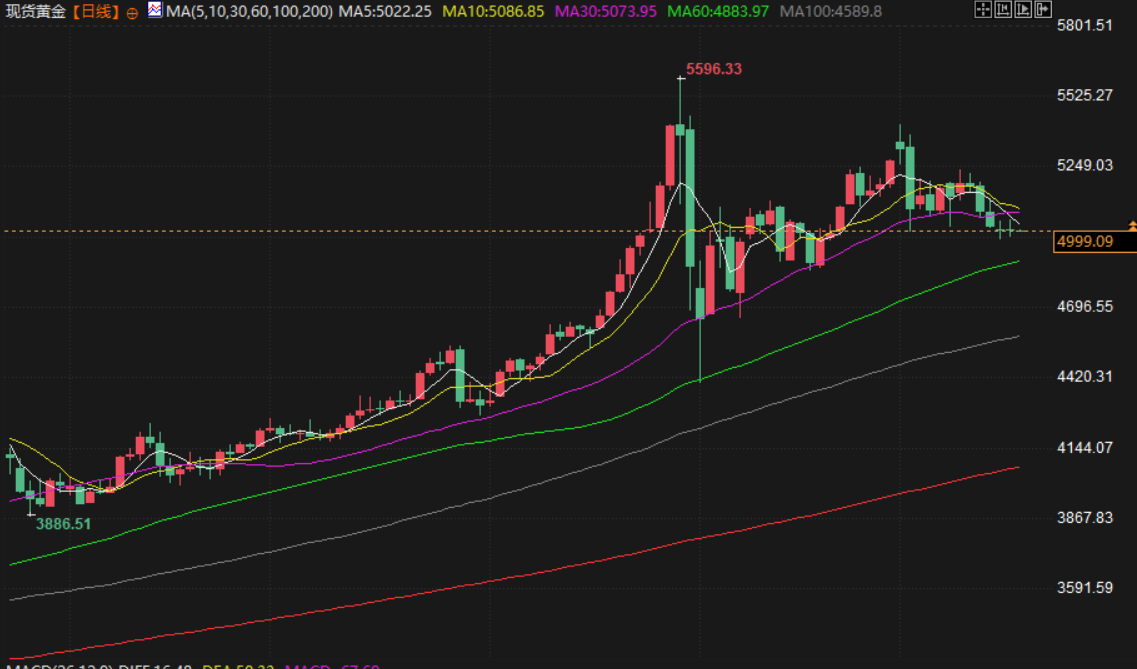
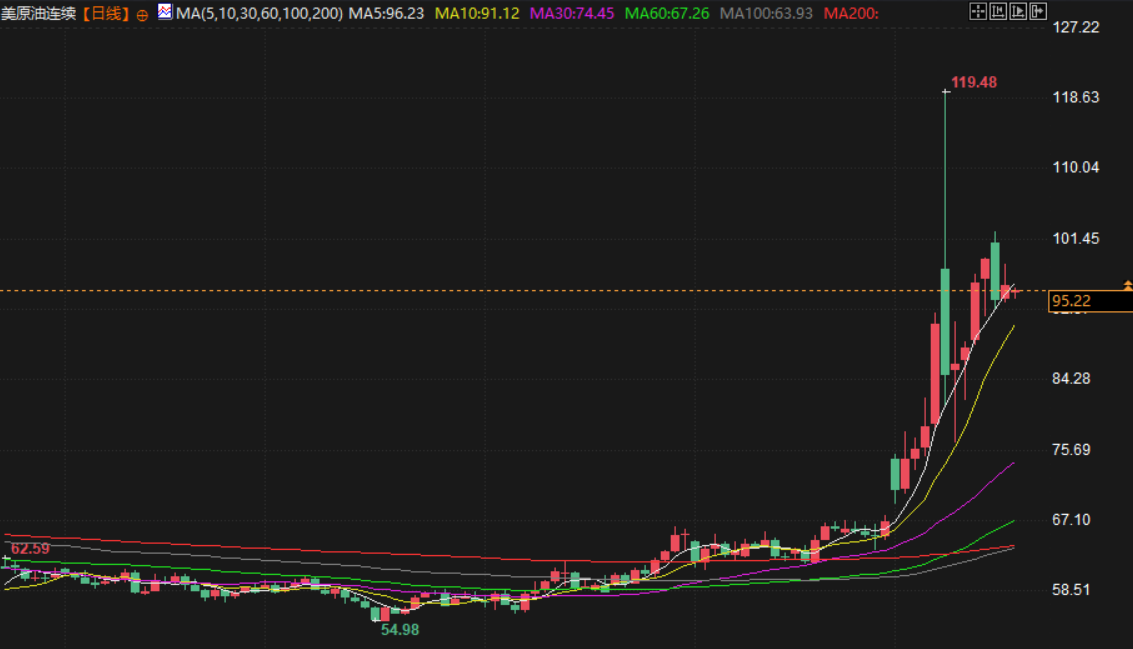
On Wednesday (March 18, Beijing time) in early Asian trading, spot gold traded around $5,000 per ounce, with safe-haven demand and bearish pressure from inflation balancing each other, keeping gold prices stable recently. The market is focused on the escalating conflict with Iran while awaiting the Federal Reserve's upcoming policy decision. US crude oil traded around $95.22 per barrel. Oil prices rose on Tuesday as Iran's renewed attack on the UAE exacerbated concerns about a deteriorating global supply outlook.

U.S. stocks closed higher on Tuesday, with the S&P 500 up 0.25%, the Nasdaq up 0.47%, and the Dow Jones Industrial Average up 0.10%, ending earlier losses triggered by Middle East conflict and soaring oil prices. Traders focused on expectations that the Federal Reserve would likely keep interest rates unchanged as it began its two-day policy meeting.
Boosted by Delta Air Lines' upward revision of revenue guidance, the travel and related sectors generally rebounded, with Delta Air Lines rising more than 6%, American Airlines Group rising 3.5%, and United Airlines and Expedia also recording significant gains.
Markets widely expect the Federal Reserve to keep borrowing costs unchanged at its meeting on Wednesday, with interest rate futures indicating only one 25-basis-point rate cut before the end of the year, far fewer than the two cuts before the conflict.
The energy and consumer discretionary sectors led the gains among the S&P 500 sectors. Additionally, Uber rose 4.2% after announcing a partnership with Nvidia to launch a robotaxi service, and financial stocks also rebounded from recent credit concerns, with Blackstone, Apollo Global Management, and KKR all rising more than 3%.
Gold prices were largely steady on Tuesday as the market focused on the escalating conflict with Iran and awaited the Federal Reserve's upcoming policy decision. Spot gold was unchanged at $5,004.71 per ounce, while U.S. gold futures edged up 0.1% to $5,008.20. A senior analyst at Kitco Metals noted that the gold market is in a state of equilibrium: safe-haven demand driven by geopolitical uncertainty is balanced by bearish pressures stemming from inflation.
While gold is typically viewed as a safe-haven asset during times of uncertainty, the high-interest-rate environment has diminished its appeal as a non-interest-bearing asset. The war between the US and Israel over Iran has now entered its third week, severely disrupting energy trade and exacerbating inflation concerns, while the market widely expects the Federal Reserve to keep interest rates unchanged on Wednesday. Commerzbank believes that this meeting is unlikely to provide a clear direction for gold prices, as the duration of the war and oil supply risks are keeping central banks cautious.
In other precious metals, spot silver fell 1.5% to $79.55 per ounce, platinum rose 0.6%, and palladium rose 0.7%.
International oil prices rose on Tuesday as renewed Iranian attacks on the United Arab Emirates exacerbated concerns about a deteriorating global supply outlook. Brent crude rose 2.67% to settle at $103.57 a barrel, while WTI crude rose 1.91% to settle at $96.02 a barrel.
Iran launched its third attack on the United Arab Emirates in four days, causing partial disruption to oil shipments at the port of Fujairah, a key export point accounting for about 1% of global demand. Sources say the de facto closure of the Strait of Hormuz has forced the UAE, OPEC's third-largest oil producer, to cut production by more than half.
Despite White House economic advisors stating that oil tankers are "beginning sporadic passages" through the Strait and predicting the conflict will last for weeks rather than months, analysts believe the risks remain significant, and any attack on tankers could easily escalate the situation again. Traders are preparing for a prolonged supply disruption, which could keep oil prices high; technical analysis indicates that the medium-term resistance level for US crude oil is at $124 per barrel.
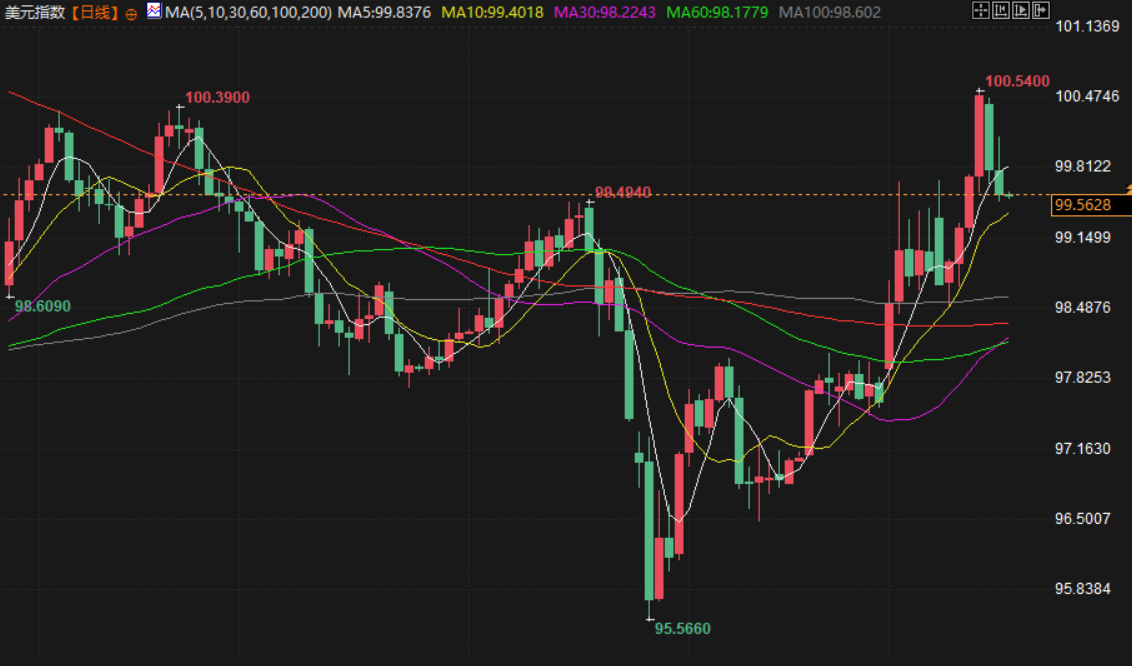
The dollar index fell for a second straight session on Tuesday as markets adjusted positions ahead of major central bank interest rate decisions this week. The dollar index dropped 0.31% to 99.55, retreating from a 10-month high of 100.54 reached on Friday, after safe-haven buying fueled by Middle East conflict and rising oil prices.
Markets widely expect the Federal Reserve, the European Central Bank, the Bank of England, and the Bank of Japan to keep interest rates unchanged this week, but traders will be closely watching their statements on inflation and the economic outlook, especially against the backdrop of the US-Israel war against Iran.
Analysts expect the Federal Reserve to adopt a hawkish stance, suggesting a prolonged pause in rate cuts amid rising oil prices and inflation. Iran's renewed attack on the UAE on Tuesday disrupted oil shipments at the port of Fujairah.
The euro rose 0.31% to $1.15403, rebounding from its lowest level since August 2025, which it hit on Monday.
The Australian dollar rose 0.46% against the US dollar after the Reserve Bank of Australia raised interest rates for the second consecutive month on Tuesday, pushing rates to a 10-month high. The Japanese yen traded at 159 yen to the US dollar, as the Japanese government reiterated its readiness to take decisive measures to address currency volatility.
The probability of the Federal Reserve keeping interest rates unchanged this week is as high as 98.9%, a rare occurrence as the market has priced in the possibility of a rate hike.
According to the latest data from CME's "FedWatch," the market expects a 98.9% probability that the Federal Reserve will keep interest rates unchanged at this week's meeting, a 0% probability of a 25 basis point rate cut, and a rare 1.1% probability of a 25 basis point rate hike. This is the first time since the start of this rate hike cycle that the market has priced in a slight rate hike. For subsequent meetings: by April, the probability of a cumulative 25 basis point rate cut is 3.1%, the probability of keeping rates unchanged is 95.9%, and the probability of a 25 basis point rate hike remains at 1.1%. By June, the probability of a cumulative 25 basis point rate cut is 78.1%, indicating that the market still expects a rate cut to begin in the middle of the year, but the probability has decreased compared to before. Recent surges in oil prices have exacerbated inflation concerns, coupled with continued strong US economic data, driving a repricing of market expectations for rate cuts, and even some small bets on rate hikes. The market will closely watch the Fed's policy statement and economic projections this week regarding the assessment of the impact of the Middle East conflict.
The United States is reportedly planning to further ease sanctions on Venezuelan oil in response to soaring oil prices.
The Trump administration plans to further ease sanctions on Venezuela's oil industry to boost crude production amid the war with Iran that has driven up oil prices. These measures, potentially announced as early as this week, include issuing more individual licenses to allow foreign companies to operate in Venezuela without violating U.S. sanctions. The administration will also introduce a broader mechanism to make it easier for more companies to enter the Venezuelan market. It remains unclear whether the measures will take the form of a universal license.
The U.S. State Department has ordered all its embassies worldwide to conduct security assessments "immediately".
On March 17 local time, the U.S. State Department ordered all its embassies worldwide to conduct security assessments "immediately," citing the ongoing tensions in the Middle East and their potential spillover effects. (CCTV News)
The Israeli military threatened to "hunt down" Iran's new Supreme Leader.
Israel Defense Forces spokesman Efi Devlin said on the 17th that the IDF would "hunt down" Iran's new Supreme Leader, Mojtaba Khamenei. Devlin stated in an interview that day that the IDF was targeting "all leaders" in Iran and would pursue and "eliminate" Mojtaba. Earlier that day, Iran's ambassador to Russia, Kazem Jalali, stated via social media that reports of Mojtaba receiving medical treatment in Russia were fake news. He called these false reports "a new psychological warfare tactic." (CCTV News)
The White House releases Department of Homeland Security funding proposal
The White House released a letter on Tuesday detailing its willingness to make policy adjustments to the Department of Homeland Security (DHS) in an effort to reach an agreement with Democrats and end the nearly five-week partial government shutdown. Democrats had previously criticized the government's proposals as lacking sincerity, and the increasingly severe staff shortage at the Transportation Security Administration (TSA) has led to significantly longer security checkpoints across the country. This move by the White House is intended to demonstrate its willingness to negotiate. The letter outlines five points that clearly indicate the White House's willingness to enshrine several policy adjustments into law, including: expanding the use of body cameras by federal immigration enforcement officers; restricting enforcement actions in certain sensitive locations such as hospitals and schools; strengthening oversight of DHS detention facilities; requiring law enforcement officers to publicly wear identification badges; and strictly adhering to existing laws prohibiting the deportation or detention of U.S. citizens.
Iran claims it can legally strike countries that allow the US and Israel to use its territory.
Iranian Foreign Minister Araqchi held a telephone conversation with Azerbaijani Foreign Minister Bayramov on March 17 local time. During the conversation, Araqchi issued a stern warning that, according to international law, no country has the right to provide its territory or military facilities to a third party for the purpose of aggression against another country. Araqchi emphasized that any country that allows the United States or Israel to use its territory as a "springboard" to attack Iran will be considered to be involved in aggression and thus become a "legitimate target" of Iran's attacks. (CCTV International News)
Iranian Parliament Speaker: The Strait of Hormuz will not return to its pre-war state.
On March 17, local time, Iranian Parliament Speaker Mohammad Ghalibaf posted on social media that the Strait of Hormuz would not return to its pre-war state. On March 13, Iran's newly appointed Supreme Leader, Mojtaba Khamenei, issued his first statement since taking office, stating that Iran would continue to block the Strait of Hormuz. The Iranian Islamic Revolutionary Guard Corps has repeatedly stated that the Strait of Hormuz is under the strict control of the Islamic Revolutionary Guard Corps Navy, and that "the United States and its allies have no right to pass through it." (CCTV News)
Trump said the possibility of the US withdrawing from NATO should be considered.
On March 17 local time, US President Trump reiterated his dissatisfaction with NATO at the White House. Trump stated that whether the US should withdraw from NATO "is indeed something we should be considering." When asked if he was reassessing the US-NATO relationship or even considering withdrawal, Trump said, "It's something we should be considering, and I don't need Congress to make that decision." However, he added that there are currently "no concrete plans," but he is "not satisfied" with the current situation. (CCTV News)
From "the horizon" to "nearby"! The trillion-dollar BeiDou industry begins.
The China Satellite Navigation Office recently announced that, to provide better services, the BeiDou Navigation Satellite System will soon undergo an on-orbit upgrade, optimizing the operational status of some satellites. As a mature, fully functional, and high-performance global satellite navigation system, the BeiDou Navigation Satellite System currently has 50 satellites in orbit, with a spatial signal accuracy better than 2 meters. With the continuous expansion of BeiDou applications, its high-precision spatiotemporal services are moving from "satellites in the sky" into everyday life. (CCTV News)
Key Focus Today
stock market
U.S. stocks closed higher on Tuesday, with the S&P 500 up 0.25%, the Nasdaq up 0.47%, and the Dow Jones Industrial Average up 0.10%, ending earlier losses triggered by Middle East conflict and soaring oil prices. Traders focused on expectations that the Federal Reserve would likely keep interest rates unchanged as it began its two-day policy meeting.
Boosted by Delta Air Lines' upward revision of revenue guidance, the travel and related sectors generally rebounded, with Delta Air Lines rising more than 6%, American Airlines Group rising 3.5%, and United Airlines and Expedia also recording significant gains.
Markets widely expect the Federal Reserve to keep borrowing costs unchanged at its meeting on Wednesday, with interest rate futures indicating only one 25-basis-point rate cut before the end of the year, far fewer than the two cuts before the conflict.
The energy and consumer discretionary sectors led the gains among the S&P 500 sectors. Additionally, Uber rose 4.2% after announcing a partnership with Nvidia to launch a robotaxi service, and financial stocks also rebounded from recent credit concerns, with Blackstone, Apollo Global Management, and KKR all rising more than 3%.
Gold Market
Gold prices were largely steady on Tuesday as the market focused on the escalating conflict with Iran and awaited the Federal Reserve's upcoming policy decision. Spot gold was unchanged at $5,004.71 per ounce, while U.S. gold futures edged up 0.1% to $5,008.20. A senior analyst at Kitco Metals noted that the gold market is in a state of equilibrium: safe-haven demand driven by geopolitical uncertainty is balanced by bearish pressures stemming from inflation.
While gold is typically viewed as a safe-haven asset during times of uncertainty, the high-interest-rate environment has diminished its appeal as a non-interest-bearing asset. The war between the US and Israel over Iran has now entered its third week, severely disrupting energy trade and exacerbating inflation concerns, while the market widely expects the Federal Reserve to keep interest rates unchanged on Wednesday. Commerzbank believes that this meeting is unlikely to provide a clear direction for gold prices, as the duration of the war and oil supply risks are keeping central banks cautious.
In other precious metals, spot silver fell 1.5% to $79.55 per ounce, platinum rose 0.6%, and palladium rose 0.7%.
oil market
International oil prices rose on Tuesday as renewed Iranian attacks on the United Arab Emirates exacerbated concerns about a deteriorating global supply outlook. Brent crude rose 2.67% to settle at $103.57 a barrel, while WTI crude rose 1.91% to settle at $96.02 a barrel.
Iran launched its third attack on the United Arab Emirates in four days, causing partial disruption to oil shipments at the port of Fujairah, a key export point accounting for about 1% of global demand. Sources say the de facto closure of the Strait of Hormuz has forced the UAE, OPEC's third-largest oil producer, to cut production by more than half.
Despite White House economic advisors stating that oil tankers are "beginning sporadic passages" through the Strait and predicting the conflict will last for weeks rather than months, analysts believe the risks remain significant, and any attack on tankers could easily escalate the situation again. Traders are preparing for a prolonged supply disruption, which could keep oil prices high; technical analysis indicates that the medium-term resistance level for US crude oil is at $124 per barrel.
Foreign exchange market
The dollar index fell for a second straight session on Tuesday as markets adjusted positions ahead of major central bank interest rate decisions this week. The dollar index dropped 0.31% to 99.55, retreating from a 10-month high of 100.54 reached on Friday, after safe-haven buying fueled by Middle East conflict and rising oil prices.
Markets widely expect the Federal Reserve, the European Central Bank, the Bank of England, and the Bank of Japan to keep interest rates unchanged this week, but traders will be closely watching their statements on inflation and the economic outlook, especially against the backdrop of the US-Israel war against Iran.
Analysts expect the Federal Reserve to adopt a hawkish stance, suggesting a prolonged pause in rate cuts amid rising oil prices and inflation. Iran's renewed attack on the UAE on Tuesday disrupted oil shipments at the port of Fujairah.
The euro rose 0.31% to $1.15403, rebounding from its lowest level since August 2025, which it hit on Monday.
The Australian dollar rose 0.46% against the US dollar after the Reserve Bank of Australia raised interest rates for the second consecutive month on Tuesday, pushing rates to a 10-month high. The Japanese yen traded at 159 yen to the US dollar, as the Japanese government reiterated its readiness to take decisive measures to address currency volatility.
International News
The probability of the Federal Reserve keeping interest rates unchanged this week is as high as 98.9%, a rare occurrence as the market has priced in the possibility of a rate hike.
According to the latest data from CME's "FedWatch," the market expects a 98.9% probability that the Federal Reserve will keep interest rates unchanged at this week's meeting, a 0% probability of a 25 basis point rate cut, and a rare 1.1% probability of a 25 basis point rate hike. This is the first time since the start of this rate hike cycle that the market has priced in a slight rate hike. For subsequent meetings: by April, the probability of a cumulative 25 basis point rate cut is 3.1%, the probability of keeping rates unchanged is 95.9%, and the probability of a 25 basis point rate hike remains at 1.1%. By June, the probability of a cumulative 25 basis point rate cut is 78.1%, indicating that the market still expects a rate cut to begin in the middle of the year, but the probability has decreased compared to before. Recent surges in oil prices have exacerbated inflation concerns, coupled with continued strong US economic data, driving a repricing of market expectations for rate cuts, and even some small bets on rate hikes. The market will closely watch the Fed's policy statement and economic projections this week regarding the assessment of the impact of the Middle East conflict.
The United States is reportedly planning to further ease sanctions on Venezuelan oil in response to soaring oil prices.
The Trump administration plans to further ease sanctions on Venezuela's oil industry to boost crude production amid the war with Iran that has driven up oil prices. These measures, potentially announced as early as this week, include issuing more individual licenses to allow foreign companies to operate in Venezuela without violating U.S. sanctions. The administration will also introduce a broader mechanism to make it easier for more companies to enter the Venezuelan market. It remains unclear whether the measures will take the form of a universal license.
The U.S. State Department has ordered all its embassies worldwide to conduct security assessments "immediately".
On March 17 local time, the U.S. State Department ordered all its embassies worldwide to conduct security assessments "immediately," citing the ongoing tensions in the Middle East and their potential spillover effects. (CCTV News)
The Israeli military threatened to "hunt down" Iran's new Supreme Leader.
Israel Defense Forces spokesman Efi Devlin said on the 17th that the IDF would "hunt down" Iran's new Supreme Leader, Mojtaba Khamenei. Devlin stated in an interview that day that the IDF was targeting "all leaders" in Iran and would pursue and "eliminate" Mojtaba. Earlier that day, Iran's ambassador to Russia, Kazem Jalali, stated via social media that reports of Mojtaba receiving medical treatment in Russia were fake news. He called these false reports "a new psychological warfare tactic." (CCTV News)
The White House releases Department of Homeland Security funding proposal
The White House released a letter on Tuesday detailing its willingness to make policy adjustments to the Department of Homeland Security (DHS) in an effort to reach an agreement with Democrats and end the nearly five-week partial government shutdown. Democrats had previously criticized the government's proposals as lacking sincerity, and the increasingly severe staff shortage at the Transportation Security Administration (TSA) has led to significantly longer security checkpoints across the country. This move by the White House is intended to demonstrate its willingness to negotiate. The letter outlines five points that clearly indicate the White House's willingness to enshrine several policy adjustments into law, including: expanding the use of body cameras by federal immigration enforcement officers; restricting enforcement actions in certain sensitive locations such as hospitals and schools; strengthening oversight of DHS detention facilities; requiring law enforcement officers to publicly wear identification badges; and strictly adhering to existing laws prohibiting the deportation or detention of U.S. citizens.
Iran claims it can legally strike countries that allow the US and Israel to use its territory.
Iranian Foreign Minister Araqchi held a telephone conversation with Azerbaijani Foreign Minister Bayramov on March 17 local time. During the conversation, Araqchi issued a stern warning that, according to international law, no country has the right to provide its territory or military facilities to a third party for the purpose of aggression against another country. Araqchi emphasized that any country that allows the United States or Israel to use its territory as a "springboard" to attack Iran will be considered to be involved in aggression and thus become a "legitimate target" of Iran's attacks. (CCTV International News)
Iranian Parliament Speaker: The Strait of Hormuz will not return to its pre-war state.
On March 17, local time, Iranian Parliament Speaker Mohammad Ghalibaf posted on social media that the Strait of Hormuz would not return to its pre-war state. On March 13, Iran's newly appointed Supreme Leader, Mojtaba Khamenei, issued his first statement since taking office, stating that Iran would continue to block the Strait of Hormuz. The Iranian Islamic Revolutionary Guard Corps has repeatedly stated that the Strait of Hormuz is under the strict control of the Islamic Revolutionary Guard Corps Navy, and that "the United States and its allies have no right to pass through it." (CCTV News)
Trump said the possibility of the US withdrawing from NATO should be considered.
On March 17 local time, US President Trump reiterated his dissatisfaction with NATO at the White House. Trump stated that whether the US should withdraw from NATO "is indeed something we should be considering." When asked if he was reassessing the US-NATO relationship or even considering withdrawal, Trump said, "It's something we should be considering, and I don't need Congress to make that decision." However, he added that there are currently "no concrete plans," but he is "not satisfied" with the current situation. (CCTV News)
Domestic News
From "the horizon" to "nearby"! The trillion-dollar BeiDou industry begins.
The China Satellite Navigation Office recently announced that, to provide better services, the BeiDou Navigation Satellite System will soon undergo an on-orbit upgrade, optimizing the operational status of some satellites. As a mature, fully functional, and high-performance global satellite navigation system, the BeiDou Navigation Satellite System currently has 50 satellites in orbit, with a spatial signal accuracy better than 2 meters. With the continuous expansion of BeiDou applications, its high-precision spatiotemporal services are moving from "satellites in the sky" into everyday life. (CCTV News)
- Risk Warning and Disclaimer
- The market involves risk, and trading may not be suitable for all investors. This article is for reference only and does not constitute personal investment advice, nor does it take into account certain users’ specific investment objectives, financial situation, or other needs. Any investment decisions made based on this information are at your own risk.