Economists warn that soaring oil prices could further worsen the K-shaped economic trend in the United States, leading to a situation where the poor become poorer and the rich become richer.
2026-03-18 12:05:20
Amid the escalating conflict between the US and Israel in the Middle East and Iran, and the disruption of shipping in the Strait of Hormuz that has caused the largest shock to global energy supplies in history, economists warn that the war is exacerbating the so-called "K-shaped economic" divergence in the United States.
Soaring oil and gasoline prices act as a "hidden tax" on household spending power, severely impacting low-income groups while leaving high-income families relatively unaffected, further widening the wealth gap.
The term "K-shaped economy" first appeared during the COVID-19 pandemic, using the letter K to vividly describe the polarization of economic recovery: the income and wealth of high-income groups continue to rise, forming the upward arm of the K; while low-income groups fall into deeper difficulties, forming the downward arm.
The surge in stock and housing prices during the pandemic primarily benefited the upper class who owned assets, while low-income earners faced the double blow of high unemployment and rising prices, exacerbating this polarization.
Before the Iran-Iraq War, the United States was already facing a growing burden crisis due to the high cost of living, with the gap between the rich and poor widening. Now, soaring oil and gasoline prices are further dragging low-income groups into the downward spiral of a K-shaped curve.
“As an economist, my biggest concern is inequality,” said Nicholas Bloom, a professor of economics at Stanford University, at a Harvard Kennedy School webinar on the economic consequences of the war with Iran. He added, “ The impact of rising oil prices on household spending power will hit low-income earners even harder .”
Since the conflict began on February 28, Brent crude oil prices have risen by more than 40%, currently hovering around $102 a barrel. The national average gasoline price in the United States has risen to $3.79 a gallon, up about 87 cents, or 30%, from a month ago. According to data from the American Automobile Association (AAA), this increase surpasses any period since October 2023, marking a new high in recent years.
Moody's chief economist Mark Zandi said, "This is particularly tough on low- and middle-income families who have little financial buffer. If they need to put more income into the tank, they have to cut back on other spending or pay off credit cards and other debts more slowly." He added, " Higher gasoline prices are like a regressive tax, with lower-income families having a higher percentage of their budget allocated to energy ."
Tufts University economics professor Michael Klein points out that rising oil prices are similar to tariffs, effectively "taxing" people's spending power . He states, "In this situation, households are paying money to oil companies instead of the federal government. If households spend more of their income on gasoline, they have less money left to buy other goods and services." He adds that consumer spending accounts for a large portion of U.S. GDP, and this shift in consumption patterns could have a negative impact on the overall economy.
Oil price fluctuations have a wide-ranging ripple effect. Diesel prices broke through $5 a gallon on Tuesday, the first high since 2022, which will push up trucking costs, thereby raising the prices of food and other commodities. According to data from the International Air Transport Association (IATA), global jet fuel prices have risen by about 83% in the past month, becoming a major cost pressure for airlines.
"Higher fuel costs, and their downstream impact on shipping, travel, and trade, are likely to further exacerbate price pressures on consumers," said Stephen Kates, a certified financial planner and financial analyst at Bankrate. He added that businesses often pass on some of these costs to consumers.
The war with Iran has effectively closed the Strait of Hormuz (which accounts for about one-fifth of the world's oil shipping routes), causing the largest oil supply disruption in history.
Soaring oil prices have a particularly severe impact on low- and middle-income households, who spend a larger proportion of their income on energy and have virtually no buffer. High-income groups, on the other hand, are relatively better able to absorb the cost increases due to their greater financial assets and higher incomes.
Economists warn that if the conflict drags on and oil prices remain high, the K-shaped economic polarization will worsen. Low-income groups will be forced to cut back on non-essential consumption, while high-income groups may continue to benefit from rising asset prices, leading to more severe structural inequality.
Overall , the energy crisis triggered by the Iran war is pushing the polarization of the US "K-shaped economy" to new heights through soaring oil and gasoline prices. The purchasing power of low-income families is being further compressed, while high-income groups are relatively more resilient to shocks.
The impact of oil price shocks has spread from gas stations to supermarket bills, air travel and logistics costs. Coupled with a weak job market and persistent inflation, the Fed's policy space remains limited.
In the coming weeks, whether the conflict subsides, the actual trend of oil prices, and the Fed's true attitude toward inflation will directly determine whether the K-shaped divergence will worsen further.
Investors and policymakers need to be highly vigilant about the profound impact of the energy crisis on consumption patterns, income inequality, and overall economic stability. This round of the Middle East crisis has evolved from a regional conflict into a major challenge to global economic and social equity.
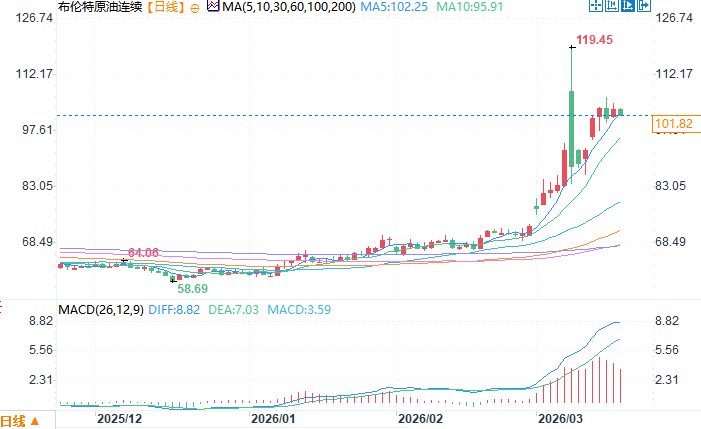
Brent crude oil daily chart source: EasyForex
At 12:04 Beijing time on March 18, Brent crude oil futures were trading at $101.09 per barrel.
Soaring oil and gasoline prices act as a "hidden tax" on household spending power, severely impacting low-income groups while leaving high-income families relatively unaffected, further widening the wealth gap.
The definition of a "K-shaped economy": the rich get richer and the poor get poorer.
The term "K-shaped economy" first appeared during the COVID-19 pandemic, using the letter K to vividly describe the polarization of economic recovery: the income and wealth of high-income groups continue to rise, forming the upward arm of the K; while low-income groups fall into deeper difficulties, forming the downward arm.
The surge in stock and housing prices during the pandemic primarily benefited the upper class who owned assets, while low-income earners faced the double blow of high unemployment and rising prices, exacerbating this polarization.
Before the Iran-Iraq War, the United States was already facing a growing burden crisis due to the high cost of living, with the gap between the rich and poor widening. Now, soaring oil and gasoline prices are further dragging low-income groups into the downward spiral of a K-shaped curve.
“As an economist, my biggest concern is inequality,” said Nicholas Bloom, a professor of economics at Stanford University, at a Harvard Kennedy School webinar on the economic consequences of the war with Iran. He added, “ The impact of rising oil prices on household spending power will hit low-income earners even harder .”
Soaring oil prices are like a "regressive tax," with low-income families bearing the brunt.
Since the conflict began on February 28, Brent crude oil prices have risen by more than 40%, currently hovering around $102 a barrel. The national average gasoline price in the United States has risen to $3.79 a gallon, up about 87 cents, or 30%, from a month ago. According to data from the American Automobile Association (AAA), this increase surpasses any period since October 2023, marking a new high in recent years.
Moody's chief economist Mark Zandi said, "This is particularly tough on low- and middle-income families who have little financial buffer. If they need to put more income into the tank, they have to cut back on other spending or pay off credit cards and other debts more slowly." He added, " Higher gasoline prices are like a regressive tax, with lower-income families having a higher percentage of their budget allocated to energy ."
Tufts University economics professor Michael Klein points out that rising oil prices are similar to tariffs, effectively "taxing" people's spending power . He states, "In this situation, households are paying money to oil companies instead of the federal government. If households spend more of their income on gasoline, they have less money left to buy other goods and services." He adds that consumer spending accounts for a large portion of U.S. GDP, and this shift in consumption patterns could have a negative impact on the overall economy.
The energy shock has spread to multiple sectors, including food and transportation.
Oil price fluctuations have a wide-ranging ripple effect. Diesel prices broke through $5 a gallon on Tuesday, the first high since 2022, which will push up trucking costs, thereby raising the prices of food and other commodities. According to data from the International Air Transport Association (IATA), global jet fuel prices have risen by about 83% in the past month, becoming a major cost pressure for airlines.
"Higher fuel costs, and their downstream impact on shipping, travel, and trade, are likely to further exacerbate price pressures on consumers," said Stephen Kates, a certified financial planner and financial analyst at Bankrate. He added that businesses often pass on some of these costs to consumers.
The Iran war exacerbated the K-shaped polarization, further compressing the purchasing power of the poor.
The war with Iran has effectively closed the Strait of Hormuz (which accounts for about one-fifth of the world's oil shipping routes), causing the largest oil supply disruption in history.
Soaring oil prices have a particularly severe impact on low- and middle-income households, who spend a larger proportion of their income on energy and have virtually no buffer. High-income groups, on the other hand, are relatively better able to absorb the cost increases due to their greater financial assets and higher incomes.
Economists warn that if the conflict drags on and oil prices remain high, the K-shaped economic polarization will worsen. Low-income groups will be forced to cut back on non-essential consumption, while high-income groups may continue to benefit from rising asset prices, leading to more severe structural inequality.
Overall , the energy crisis triggered by the Iran war is pushing the polarization of the US "K-shaped economy" to new heights through soaring oil and gasoline prices. The purchasing power of low-income families is being further compressed, while high-income groups are relatively more resilient to shocks.
The impact of oil price shocks has spread from gas stations to supermarket bills, air travel and logistics costs. Coupled with a weak job market and persistent inflation, the Fed's policy space remains limited.
In the coming weeks, whether the conflict subsides, the actual trend of oil prices, and the Fed's true attitude toward inflation will directly determine whether the K-shaped divergence will worsen further.
Investors and policymakers need to be highly vigilant about the profound impact of the energy crisis on consumption patterns, income inequality, and overall economic stability. This round of the Middle East crisis has evolved from a regional conflict into a major challenge to global economic and social equity.
Brent crude oil daily chart source: EasyForex
At 12:04 Beijing time on March 18, Brent crude oil futures were trading at $101.09 per barrel.
- Risk Warning and Disclaimer
- The market involves risk, and trading may not be suitable for all investors. This article is for reference only and does not constitute personal investment advice, nor does it take into account certain users’ specific investment objectives, financial situation, or other needs. Any investment decisions made based on this information are at your own risk.