The assassination of Iran's security secretary has sparked Iran's vow of "blood revenge," further escalating turmoil in the oil market.
2026-03-18 09:07:59
Iran's Tasnim News Agency reported that Ali Larijani, secretary of Iran's Supreme National Security Council, along with his son, senior security official Morteza Larijani, and several bodyguards, were killed. The Supreme National Security Council confirmed Ali Larijani's death, stating that he, along with deputy security official Alireza Bayat and members of his security team, were killed.
Iran's Islamic Revolutionary Guard Corps announced a "blood feud" in retribution for the death of Larijani. Iranian President Peshichiyan issued a statement early Wednesday morning (March 18) mourning Larijani and vowing to severely punish the perpetrators, while highly praising Larijani's contributions to regional peace and security.
As the US and Israel escalate their strikes against Iran and there are no signs of a clearing of the Strait of Hormuz, the risk of oil prices fluctuating at high levels has increased. In early Asian trading on Wednesday, US crude oil prices fluctuated and fell back, currently trading around $94.15 per barrel, down about 1.4% on the day.
According to reports, Ali Larijani, along with his son Morteza Larijani (a senior security official), deputy security official Alireza Bayat, and several bodyguards, were killed in the same incident.
Iran's Supreme National Security Council confirmed Larijani's death in a statement. While details of the incident have not yet been fully released, the Revolutionary Guard has announced a "blood feud." This incident marks a major blow to Iran's top security and could further escalate the conflict between the US, Israel, and Iran.
Iranian President Peshizian stated that Larijani, as Secretary of the Supreme National Security Council, dedicated himself to promoting regional peace and security and enhancing friendly relations among Islamic countries. His death is an irreparable loss, and the perpetrators will be severely punished.
Pezechian emphasized that Iran will continue its path of resistance, combining rationality and foresight, remaining steadfast in the face of threats, without compromise or retreat. This statement demonstrates that despite the loss of a key figure, the Iranian leadership maintains a hardline stance and refuses any concessions.
The U.S. Central Command announced that hours earlier, the U.S. military successfully destroyed Iranian hardened missile launch sites along the coast of the Strait of Hormuz using multiple 5,000-pound deep-penetrating munitions. These sites, home to Iranian anti-ship cruise missiles, posed a direct threat to international shipping in the strait.
This strike represents a further escalation of US-Israeli military action against Iran, aimed at weakening Iran's ability to blockade or threaten the Strait of Hormuz.
With the Strait of Hormuz essentially blocked, approximately one-fifth of global oil and liquefied natural gas trade is disrupted. Iranian threats and attacks have led to widespread ship evasion by ship owners, causing insurance premiums to skyrocket. Gulf oil-producing countries, with saturated storage facilities, are forced to cut production, further widening the supply gap.
The killing of Larijani, coupled with the US strike on a missile site, has further escalated regional tensions and increased the risk of oil prices fluctuating at high levels.
Larijani's assassination will greatly enrage the Iranian Revolutionary Guard and hardliners, potentially triggering extreme retaliatory actions (such as large-scale missile attacks, a complete blockade of the Strait of Hormuz, and expanded proxy operations). While the US destruction of missile sites along the Hormuz coast weakens Iran's anti-ship capabilities, it may also prompt Iran to take asymmetric retaliatory measures.
The probability of a ceasefire or de-escalation in the short term is extremely low, and panic in the global energy market is rising again. Investors need to be wary of a new round of supply shocks triggered by Iran's "blood feud" statement, pay attention to the resumption of navigation in the Taiwan Strait and the actual implementation of the G7/IEA reserve releases, and keep an eye on the persistently high risks to oil prices and inflation.
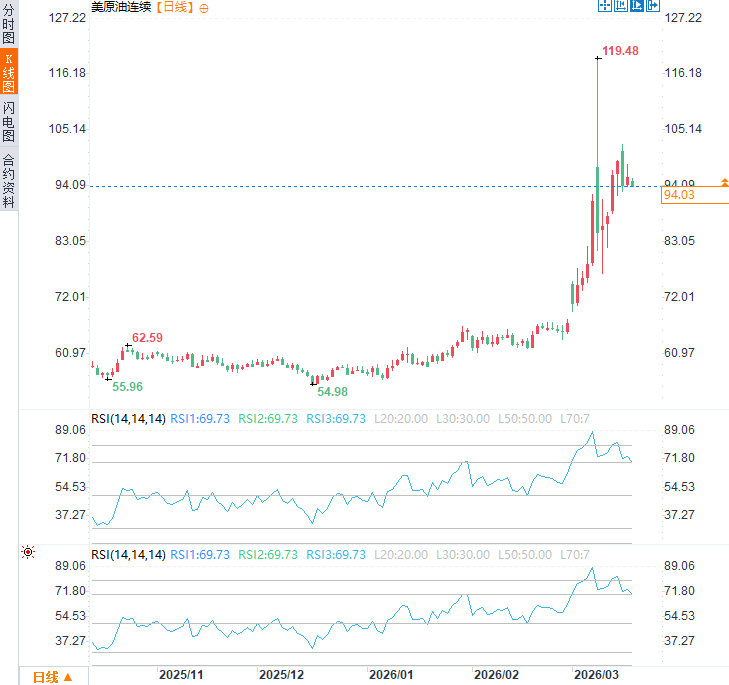
(US crude oil daily chart, source: FX678)
Ali Larijani, secretary of Iran's Supreme National Security Council, along with his son, deputy, and several bodyguards, were killed. The Revolutionary Guard announced a "blood feud." President Pezechiyan expressed his condolences and vowed to severely punish the perpetrators, emphasizing the continuation of the "rational resistance" approach. The US military used a 5,000-pound bunker-buster bomb to destroy hardened missile sites along the coast of Hormuz, weakening Iran's anti-ship threat.
With the Strait of Hormuz essentially sealed off, one-fifth of global oil shipments are disrupted, and the energy crisis continues to escalate. The assassination of a high-ranking Iranian official could trigger extreme retaliation, increasing the risk of escalating US military action. The probability of a short-term ceasefire is extremely low, and oil prices are fluctuating at high levels, exacerbating global inflationary pressures. Investors need to be highly vigilant against a new round of supply disruptions triggered by Iranian retaliatory actions and pay close attention to the resumption of navigation in the Strait and progress in international coordination.
At 9:07 AM Beijing time, US crude oil futures were trading at $93.99 per barrel.
Iran's Islamic Revolutionary Guard Corps announced a "blood feud" in retribution for the death of Larijani. Iranian President Peshichiyan issued a statement early Wednesday morning (March 18) mourning Larijani and vowing to severely punish the perpetrators, while highly praising Larijani's contributions to regional peace and security.
As the US and Israel escalate their strikes against Iran and there are no signs of a clearing of the Strait of Hormuz, the risk of oil prices fluctuating at high levels has increased. In early Asian trading on Wednesday, US crude oil prices fluctuated and fell back, currently trading around $94.15 per barrel, down about 1.4% on the day.
Larijani was killed along with his son, deputy, and several bodyguards.
According to reports, Ali Larijani, along with his son Morteza Larijani (a senior security official), deputy security official Alireza Bayat, and several bodyguards, were killed in the same incident.
Iran's Supreme National Security Council confirmed Larijani's death in a statement. While details of the incident have not yet been fully released, the Revolutionary Guard has announced a "blood feud." This incident marks a major blow to Iran's top security and could further escalate the conflict between the US, Israel, and Iran.
President Pezzich offered his condolences and vowed to severely punish the perpetrators, emphasizing the continuation of the rational resistance approach.
Iranian President Peshizian stated that Larijani, as Secretary of the Supreme National Security Council, dedicated himself to promoting regional peace and security and enhancing friendly relations among Islamic countries. His death is an irreparable loss, and the perpetrators will be severely punished.
Pezechian emphasized that Iran will continue its path of resistance, combining rationality and foresight, remaining steadfast in the face of threats, without compromise or retreat. This statement demonstrates that despite the loss of a key figure, the Iranian leadership maintains a hardline stance and refuses any concessions.
The U.S. military used a 5,000-pound bunker buster bomb to destroy missile sites along the Hormuz coast.
The U.S. Central Command announced that hours earlier, the U.S. military successfully destroyed Iranian hardened missile launch sites along the coast of the Strait of Hormuz using multiple 5,000-pound deep-penetrating munitions. These sites, home to Iranian anti-ship cruise missiles, posed a direct threat to international shipping in the strait.
This strike represents a further escalation of US-Israeli military action against Iran, aimed at weakening Iran's ability to blockade or threaten the Strait of Hormuz.
The Strait of Hormuz is essentially blocked, disrupting one-fifth of global oil shipments.
With the Strait of Hormuz essentially blocked, approximately one-fifth of global oil and liquefied natural gas trade is disrupted. Iranian threats and attacks have led to widespread ship evasion by ship owners, causing insurance premiums to skyrocket. Gulf oil-producing countries, with saturated storage facilities, are forced to cut production, further widening the supply gap.
The killing of Larijani, coupled with the US strike on a missile site, has further escalated regional tensions and increased the risk of oil prices fluctuating at high levels.
The assassination of a high-ranking Iranian official could trigger extreme retaliation, increasing the risk of escalating US military action.
Larijani's assassination will greatly enrage the Iranian Revolutionary Guard and hardliners, potentially triggering extreme retaliatory actions (such as large-scale missile attacks, a complete blockade of the Strait of Hormuz, and expanded proxy operations). While the US destruction of missile sites along the Hormuz coast weakens Iran's anti-ship capabilities, it may also prompt Iran to take asymmetric retaliatory measures.
The probability of a ceasefire or de-escalation in the short term is extremely low, and panic in the global energy market is rising again. Investors need to be wary of a new round of supply shocks triggered by Iran's "blood feud" statement, pay attention to the resumption of navigation in the Taiwan Strait and the actual implementation of the G7/IEA reserve releases, and keep an eye on the persistently high risks to oil prices and inflation.
(US crude oil daily chart, source: FX678)
Editor's Summary
Ali Larijani, secretary of Iran's Supreme National Security Council, along with his son, deputy, and several bodyguards, were killed. The Revolutionary Guard announced a "blood feud." President Pezechiyan expressed his condolences and vowed to severely punish the perpetrators, emphasizing the continuation of the "rational resistance" approach. The US military used a 5,000-pound bunker-buster bomb to destroy hardened missile sites along the coast of Hormuz, weakening Iran's anti-ship threat.
With the Strait of Hormuz essentially sealed off, one-fifth of global oil shipments are disrupted, and the energy crisis continues to escalate. The assassination of a high-ranking Iranian official could trigger extreme retaliation, increasing the risk of escalating US military action. The probability of a short-term ceasefire is extremely low, and oil prices are fluctuating at high levels, exacerbating global inflationary pressures. Investors need to be highly vigilant against a new round of supply disruptions triggered by Iranian retaliatory actions and pay close attention to the resumption of navigation in the Strait and progress in international coordination.
At 9:07 AM Beijing time, US crude oil futures were trading at $93.99 per barrel.
- Risk Warning and Disclaimer
- The market involves risk, and trading may not be suitable for all investors. This article is for reference only and does not constitute personal investment advice, nor does it take into account certain users’ specific investment objectives, financial situation, or other needs. Any investment decisions made based on this information are at your own risk.