Geopolitical conflicts complicate the Bank of Japan's policy decision; it is expected to maintain a hawkish stance and hold the rate at 0.75%.
2026-03-18 13:38:06
According to APP, Alicia Garcia, chief economist for Asia Pacific at Natixis, stated in a recent analysis that the US-Israel-Iran conflict has complicated the Bank of Japan 's interest rate decision this week, further exacerbating uncertainty amid multiple headwinds for economic growth. This conflict will trigger cost-driven inflation in Japan, potentially prompting the Bank of Japan to consider raising interest rates to stabilize the yen and curb imported inflation. However, Garcia believes the Bank of Japan will proceed cautiously. Global uncertainty could dampen companies' willingness to raise wages, and a precautionary rate hike could undermine nominal wage growth momentum, especially given rising oil prices putting pressure on private consumption and business investment. The central bank is likely to adopt a hawkish stance and remain on hold to avoid disrupting spring wage negotiations, while maintaining a tightening bias to mitigate a new round of imported inflationary pressures.
In a report published in the same period, Kei Fujimoto, an economist at Sumitomo Mitsui Trust, explicitly stated that he expects the Bank of Japan to maintain its policy rate at 0.75% this week. The Bank of Japan will be monitoring how rising crude oil prices will increase the cost of petrochemical products and other commodities made from crude oil, and how these cost pressures will be transmitted to domestic prices. Although rising crude oil prices will directly push up energy prices such as gasoline in the short term, this temporary fluctuation is unlikely to prompt the central bank to raise interest rates sooner than expected.
The latest market data shows that as of March 2026, the Bank of Japan's policy rate has remained at 0.75%, the latest level since the increase in December 2025. The consensus of the meeting on March 18-19 this week is expected to remain unchanged, and the market is pricing in the next rate hike to the end of June.
To clearly compare the interest rate path and its multi-dimensional impact, the following table presents key indicators (including economic transmission, exchange rate effects, and expert disagreement):
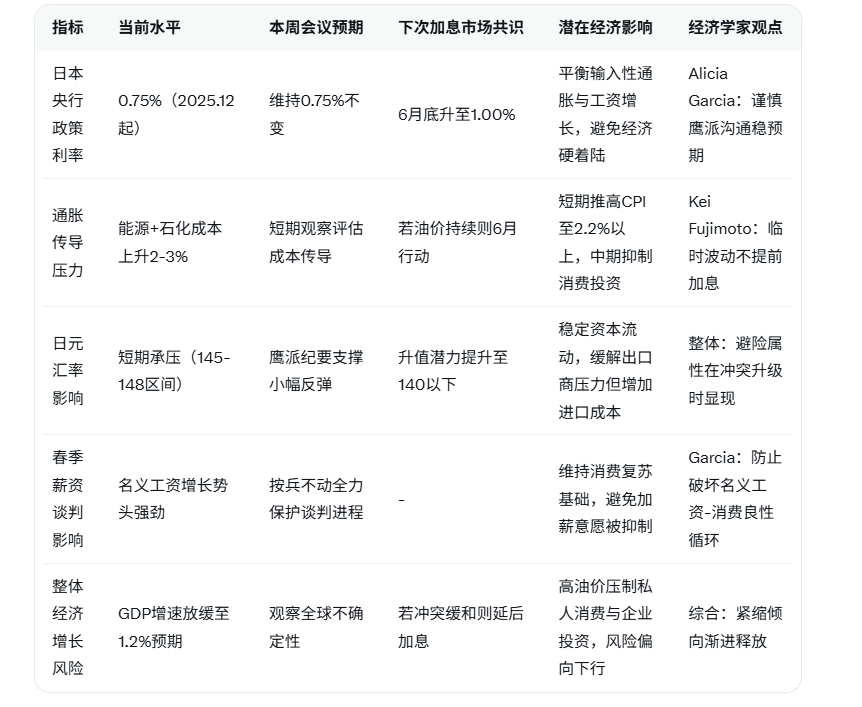
From an in-depth analysis perspective, the US-Israel-Iran conflict directly pushed up global oil prices, and the shipping risks in the Strait of Hormuz amplified Japan's import costs. Imported inflationary pressures are rapidly transmitted to the domestic CPI through the energy and raw material chains. Alicia Garcia emphasized that current global uncertainty has suppressed companies' willingness to raise wages, and premature interest rate hikes could disrupt the wage growth momentum formed by the "Spring Coalition" negotiations in spring 2026, thereby weakening the foundation for consumption recovery. Kei Fujimoto further pointed out that while the increase in petrochemical product costs caused by crude oil will push up gasoline prices in the short term, this is a temporary fluctuation and will not immediately affect the core inflation path; therefore, the central bank does not need to rush into action. It is reasonable to speculate that the Bank of Japan's move aims for a dual balance: stabilizing the yen exchange rate through hawkish communication to prevent capital outflows, while maintaining an easing window to support corporate investment and wage cycles. If the conflict continues, imported inflation may push the annual CPI above 2.2%, but the central bank will gradually release signals of "higher and longer" tightening to avoid a hard landing for the economy.
On the other hand, the yen is under short-term pressure, but its safe-haven appeal may rebound if the conflict escalates. Traders generally believe that if oil prices remain high, the Bank of Japan, while holding rates steady, will reinforce its "tightening bias" in the minutes, with the market pricing in a more than 60% probability of a rate hike at the end of June. This cautiously hawkish strategy helps anchor inflation expectations while providing policy certainty for businesses, contributing to continued nominal wage growth.
Editor's Summary : While the US-Israel-Iran conflict has exacerbated cost inflation pressures in Japan, the Bank of Japan's hawkish decision to maintain its interest rate at 0.75% this week reflects a prudent balance between wage negotiations and stable growth. Future policy path will depend on the actual strength of oil price transmission and the pace of geopolitical easing; investors should continue to monitor spring wage data and meeting minutes.
Frequently Asked Questions
Q1: Why is the conflict between the US, Israel, and Iran complicating the Bank of Japan's interest rate decision this week?
A: The conflict directly pushed up crude oil and commodity prices. As a major resource importer, Japan experienced rapid transmission of imported inflationary pressures to domestic costs through energy and raw material channels. Alicia Garcia points out that this further amplifies the policy dilemma at a time when economic growth is already facing multiple headwinds (such as global uncertainty): raising interest rates could stabilize the yen and inflation, but it could disrupt spring wage negotiations and suppress consumption and investment. Therefore, the central bank has chosen a cautiously hawkish stance, remaining on hold to observe the actual effects of cost transmission and avoid premature tightening that could damage the economic recovery momentum.
Q2: Why does Alicia Garcia believe that the Bank of Japan will take a hawkish stance but keep interest rates unchanged?
A: She emphasized that global uncertainty has dampened companies' willingness to raise wages, high oil prices are putting pressure on private consumption and investment, and a precautionary interest rate hike could interrupt the momentum of nominal wage growth. Meanwhile, to stabilize the yen and mitigate imported inflation, the central bank will maintain a tightening stance through communication, but will postpone actual action. This strategy both sends a hawkish signal to stabilize expectations and avoids unnecessary shocks to the real economy, aligning with the current data-dependent framework.
Q3: What is the basis for Kei Fujimoto's decision to maintain an interest rate of 0.75%?
A: Kei Fujimoto believes that while rising crude oil prices will push up energy prices such as gasoline in the short term, this is a temporary fluctuation and will not immediately translate into core inflation or long-term costs of petrochemical products. The Bank of Japan will focus this week on assessing the impact of these pressures on domestic prices and will avoid any actions that could disrupt business confidence during the crucial spring wage negotiations. The current policy interest rate of 0.75% is already at a relatively high level; maintaining it unchanged would leave room for further gradual tightening, a consensus fully shared by the market.
Q4: What are the specific transmission paths of rising oil prices to Japan's inflation and economic growth?
A: In the short term, rising costs of gasoline, electricity, and petrochemical products will directly push up the CPI; in the medium term, this will be transmitted through the supply chain to manufacturing and retail prices, creating cost-driven inflation. Meanwhile, high oil prices will suppress business investment and household consumption, and coupled with global uncertainties, may slow GDP growth. The Bank of Japan needs to weigh whether to offset imported pressures by raising interest rates, but Alicia Garcia warns that acting too quickly could disrupt the wage-consumption cycle, therefore a strategy of observation and communication is preferred.
Q5: How will the yen exchange rate and market expectations evolve after this week's decision?
A: While maintaining the 0.75% interest rate is a short-term negative for the yen, the hawkish minutes and tightening stance will support the exchange rate and prevent a sharp depreciation. If the conflict eases and oil prices fall, imported pressure will be reduced, and the consensus on a rate hike at the end of June (60% probability) will still dominate pricing. Conversely, escalating geopolitical tensions could trigger safe-haven buying, pushing up the yen. Investors should pay attention to the meeting minutes and spring wage data, as this event highlights the central bank's ability to flexibly balance external shocks, and policy transparency will be key to stabilizing market confidence.
In a report published in the same period, Kei Fujimoto, an economist at Sumitomo Mitsui Trust, explicitly stated that he expects the Bank of Japan to maintain its policy rate at 0.75% this week. The Bank of Japan will be monitoring how rising crude oil prices will increase the cost of petrochemical products and other commodities made from crude oil, and how these cost pressures will be transmitted to domestic prices. Although rising crude oil prices will directly push up energy prices such as gasoline in the short term, this temporary fluctuation is unlikely to prompt the central bank to raise interest rates sooner than expected.
The latest market data shows that as of March 2026, the Bank of Japan's policy rate has remained at 0.75%, the latest level since the increase in December 2025. The consensus of the meeting on March 18-19 this week is expected to remain unchanged, and the market is pricing in the next rate hike to the end of June.
To clearly compare the interest rate path and its multi-dimensional impact, the following table presents key indicators (including economic transmission, exchange rate effects, and expert disagreement):
From an in-depth analysis perspective, the US-Israel-Iran conflict directly pushed up global oil prices, and the shipping risks in the Strait of Hormuz amplified Japan's import costs. Imported inflationary pressures are rapidly transmitted to the domestic CPI through the energy and raw material chains. Alicia Garcia emphasized that current global uncertainty has suppressed companies' willingness to raise wages, and premature interest rate hikes could disrupt the wage growth momentum formed by the "Spring Coalition" negotiations in spring 2026, thereby weakening the foundation for consumption recovery. Kei Fujimoto further pointed out that while the increase in petrochemical product costs caused by crude oil will push up gasoline prices in the short term, this is a temporary fluctuation and will not immediately affect the core inflation path; therefore, the central bank does not need to rush into action. It is reasonable to speculate that the Bank of Japan's move aims for a dual balance: stabilizing the yen exchange rate through hawkish communication to prevent capital outflows, while maintaining an easing window to support corporate investment and wage cycles. If the conflict continues, imported inflation may push the annual CPI above 2.2%, but the central bank will gradually release signals of "higher and longer" tightening to avoid a hard landing for the economy.
On the other hand, the yen is under short-term pressure, but its safe-haven appeal may rebound if the conflict escalates. Traders generally believe that if oil prices remain high, the Bank of Japan, while holding rates steady, will reinforce its "tightening bias" in the minutes, with the market pricing in a more than 60% probability of a rate hike at the end of June. This cautiously hawkish strategy helps anchor inflation expectations while providing policy certainty for businesses, contributing to continued nominal wage growth.
Editor's Summary : While the US-Israel-Iran conflict has exacerbated cost inflation pressures in Japan, the Bank of Japan's hawkish decision to maintain its interest rate at 0.75% this week reflects a prudent balance between wage negotiations and stable growth. Future policy path will depend on the actual strength of oil price transmission and the pace of geopolitical easing; investors should continue to monitor spring wage data and meeting minutes.
Frequently Asked Questions
Q1: Why is the conflict between the US, Israel, and Iran complicating the Bank of Japan's interest rate decision this week?
A: The conflict directly pushed up crude oil and commodity prices. As a major resource importer, Japan experienced rapid transmission of imported inflationary pressures to domestic costs through energy and raw material channels. Alicia Garcia points out that this further amplifies the policy dilemma at a time when economic growth is already facing multiple headwinds (such as global uncertainty): raising interest rates could stabilize the yen and inflation, but it could disrupt spring wage negotiations and suppress consumption and investment. Therefore, the central bank has chosen a cautiously hawkish stance, remaining on hold to observe the actual effects of cost transmission and avoid premature tightening that could damage the economic recovery momentum.
Q2: Why does Alicia Garcia believe that the Bank of Japan will take a hawkish stance but keep interest rates unchanged?
A: She emphasized that global uncertainty has dampened companies' willingness to raise wages, high oil prices are putting pressure on private consumption and investment, and a precautionary interest rate hike could interrupt the momentum of nominal wage growth. Meanwhile, to stabilize the yen and mitigate imported inflation, the central bank will maintain a tightening stance through communication, but will postpone actual action. This strategy both sends a hawkish signal to stabilize expectations and avoids unnecessary shocks to the real economy, aligning with the current data-dependent framework.
Q3: What is the basis for Kei Fujimoto's decision to maintain an interest rate of 0.75%?
A: Kei Fujimoto believes that while rising crude oil prices will push up energy prices such as gasoline in the short term, this is a temporary fluctuation and will not immediately translate into core inflation or long-term costs of petrochemical products. The Bank of Japan will focus this week on assessing the impact of these pressures on domestic prices and will avoid any actions that could disrupt business confidence during the crucial spring wage negotiations. The current policy interest rate of 0.75% is already at a relatively high level; maintaining it unchanged would leave room for further gradual tightening, a consensus fully shared by the market.
Q4: What are the specific transmission paths of rising oil prices to Japan's inflation and economic growth?
A: In the short term, rising costs of gasoline, electricity, and petrochemical products will directly push up the CPI; in the medium term, this will be transmitted through the supply chain to manufacturing and retail prices, creating cost-driven inflation. Meanwhile, high oil prices will suppress business investment and household consumption, and coupled with global uncertainties, may slow GDP growth. The Bank of Japan needs to weigh whether to offset imported pressures by raising interest rates, but Alicia Garcia warns that acting too quickly could disrupt the wage-consumption cycle, therefore a strategy of observation and communication is preferred.
Q5: How will the yen exchange rate and market expectations evolve after this week's decision?
A: While maintaining the 0.75% interest rate is a short-term negative for the yen, the hawkish minutes and tightening stance will support the exchange rate and prevent a sharp depreciation. If the conflict eases and oil prices fall, imported pressure will be reduced, and the consensus on a rate hike at the end of June (60% probability) will still dominate pricing. Conversely, escalating geopolitical tensions could trigger safe-haven buying, pushing up the yen. Investors should pay attention to the meeting minutes and spring wage data, as this event highlights the central bank's ability to flexibly balance external shocks, and policy transparency will be key to stabilizing market confidence.
- Risk Warning and Disclaimer
- The market involves risk, and trading may not be suitable for all investors. This article is for reference only and does not constitute personal investment advice, nor does it take into account certain users’ specific investment objectives, financial situation, or other needs. Any investment decisions made based on this information are at your own risk.