Behind the yen's three-day rally, is the central bank's decision not to raise interest rates this week also a hawkish stance?
2026-03-18 15:23:04
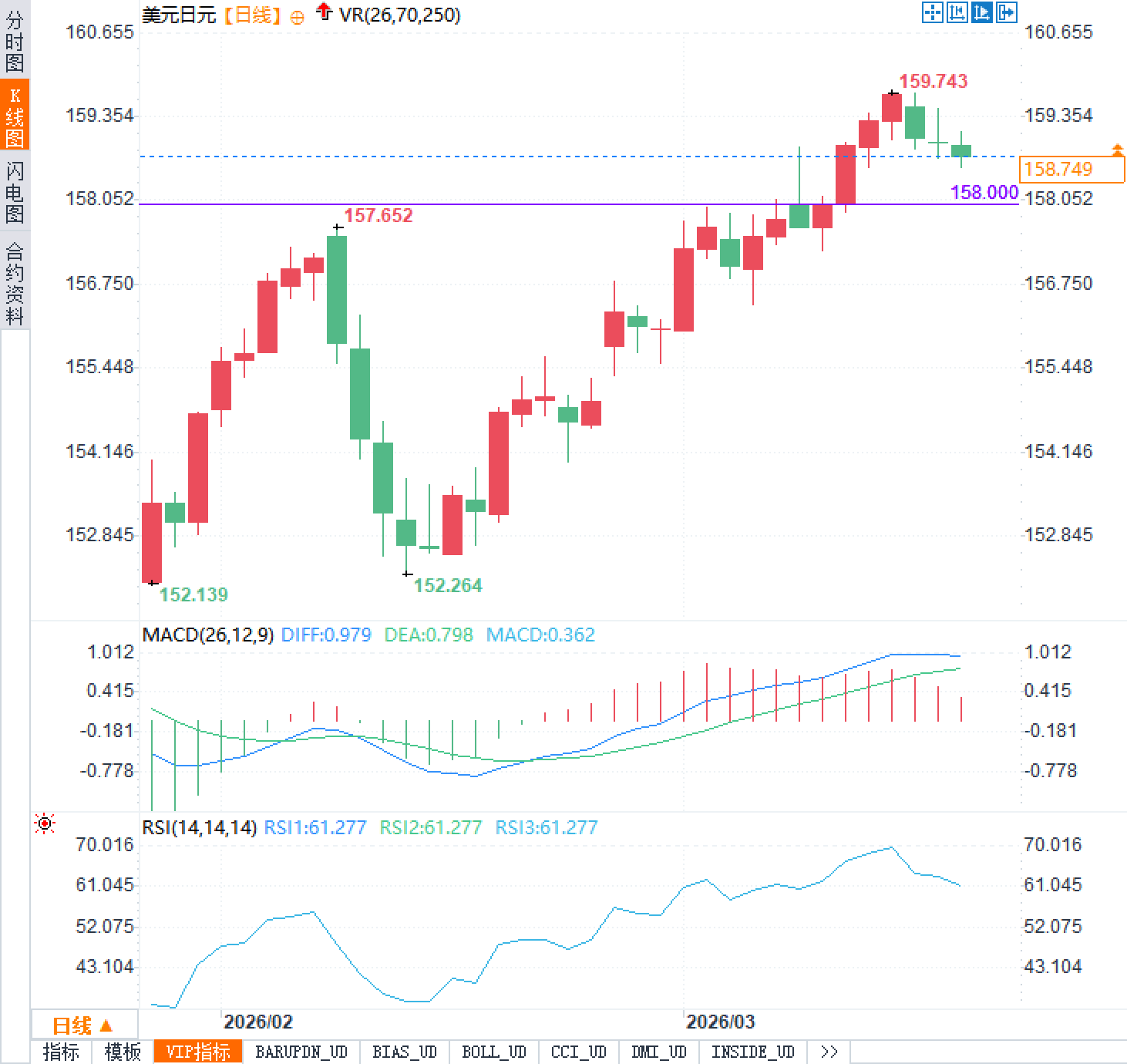
The USD/JPY exchange rate experienced increased volatility ahead of the Federal Reserve and Bank of Japan policy meetings. On Wednesday, March 18, USD/JPY traded in the 158.5-159.0 range, slightly lower than in previous days but still above 158. The yen strengthened for the third consecutive day, mainly due to increased market expectations of a hawkish signal from the Bank of Japan at this week's policy meeting. Continued geopolitical conflicts in the Middle East have pushed up oil prices, and escalating tensions related to Iran have exacerbated supply concerns, leading to higher global energy costs and further amplifying imported inflationary pressures in Japan. As an economy heavily reliant on Middle Eastern oil imports, rising oil prices directly increase core CPI expectations for Japan, reinforcing the necessity for the Bank of Japan to maintain its normalization path.
The USD/JPY pair recently retreated from above 159 to the 158.6-158.9 level, with the yen's gains primarily driven by bets on the Bank of Japan's (BOJ) policy meeting. The market expects the BOJ to maintain its short-term policy rate at 0.75% at this meeting, but Governor Kazuo Ueda may reinforce the possibility of a rate hike through forward guidance. Hawkish voices persist within the BOJ, with some board members emphasizing the need to prioritize addressing upside risks to inflation. Ueda recently stated publicly that core inflation is gradually accelerating towards the 2% target and is expected to stabilize around 2% between the second half of fiscal year 2026 and 2027. He stressed the need for sustainable inflation to be accompanied by wage growth, suggesting that if data supports this, the BOJ would not rule out a further rate hike in April. Oil prices surged due to the Middle East conflict, with Brent crude rising significantly recently, amplifying import cost pressures on Japan. The market infers that the BOJ may accelerate its exit from its ultra-loose monetary policy, thus supporting the yen.
Escalating tensions in the Middle East directly impact Japan's energy security. Japan's crude oil imports are highly concentrated in the Middle East, and the potential disruption of the Strait of Hormuz makes oil prices more likely to rise than fall. Rising oil prices push up import price indices, potentially causing core CPI to exceed expectations. The Bank of Japan needs to balance the dual pressures of slowing growth and accelerating inflation. Current oil price volatility has already widened the year-on-year increase in some import price indices, and coupled with the previous weakness of the yen, the imported inflation effect is stronger. This provides the Bank of Japan with a reason to maintain a hawkish stance, but also increases the difficulty of assessing downside risks to the economy. Japanese Prime Minister Sanae Takaichi will meet with the US President this week, and on the diplomatic front, energy security needs to be balanced. Trump previously mentioned Japan's participation in the Strait of Hormuz escort mission but subsequently withdrew, highlighting Tokyo's cautious stance between the US-Japan alliance and energy dependence.
Japan's exports grew 4.2% year-on-year in February, higher than the market expectation of 1.6%, but significantly slower than January's 16.8%, marking the sixth consecutive month of positive growth. While export momentum remains positive, it has weakened considerably, mainly due to fluctuations in Asian demand and the base effect from the previous month. January saw a surge, but the growth rate declined after returning to normal in February. Automobiles, industrial equipment, and electronic products remain the main export categories, but rising uncertainty in global demand casts doubt on future trends.
The following is a comparison of recent export growth rates (unit: %): month Year-on-year growth rate Market expectations January 16.8 Approximately 12.0 February 4.2 1.6
Direct drivers of the yen's rebound
The USD/JPY pair recently retreated from above 159 to the 158.6-158.9 level, with the yen's gains primarily driven by bets on the Bank of Japan's (BOJ) policy meeting. The market expects the BOJ to maintain its short-term policy rate at 0.75% at this meeting, but Governor Kazuo Ueda may reinforce the possibility of a rate hike through forward guidance. Hawkish voices persist within the BOJ, with some board members emphasizing the need to prioritize addressing upside risks to inflation. Ueda recently stated publicly that core inflation is gradually accelerating towards the 2% target and is expected to stabilize around 2% between the second half of fiscal year 2026 and 2027. He stressed the need for sustainable inflation to be accompanied by wage growth, suggesting that if data supports this, the BOJ would not rule out a further rate hike in April. Oil prices surged due to the Middle East conflict, with Brent crude rising significantly recently, amplifying import cost pressures on Japan. The market infers that the BOJ may accelerate its exit from its ultra-loose monetary policy, thus supporting the yen.
External geopolitical risks and energy price transmission
Escalating tensions in the Middle East directly impact Japan's energy security. Japan's crude oil imports are highly concentrated in the Middle East, and the potential disruption of the Strait of Hormuz makes oil prices more likely to rise than fall. Rising oil prices push up import price indices, potentially causing core CPI to exceed expectations. The Bank of Japan needs to balance the dual pressures of slowing growth and accelerating inflation. Current oil price volatility has already widened the year-on-year increase in some import price indices, and coupled with the previous weakness of the yen, the imported inflation effect is stronger. This provides the Bank of Japan with a reason to maintain a hawkish stance, but also increases the difficulty of assessing downside risks to the economy. Japanese Prime Minister Sanae Takaichi will meet with the US President this week, and on the diplomatic front, energy security needs to be balanced. Trump previously mentioned Japan's participation in the Strait of Hormuz escort mission but subsequently withdrew, highlighting Tokyo's cautious stance between the US-Japan alliance and energy dependence.
Export data performance and economic fundamentals
Japan's exports grew 4.2% year-on-year in February, higher than the market expectation of 1.6%, but significantly slower than January's 16.8%, marking the sixth consecutive month of positive growth. While export momentum remains positive, it has weakened considerably, mainly due to fluctuations in Asian demand and the base effect from the previous month. January saw a surge, but the growth rate declined after returning to normal in February. Automobiles, industrial equipment, and electronic products remain the main export categories, but rising uncertainty in global demand casts doubt on future trends.
The following is a comparison of recent export growth rates (unit: %):
Frequently Asked Questions
Question 1: Why does the Middle East conflict support a stronger yen?
A: Japan is highly dependent on Middle Eastern crude oil imports, and the conflict has pushed up oil prices, directly amplifying imported inflationary pressures. The Bank of Japan faces higher inflation risks, and the market expects it to accelerate its policy normalization path, including strengthening its interest rate hike signals. This provides support for the yen against the dollar. Although short-term growth risks have increased, the inflation-first logic dominates foreign exchange pricing. For every 10% increase in oil prices, Japan's core CPI could rise by an additional 0.3-0.5 percentage points.
Question 2: What is the probability of the Bank of Japan raising interest rates at this meeting? What impact will this have on the yen?
A: The market expects the interest rate to remain unchanged at 0.75% at this meeting. However, Kazuo Ueda's recent remarks emphasized that inflation is accelerating towards 2% and that he will use data as a basis for rate hikes. The market assesses the probability of a rate hike in April in the 30%-40% range. If the meeting statement or press conference reinforces the hawkish tone of "acting according to data," the yen may rebound further to the 157-158 range; conversely, if it downplays inflation risks, the yen will come under pressure and fall back to around 160. Traders should pay attention to Ueda's post-meeting remarks regarding the weighting of the wage-price cycle and geopolitical risks.
Question 3: February's export data exceeded expectations but slowed down. What does this mean for the medium-term trend of the Japanese yen?
A: While the 4.2% growth rate exceeded expectations, it was a significant drop from January, indicating a marginal weakening of export momentum. Global demand uncertainty and base effects are contributing factors; however, the current yen rebound is mainly driven by policy expectations and oil price inflation, rather than exports themselves. In the medium term, if the Bank of Japan maintains a hawkish stance, coupled with high oil prices, the yen may gradually recover from its previous overvaluation; if geopolitical risks ease or global growth deteriorates, weak exports will amplify downward pressure on the yen. Traders are focusing on the correlation between subsequent trade data and oil prices.
- Risk Warning and Disclaimer
- The market involves risk, and trading may not be suitable for all investors. This article is for reference only and does not constitute personal investment advice, nor does it take into account certain users’ specific investment objectives, financial situation, or other needs. Any investment decisions made based on this information are at your own risk.