The Bank of Canada is likely to keep interest rates unchanged and remain cautious, with oil price fluctuations driven by the Iranian conflict dominating the Canadian dollar and yields.
2026-03-18 15:33:05
According to APP, TD Securities strategists expect the Bank of Canada to keep its overnight interest rate unchanged at 2.25% and adopt a cautious tone, as both economic growth and inflation are lower than the central bank's previous forecasts. They particularly emphasized the significantly increased uncertainty and new inflation risks from the conflict in Iran and higher oil prices. Oil price volatility is considered a major driver of near-term Canadian yields.

Strategists further pointed out that policy will remain on hold, and any dovish statements will need to be balanced with an acknowledgment of new inflation risks. Oil price volatility will continue to dominate near- and short-term yield movements, and the Bank of Canada is expected to wait longer to address the continued rise in uncertainty. Ahead of the meeting, they favor shorting the Canada-US 10-year Treasury spread and positioning for 3s5s swap spread narrowing trades. Meanwhile, market focus will remain on geopolitical dynamics, and the Canadian dollar is expected to outperform other major currencies (except the US dollar) due to its positive correlation with high oil prices and its low beta in response to risk aversion.
The latest market data shows that as of March 2026, the Bank of Canada's overnight interest rate has stabilized at 2.25%. This week's meeting reached a consensus to keep it unchanged, and the market's pricing for the next action has been postponed to the second half of the year. Oil price fluctuations have become the core variable in the short-term pricing of the yield curve.
To clearly compare the policy paths and their multi-dimensional impacts, the following table presents key indicators (including interest rate levels, tone and positioning, inflation risk transmission, oil price driving effects, Canadian dollar outlook, yield, and geopolitical scenario assumptions):
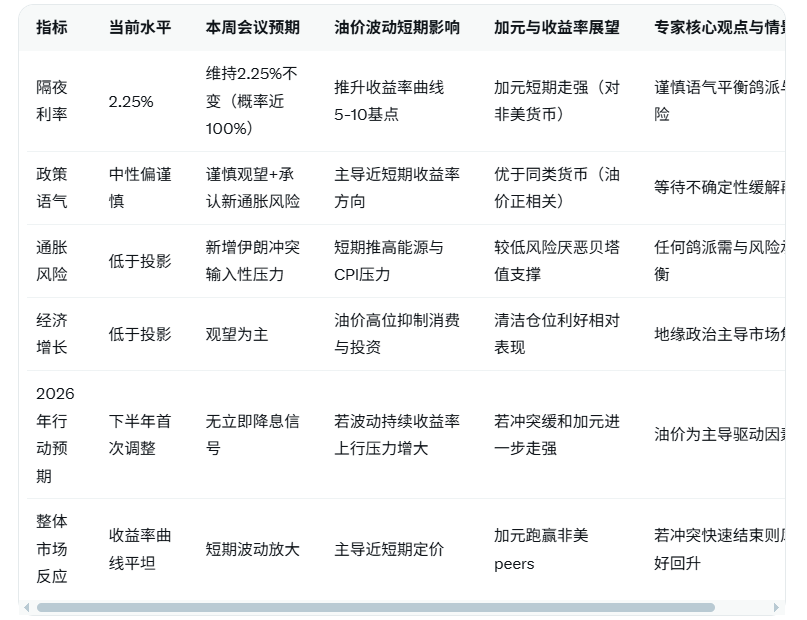
From an in-depth analysis perspective, the Iranian conflict has directly driven up global oil prices. While Canada, as an energy exporter, has benefited from the price increase, the risks of imported inflation and supply chain uncertainties have significantly exceeded the central bank's previous forecasts. TD Securities strategists emphasize that with both economic growth and inflation below their projected levels, the Bank of Canada 's cautious wait-and-see approach rather than immediate easing is precisely to avoid amplifying volatility with premature dovish signals. It is reasonable to speculate that if oil prices remain high, the daily yield curve may shift upward by 5-10 basis points, and the Canadian dollar, with its positive correlation to oil prices and low risk-averse beta, will continue to outperform currencies such as the euro and the pound. Conversely, if the conflict eases in mid-to-late April, yield pressures will quickly ease, and the advantage of clean market positioning will further amplify the Canadian dollar's gains.
On the other hand, global geopolitical focus continues to dominate market narratives, and the Bank of Canada is expected to reinforce its "wait and see" signal in its statement, leaving room for further gradual adjustments. Traders generally believe that if oil price volatility persists, yields will be under short-term pressure, but the Canadian dollar's relative resilience will continue, providing a clear risk-reward framework for fixed-income and foreign exchange investors.
Editor's Summary : While the Iranian conflict and oil price volatility have increased uncertainty, the Bank of Canada 's cautious decision to maintain its 2.25% interest rate has shaped a dynamic balance between short-term yields and the exchange rate. Future trends will depend on the pace of the conflict's evolution and the actual strength of the oil price transmission; market participants need to continuously monitor geopolitical developments and communicate details with the central bank.
Frequently Asked Questions
Q1: Why does the Bank of Canada expect to keep the overnight rate unchanged at 2.25% and use a cautious tone?
A: TD Securities strategists point out that both economic growth and inflation are already below central bank projections, coupled with new uncertainties brought about by the Iranian conflict. Policymakers need to remain cautious to avoid signaling premature easing. The statement will balance any dovish elements with an acknowledgment of new inflation risks, ensuring market expectations are not misled, while leaving room for subsequent data verification. This cautious stance is the optimal choice under the current macroeconomic environment.
Q2: How have the conflict in Iran and oil price volatility become the main drivers of near-term yields?
A: The conflict directly amplifies energy price volatility, pushing up Canadian inflation expectations through imported channels, thereby affecting the yield curve. Strategists have clearly stated that oil price volatility will dominate near-term pricing; if it remains high, yields could rise by 5-10 basis points; conversely, a easing of tensions would quickly release pressure. This driver far exceeds traditional domestic data and has become the market's short-term focus.
Q3: Why is the Canadian dollar expected to outperform other major currencies (except the US dollar)?
A: The Canadian dollar's positive correlation with high oil prices and its low risk-averse beta both support its relative strength. Amidst geopolitical focus, its energy-exporting nature makes the Canadian dollar more resilient in a risk-averse environment, and it is expected to continue outperforming similar currencies such as the euro and pound sterling, creating a short-term advantage window.
Q4: If the conflict with Iran eases quickly, what changes will occur in Canadian yields and the Canadian dollar?
A: Easing will quickly alleviate the pressure of oil price volatility, the yield curve will fall, the central bank's wait-and-see attitude may gradually shift to a more moderate stance, and opportunities for profit-taking in carry trades will emerge; although the Canadian dollar benefits in the short term from its positive correlation with oil prices, the overall recovery in risk appetite will support its continued outperformance of non-US dollar currencies.
Strategists further pointed out that policy will remain on hold, and any dovish statements will need to be balanced with an acknowledgment of new inflation risks. Oil price volatility will continue to dominate near- and short-term yield movements, and the Bank of Canada is expected to wait longer to address the continued rise in uncertainty. Ahead of the meeting, they favor shorting the Canada-US 10-year Treasury spread and positioning for 3s5s swap spread narrowing trades. Meanwhile, market focus will remain on geopolitical dynamics, and the Canadian dollar is expected to outperform other major currencies (except the US dollar) due to its positive correlation with high oil prices and its low beta in response to risk aversion.
The latest market data shows that as of March 2026, the Bank of Canada's overnight interest rate has stabilized at 2.25%. This week's meeting reached a consensus to keep it unchanged, and the market's pricing for the next action has been postponed to the second half of the year. Oil price fluctuations have become the core variable in the short-term pricing of the yield curve.
To clearly compare the policy paths and their multi-dimensional impacts, the following table presents key indicators (including interest rate levels, tone and positioning, inflation risk transmission, oil price driving effects, Canadian dollar outlook, yield, and geopolitical scenario assumptions):
From an in-depth analysis perspective, the Iranian conflict has directly driven up global oil prices. While Canada, as an energy exporter, has benefited from the price increase, the risks of imported inflation and supply chain uncertainties have significantly exceeded the central bank's previous forecasts. TD Securities strategists emphasize that with both economic growth and inflation below their projected levels, the Bank of Canada 's cautious wait-and-see approach rather than immediate easing is precisely to avoid amplifying volatility with premature dovish signals. It is reasonable to speculate that if oil prices remain high, the daily yield curve may shift upward by 5-10 basis points, and the Canadian dollar, with its positive correlation to oil prices and low risk-averse beta, will continue to outperform currencies such as the euro and the pound. Conversely, if the conflict eases in mid-to-late April, yield pressures will quickly ease, and the advantage of clean market positioning will further amplify the Canadian dollar's gains.
On the other hand, global geopolitical focus continues to dominate market narratives, and the Bank of Canada is expected to reinforce its "wait and see" signal in its statement, leaving room for further gradual adjustments. Traders generally believe that if oil price volatility persists, yields will be under short-term pressure, but the Canadian dollar's relative resilience will continue, providing a clear risk-reward framework for fixed-income and foreign exchange investors.
Editor's Summary : While the Iranian conflict and oil price volatility have increased uncertainty, the Bank of Canada 's cautious decision to maintain its 2.25% interest rate has shaped a dynamic balance between short-term yields and the exchange rate. Future trends will depend on the pace of the conflict's evolution and the actual strength of the oil price transmission; market participants need to continuously monitor geopolitical developments and communicate details with the central bank.
Frequently Asked Questions
Q1: Why does the Bank of Canada expect to keep the overnight rate unchanged at 2.25% and use a cautious tone?
A: TD Securities strategists point out that both economic growth and inflation are already below central bank projections, coupled with new uncertainties brought about by the Iranian conflict. Policymakers need to remain cautious to avoid signaling premature easing. The statement will balance any dovish elements with an acknowledgment of new inflation risks, ensuring market expectations are not misled, while leaving room for subsequent data verification. This cautious stance is the optimal choice under the current macroeconomic environment.
Q2: How have the conflict in Iran and oil price volatility become the main drivers of near-term yields?
A: The conflict directly amplifies energy price volatility, pushing up Canadian inflation expectations through imported channels, thereby affecting the yield curve. Strategists have clearly stated that oil price volatility will dominate near-term pricing; if it remains high, yields could rise by 5-10 basis points; conversely, a easing of tensions would quickly release pressure. This driver far exceeds traditional domestic data and has become the market's short-term focus.
Q3: Why is the Canadian dollar expected to outperform other major currencies (except the US dollar)?
A: The Canadian dollar's positive correlation with high oil prices and its low risk-averse beta both support its relative strength. Amidst geopolitical focus, its energy-exporting nature makes the Canadian dollar more resilient in a risk-averse environment, and it is expected to continue outperforming similar currencies such as the euro and pound sterling, creating a short-term advantage window.
Q4: If the conflict with Iran eases quickly, what changes will occur in Canadian yields and the Canadian dollar?
A: Easing will quickly alleviate the pressure of oil price volatility, the yield curve will fall, the central bank's wait-and-see attitude may gradually shift to a more moderate stance, and opportunities for profit-taking in carry trades will emerge; although the Canadian dollar benefits in the short term from its positive correlation with oil prices, the overall recovery in risk appetite will support its continued outperformance of non-US dollar currencies.
- Risk Warning and Disclaimer
- The market involves risk, and trading may not be suitable for all investors. This article is for reference only and does not constitute personal investment advice, nor does it take into account certain users’ specific investment objectives, financial situation, or other needs. Any investment decisions made based on this information are at your own risk.