Concerns about a protracted war with Iran intensify; Standard Chartered raises its 2026-2027 Brent crude oil average price forecast.
2026-03-18 13:40:00
The EU's refusal to militarily intervene in the Strait of Hormuz highlights Europe's cautious stance against involvement in war. Standard Chartered significantly raised its 2026-2027 oil price forecasts, indicating growing market concerns about a protracted conflict. The IEA's largest-ever reserve release may provide a short-term floor for oil prices, but structural supply disruptions and natural gas production cuts are triggering severe volatility in the global energy market. Major Asian importers are accelerating their transition to coal and nuclear power, demonstrating that energy security is becoming a core consideration in geopolitical conflicts.
Amid escalating tensions between the US, Israel, and Iran in the Middle East, and with shipping in the Strait of Hormuz nearly paralyzed, EU foreign ministers on Monday (March 16) collectively rejected US President Trump's proposal to send European countries to participate in escort missions. The EU only expressed its willingness to further strengthen the security of its military bases in the region, but declined to directly engage in military operations.
European leaders have made it clear they do not want to be dragged into a war. German Defense Minister Boris Pistorius stated, "This is not our war. We did not start it." He added, "What exactly does Trump expect a few European frigates to do in the Strait of Hormuz that the powerful US navy cannot?" This statement reflects Europe's cautious and reserved attitude in the face of US pressure.
In contrast to the EU's refusal to intervene militarily, a recent report from Standard Chartered's energy and commodities analysts indicates that oil prices will remain high for longer than previously expected due to the lack of a clear "exit path" for the conflict.
The bank has significantly raised its forecasts: the average price of Brent crude oil in 2026 has been revised upward from $70 per barrel to $85.50 per barrel; and the 2027 forecast has been revised upward from $67 per barrel to $77.50 per barrel.
The report predicts that oil prices will follow a trend of high first and low in 2026: an average of $78 per barrel in the first quarter, $98 per barrel in the second quarter, $85 per barrel in the third quarter, and $80.50 per barrel in the fourth quarter.
Nevertheless, Standard Chartered believes that the downside for oil prices is limited, mainly because the Middle East war has reduced global oil supply by 7.4-8.2 million barrels per day, including a reduction of 2.9 million barrels per day in Iraq, 2-2.5 million barrels per day in Saudi Arabia, 0.5-0.8 million barrels per day in the UAE, 0.5 million barrels per day in Qatar and Kuwait, and 0.5 million barrels per day in Iran, with Iranian production 1 million barrels per day lower than before the war.
The report points out that all exports that cannot bypass the Strait of Hormuz have been diverted, and unless the blockade is eased, global oil supply is unlikely to increase significantly. Saudi Arabia is using temporary capacity expansion of its East-West pipeline to increase shipments to the Red Sea to 7 million barrels per day to partially alleviate the pressure.
Last week, the International Energy Agency announced that its 32 member countries had coordinated the release of 411.9 million barrels of oil reserves, the largest release in the agency's history, far exceeding the 182 million barrels released after the Russia-Ukraine conflict in 2022.
Standard Chartered believes this release is a double-edged sword: while increasing market supply in the short term, it also signals an "extremely serious situation," potentially strengthening long-term price support. The structural demand for subsequent replenishment of reserves may provide a floor for oil prices at the mid-to-low $70 level.
The natural gas market was also severely impacted. Two weeks ago, Iranian drone strikes at Qatar's Ras Laffan and Mesaieed facilities led Qatar Energy to declare force majeure and suspend liquefied natural gas (LNG) production, affecting an annual capacity of 77 million tons, representing approximately 20% of global LNG supply.
The disruption to shipping through the Strait of Hormuz has further cut off approximately 20% of global LNG supply, triggering sharp fluctuations in global gas prices. On Tuesday, European natural gas futures remained above €50 per megawatt-hour, nearly 30% higher than the 12-month average.
Standard Chartered points out that Qatar's LNG exports rely almost entirely on the Ras Lafan facility and must pass through the narrow Strait of Hormuz, exposing its structural vulnerability. The inability to find a substitute for Qatar's LNG in the short term has led to a significant increase in gas price volatility.
Major Asian LNG importers are actively adjusting their power generation structures, shifting towards coal and nuclear power, in order to manage limited LNG supply, reduce dependence on volatile spot markets, and safeguard energy security.
Asian giants are increasing domestic natural gas production, pipeline imports (particularly from Russia), and boosting coal and nuclear power production in an effort to reduce their reliance on imported LNG.
A major Asian power holds the most long-term LNG contracts globally.
Japanese utilities are prioritizing coal-fired power generation and accelerating the restart of nuclear reactors to conserve natural gas reserves, with some operators significantly increasing the operating load of their coal-fired units to near full capacity. Japan's long-term plan aims to achieve a 20% share of nuclear power by 2040.
South Korea, on the other hand, relaxed restrictions on coal-fired power generation and increased the utilization rate of nuclear power to 80% in order to cope with soaring energy costs.
In the coming months, whether the conflict de-escalates, the speed at which cross-strait traffic resumes, and the strength of coordination among major powers will directly determine global energy price trends and the prospects for economic recovery. Investors need to be highly vigilant about the cascading impacts of high oil and gas price volatility on inflation, supply chains, and monetary policy. This round of the Middle East crisis has evolved from a regional conflict into a major turning point for global energy and economic security.
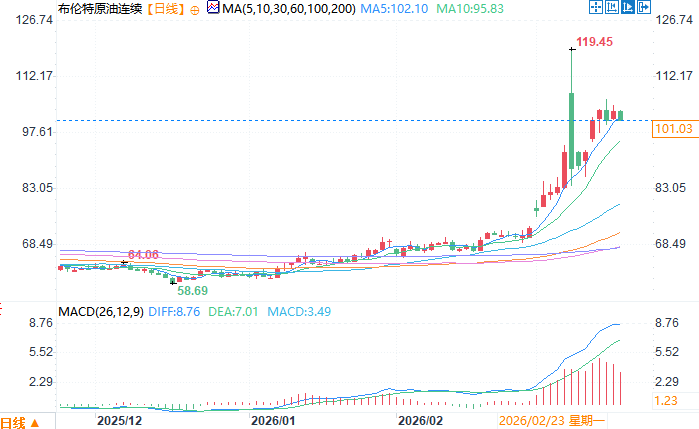
Brent crude oil daily chart source: EasyForex
At 13:39 Beijing time on March 18, Brent crude oil futures were trading at $101.03 per barrel.
Europe refuses to provide escort in the Strait of Hormuz
Amid escalating tensions between the US, Israel, and Iran in the Middle East, and with shipping in the Strait of Hormuz nearly paralyzed, EU foreign ministers on Monday (March 16) collectively rejected US President Trump's proposal to send European countries to participate in escort missions. The EU only expressed its willingness to further strengthen the security of its military bases in the region, but declined to directly engage in military operations.
European leaders have made it clear they do not want to be dragged into a war. German Defense Minister Boris Pistorius stated, "This is not our war. We did not start it." He added, "What exactly does Trump expect a few European frigates to do in the Strait of Hormuz that the powerful US navy cannot?" This statement reflects Europe's cautious and reserved attitude in the face of US pressure.
With expectations of persistently high oil prices rising, Standard Chartered has significantly raised its 2026-2027 Brent crude oil average price forecast.
In contrast to the EU's refusal to intervene militarily, a recent report from Standard Chartered's energy and commodities analysts indicates that oil prices will remain high for longer than previously expected due to the lack of a clear "exit path" for the conflict.
The bank has significantly raised its forecasts: the average price of Brent crude oil in 2026 has been revised upward from $70 per barrel to $85.50 per barrel; and the 2027 forecast has been revised upward from $67 per barrel to $77.50 per barrel.
The report predicts that oil prices will follow a trend of high first and low in 2026: an average of $78 per barrel in the first quarter, $98 per barrel in the second quarter, $85 per barrel in the third quarter, and $80.50 per barrel in the fourth quarter.
Nevertheless, Standard Chartered believes that the downside for oil prices is limited, mainly because the Middle East war has reduced global oil supply by 7.4-8.2 million barrels per day, including a reduction of 2.9 million barrels per day in Iraq, 2-2.5 million barrels per day in Saudi Arabia, 0.5-0.8 million barrels per day in the UAE, 0.5 million barrels per day in Qatar and Kuwait, and 0.5 million barrels per day in Iran, with Iranian production 1 million barrels per day lower than before the war.
The report points out that all exports that cannot bypass the Strait of Hormuz have been diverted, and unless the blockade is eased, global oil supply is unlikely to increase significantly. Saudi Arabia is using temporary capacity expansion of its East-West pipeline to increase shipments to the Red Sea to 7 million barrels per day to partially alleviate the pressure.
The International Energy Agency's largest-ever release of strategic reserves may provide a short-term bottom at the low to mid-range of $70.
Last week, the International Energy Agency announced that its 32 member countries had coordinated the release of 411.9 million barrels of oil reserves, the largest release in the agency's history, far exceeding the 182 million barrels released after the Russia-Ukraine conflict in 2022.
Standard Chartered believes this release is a double-edged sword: while increasing market supply in the short term, it also signals an "extremely serious situation," potentially strengthening long-term price support. The structural demand for subsequent replenishment of reserves may provide a floor for oil prices at the mid-to-low $70 level.
The natural gas market also experienced a major shock, with Qatar's LNG production capacity of 77 million tons per year being disrupted.
The natural gas market was also severely impacted. Two weeks ago, Iranian drone strikes at Qatar's Ras Laffan and Mesaieed facilities led Qatar Energy to declare force majeure and suspend liquefied natural gas (LNG) production, affecting an annual capacity of 77 million tons, representing approximately 20% of global LNG supply.
The disruption to shipping through the Strait of Hormuz has further cut off approximately 20% of global LNG supply, triggering sharp fluctuations in global gas prices. On Tuesday, European natural gas futures remained above €50 per megawatt-hour, nearly 30% higher than the 12-month average.
Standard Chartered points out that Qatar's LNG exports rely almost entirely on the Ras Lafan facility and must pass through the narrow Strait of Hormuz, exposing its structural vulnerability. The inability to find a substitute for Qatar's LNG in the short term has led to a significant increase in gas price volatility.
Major Asian LNG importers are actively adjusting their power generation structures, shifting towards coal and nuclear power, in order to manage limited LNG supply, reduce dependence on volatile spot markets, and safeguard energy security.
Asian countries are accelerating their reduction of reliance on LNG, with coal and nuclear power emerging as alternatives.
Asian giants are increasing domestic natural gas production, pipeline imports (particularly from Russia), and boosting coal and nuclear power production in an effort to reduce their reliance on imported LNG.
A major Asian power holds the most long-term LNG contracts globally.
Japanese utilities are prioritizing coal-fired power generation and accelerating the restart of nuclear reactors to conserve natural gas reserves, with some operators significantly increasing the operating load of their coal-fired units to near full capacity. Japan's long-term plan aims to achieve a 20% share of nuclear power by 2040.
South Korea, on the other hand, relaxed restrictions on coal-fired power generation and increased the utilization rate of nuclear power to 80% in order to cope with soaring energy costs.
In the coming months, whether the conflict de-escalates, the speed at which cross-strait traffic resumes, and the strength of coordination among major powers will directly determine global energy price trends and the prospects for economic recovery. Investors need to be highly vigilant about the cascading impacts of high oil and gas price volatility on inflation, supply chains, and monetary policy. This round of the Middle East crisis has evolved from a regional conflict into a major turning point for global energy and economic security.
Brent crude oil daily chart source: EasyForex
At 13:39 Beijing time on March 18, Brent crude oil futures were trading at $101.03 per barrel.
- Risk Warning and Disclaimer
- The market involves risk, and trading may not be suitable for all investors. This article is for reference only and does not constitute personal investment advice, nor does it take into account certain users’ specific investment objectives, financial situation, or other needs. Any investment decisions made based on this information are at your own risk.