Tonight's decision! Conflicting data, uncertain market direction—will the Canadian dollar rise or fall?
2026-03-18 17:47:21
On Wednesday, March 18th, the market expects the Bank of Canada to maintain its overnight target rate at 2.25% at 21:45, continuing the policy pause that began in January. Traders are closely watching the fundamental logic and geopolitical risk implications behind this decision. Increased global uncertainty, particularly the disruption of energy supplies caused by Middle East geopolitical conflicts, has led to a significant rise in crude oil prices, pushing them above $100 per barrel. This has a dual effect on Canada's economy as a major oil exporter: on the one hand, it pushes up inflation expectations, and on the other hand, it supports exports and economic growth.
Meanwhile, the USD/CAD exchange rate hovered around 1.3690, reflecting the market's overall pricing in trade uncertainty and weak domestic data. The February jobs report showed a net loss of 83,900 jobs, with the unemployment rate rising to 6.7%, a rare sharp decline since the pandemic. The February CPI fell to 1.8% year-on-year, and core indicators such as the trimmed mean CPI fell to 2.3% year-on-year, indicating an easing of overall inflationary pressures. However, a rebound in energy prices could reverse this trend in subsequent months. The Bank of Canada may choose to remain on the sidelines tonight, emphasizing that the neutral interest rate range remains at 2.25%-3.25%, indicating that policymakers are relatively satisfied with the current positioning while remaining vigilant against external shocks.
The following is a comparison of key indicators:
Data indicates that inflation has fallen back to near the target level and the labor market is showing clear signs of easing, giving the central bank room to make adjustments without rushing into them.
Escalating geopolitical conflicts in the Middle East and the risk of supply disruptions in the Strait of Hormuz have driven up international oil prices, with Brent crude recently breaking through the $100/barrel mark and WTI following suit. This presents a stark contrast for the Canadian economy: as a major global oil exporter, rising energy prices directly benefit the trade balance and growth in resource-rich provinces, potentially supporting 2026 GDP forecasts. However, rising imported energy costs and transportation expenses could also transmit to core inflation, particularly in the gasoline and food chains. The central bank needs to weigh this dual impact and is more inclined to observe than pre-emptively adjust in the short term. Governor Tiff Markram previously emphasized that structural adjustments will take several years, and that trade uncertainty and energy volatility are both external shocks; policy should remain flexible to address potential divergences. The market should pay attention to subsequent CPI reports; if the energy surge continues, core indicators may return to an upward trend.
The Bank of Canada's latest outlook projects average GDP growth of around 1.1% in 2026, slightly weaker than previous forecasts. Fourth-quarter growth is expected to plateau with no significant increase, reflecting a cooling labor market and dragging down by external uncertainties. Potential output growth is constrained by demographics and productivity, and structural changes will require a long period to digest. The Bank of Canada maintains its neutral interest rate estimate at 2.25%-3.25%, suggesting that the current 2.25% level is in the lower-neutral range, providing a buffer against downside risks. Policy space remains available should the labor market deteriorate further, but the current priority is to confirm a sustainable inflation target. Traders should pay attention to leading indicators such as employment and PMI, which will determine the probability of a policy shift in the second half of the year.
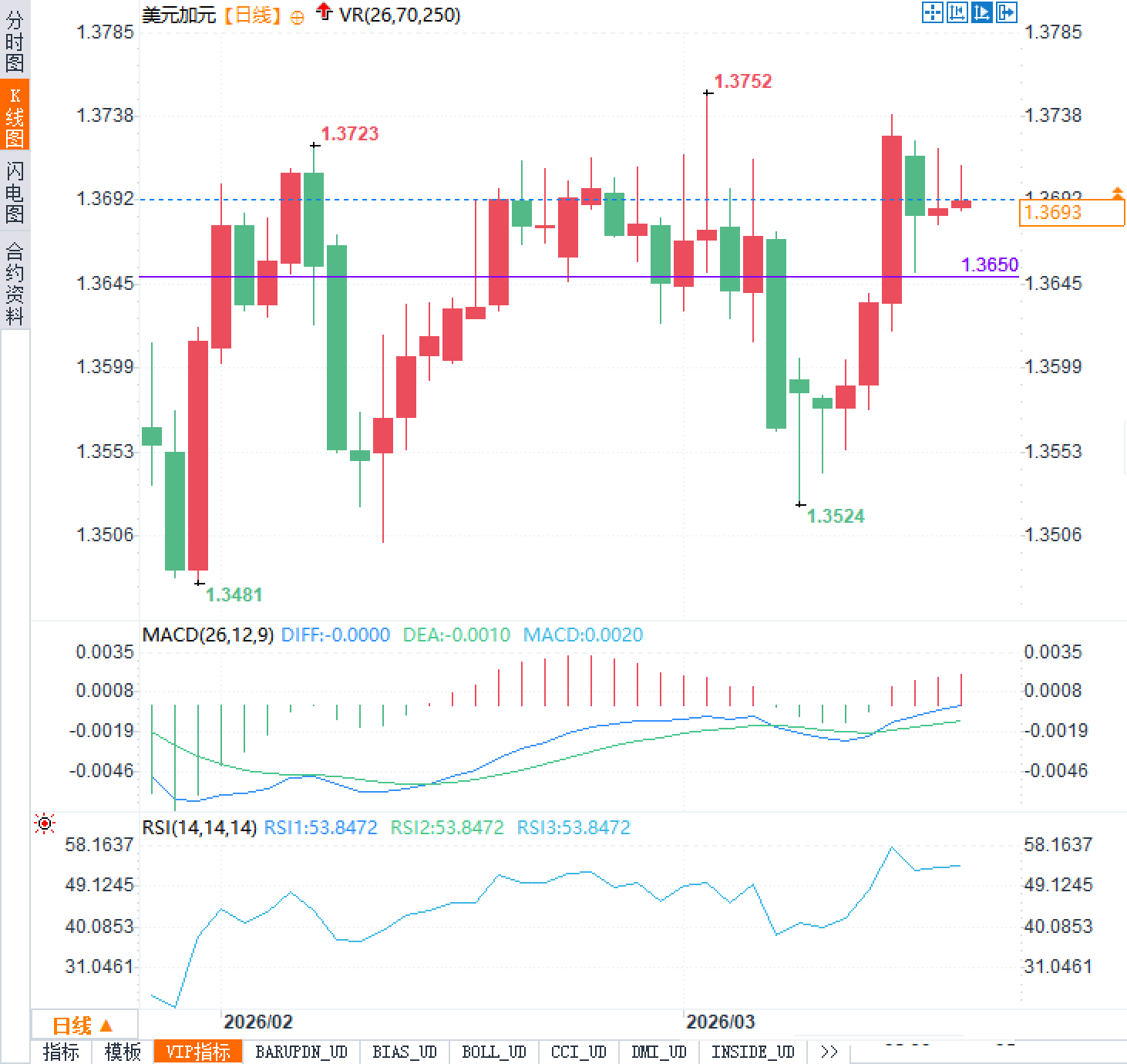
Meanwhile, the USD/CAD exchange rate hovered around 1.3690, reflecting the market's overall pricing in trade uncertainty and weak domestic data. The February jobs report showed a net loss of 83,900 jobs, with the unemployment rate rising to 6.7%, a rare sharp decline since the pandemic. The February CPI fell to 1.8% year-on-year, and core indicators such as the trimmed mean CPI fell to 2.3% year-on-year, indicating an easing of overall inflationary pressures. However, a rebound in energy prices could reverse this trend in subsequent months. The Bank of Canada may choose to remain on the sidelines tonight, emphasizing that the neutral interest rate range remains at 2.25%-3.25%, indicating that policymakers are relatively satisfied with the current positioning while remaining vigilant against external shocks.
The following is a comparison of key indicators:
| index | Latest value (February 2026) | Previous value | Bank of Canada target/neutral range |
|---|---|---|---|
| Overnight target rate | 2.25% | 2.25% | Neutral range: 2.25%-3.25% |
| CPI year-on-year | 1.8% | 2.3% | 2% |
| Trimming the mean CPI year-on-year | 2.3% | 2.4% | Close to 2% |
| unemployment rate | 6.7% | 6.5% | - |
| Net employment change | -83,900 | -24,800 | - |
Data indicates that inflation has fallen back to near the target level and the labor market is showing clear signs of easing, giving the central bank room to make adjustments without rushing into them.
The double-edged sword effect of geopolitical risks and energy prices
Escalating geopolitical conflicts in the Middle East and the risk of supply disruptions in the Strait of Hormuz have driven up international oil prices, with Brent crude recently breaking through the $100/barrel mark and WTI following suit. This presents a stark contrast for the Canadian economy: as a major global oil exporter, rising energy prices directly benefit the trade balance and growth in resource-rich provinces, potentially supporting 2026 GDP forecasts. However, rising imported energy costs and transportation expenses could also transmit to core inflation, particularly in the gasoline and food chains. The central bank needs to weigh this dual impact and is more inclined to observe than pre-emptively adjust in the short term. Governor Tiff Markram previously emphasized that structural adjustments will take several years, and that trade uncertainty and energy volatility are both external shocks; policy should remain flexible to address potential divergences. The market should pay attention to subsequent CPI reports; if the energy surge continues, core indicators may return to an upward trend.
Economic growth path and neutral interest rate assessment
The Bank of Canada's latest outlook projects average GDP growth of around 1.1% in 2026, slightly weaker than previous forecasts. Fourth-quarter growth is expected to plateau with no significant increase, reflecting a cooling labor market and dragging down by external uncertainties. Potential output growth is constrained by demographics and productivity, and structural changes will require a long period to digest. The Bank of Canada maintains its neutral interest rate estimate at 2.25%-3.25%, suggesting that the current 2.25% level is in the lower-neutral range, providing a buffer against downside risks. Policy space remains available should the labor market deteriorate further, but the current priority is to confirm a sustainable inflation target. Traders should pay attention to leading indicators such as employment and PMI, which will determine the probability of a policy shift in the second half of the year.
Frequently Asked Questions
Question 1: Why might the Bank of Canada choose to keep interest rates unchanged despite falling inflation and rising energy prices?
A: The CPI fell to 1.8% year-on-year in February, and the core trimmed mean and other indicators dropped to 2.3%, indicating that underlying inflationary pressures are easing. The easing of the labor market (unemployment rate rose to 6.7%, and employment plummeted by 83,900) further weakened demand-side momentum. The central bank prefers to "see through" short-term energy-driven inflationary pulses rather than react immediately, in order to avoid excessive policy tightening that could suppress the already slowing economy. While geopolitical risks have boosted oil prices, Canada, as a net oil exporter, has partially offset the negative impacts. Policymakers prioritize maintaining the current neutral stance and closely monitor subsequent data developments.
Question 2: What does the current USD/CAD pair fluctuating around 1.3690 mean for traders?
A: The weakness of the Canadian dollar reflects the market's overall pricing in trade uncertainty, a weak labor market, and global risk appetite. Rising energy prices should have supported the Canadian dollar, but geopolitical conflicts and trade frictions dominated sentiment, preventing the Canadian dollar from benefiting significantly. The central bank's potential for a stable policy reinforces expectations of a wait-and-see approach, and short-term fluctuations may be dominated by energy prices and the USD/Canadian interest rate differential.
Question 3: With a weak economic growth outlook for 2026, will the central bank shift to an easing stance?
A: The central bank expects GDP growth of 1.1% in 2026, flattening out in the fourth quarter, with structural adjustments and external uncertainties dragging down potential output. Current interest rates are at the lower end of the neutral range, providing a buffer. If the labor market continues to deteriorate and inflation remains anchored to the target, policy may gradually shift towards supporting growth. However, policymakers emphasize the need for more evidence to confirm the path, making a stable stance more likely in the short term. Traders are focusing on the evolution of employment, inflation, and geopolitical events, which will determine the timing and magnitude of any shift.
- Risk Warning and Disclaimer
- The market involves risk, and trading may not be suitable for all investors. This article is for reference only and does not constitute personal investment advice, nor does it take into account certain users’ specific investment objectives, financial situation, or other needs. Any investment decisions made based on this information are at your own risk.