With the Bank of Canada stabilizing the Canadian dollar, the last line of defense for Canadian dollar bulls has been targeted. Will 1.3650 be the bottom line?
2026-03-18 21:54:29
On Wednesday (March 18), the Bank of Canada (BoC) announced its latest interest rate decision, maintaining the overnight rate target at 2.25%, the bank rate at 2.5%, and the deposit rate at 2.20%. This decision was in line with mainstream market expectations, but in the subsequent policy statement, policymakers' concerns about economic growth and vigilance against inflation risks formed a complex macroeconomic backdrop.

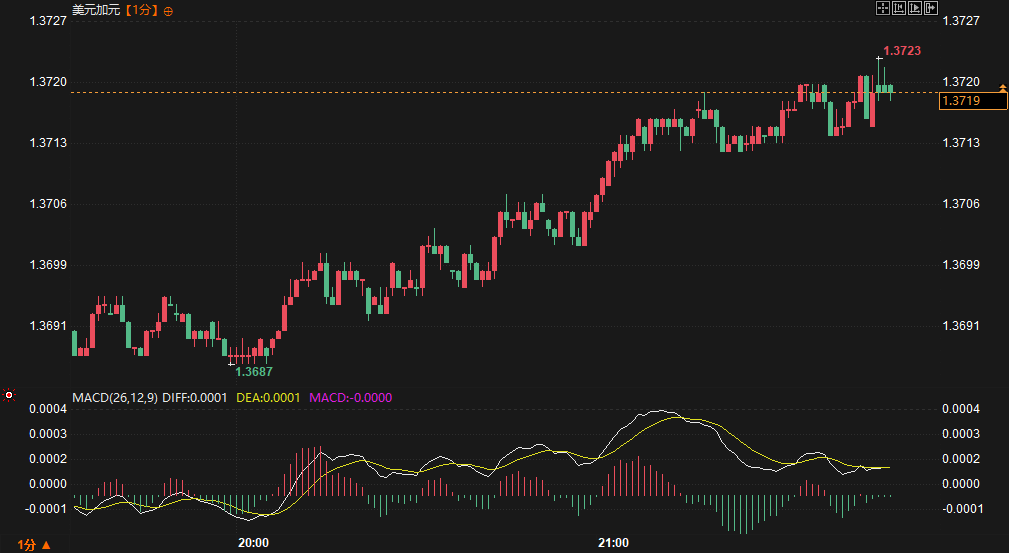
Prior to the policy decision, the USD/CAD pair traded in a narrow range as market participants awaited guidance on the policy tone. Immediately after the data release, the USD/CAD pair fluctuated by about 5 points, currently trading at 1.3720. Despite the unchanged interest rate, the Bank of Canada clearly stated that recent data suggests Canadian short-term economic growth will be weaker than expected in January.
Looking back at historical trends, the Canadian dollar has been under pressure from both geopolitical premiums and trade policy uncertainty over the past quarter. Canada's GDP grew by 2.4% in the third quarter of last year, but unexpectedly contracted by 0.6% in the fourth quarter, a correction exceeding even the most pessimistic market forecasts. Although the Bank of Canada attributed this to reduced inventories, the weakening labor market—with the unemployment rate rising to 6.7% in February—undoubtedly foreshadowed a subsequent shift in monetary policy.
From a fundamental perspective, the Bank of Canada's stance presents a "contradictory pessimism." On the one hand, growth risks have clearly declined. Influenced by the external environment and geopolitical situations, global bond yields have risen, and financial conditions have tightened from a loose level. Due to energy price volatility triggered by the Middle East situation, the Bank of Canada warns that soaring gasoline prices will push up overall inflation in the coming months.
This combination of weak growth and upside risks to inflation limits the central bank's room for immediate interest rate cuts. Technically, the USD/CAD pair is showing clear signs of consolidation around 1.3720. Observing technical indicators, the MACD (Moving Average Convergence Divergence) is moving sideways above the zero line, with the red momentum bars shrinking, suggesting that bullish momentum is weakening.
The RSI (Relative Strength Index) is currently hovering around 58, not yet entering the overbought zone above 70, indicating that the exchange rate still has room to test resistance in the short term. The Bollinger Bands are narrowing, suggesting that the range-bound trading may continue. According to the latest quotes, the first technical resistance level is located in the 1.3780 area, which is the intersection of the previous high and the upper Bollinger Band; while the support level is concentrated around 1.3650, which is also the 50-day SMA (Simple Moving Average).
Institutional investors and retail investors have significantly different interpretations of this resolution.
From a professional perspective : Most investment bank analysts believe the Bank of Canada's statement was more hawkish than expected. Despite dismal growth data, the central bank's emphasis on energy inflation caused by the Middle East situation means that the likelihood of a rate cut in the short term has decreased. Institutions are generally focused on the "tightening financial conditions" mentioned in the statement, believing this will replace some of the function of rate hikes, thereby maintaining interest rate stability.
Retail and independent traders' perspective : Retail investors focused more on Canada's weak employment data. Many traders complained on platforms about sluggish economic growth, believing the central bank failed to respond aggressively enough to the 0.6% contraction in the fourth quarter. In social media discussions, retail investors tended to look for opportunities to short the USD/CAD pair, hoping that rising oil prices would drive a rebound in the Canadian dollar, while ignoring the support that global risk aversion provided to the US dollar.
This discrepancy led to short-term two-way fluctuations after the resolution was announced: institutions were digesting inflation risks, while retail investors were hedging against weak growth.
Looking ahead, Canada's macroeconomic trajectory will be highly dependent on external energy price trends and geopolitical developments. The Bank of Canada noted that the impact of the Middle East situation on the global economy is highly uncertain, particularly the potential logistical bottlenecks in the Strait of Hormuz that could disrupt commodity supplies.
For the USD/CAD exchange rate, given Canada's reliance on exports, the Canadian dollar may receive some support as a commodity currency if geopolitical tensions persist and energy costs remain high for an extended period. However, due to the relatively resilient performance of the US economy (driven by consumption and investment in artificial intelligence), the US dollar's interest rate advantage is unlikely to be shaken in the short term.
From a technical perspective, as long as the exchange rate holds above the key psychological level of 1.3600 , the long-term bullish trend remains consistent. Future focus will shift from interest rate decisions to subsequent actual inflation figures and further adjustments to trade policies.
Q: Why did Canada's GDP contract in the fourth quarter, but the central bank did not immediately cut interest rates?
A: The Bank of Canada clearly stated in its announcement that although GDP contracted by 0.6%, this was mainly due to a significant reduction in inventories, while domestic demand (consumption and government spending) actually grew by more than 2%. More importantly, the risk of rising energy prices due to the situation in the Middle East has increased inflation expectations. Until inflation stabilizes at the 2% target, the central bank must strike a balance between growth pressures and price stability.
Q: How specifically does the situation in the Middle East affect Canada's monetary policy?
A: This impact is two-way. First, as an energy exporter, rising oil prices theoretically benefit the Canadian dollar; however, second, global geopolitical tensions can lead to tighter financial conditions, wider credit spreads, and suppressed global trade. The Bank of Canada currently believes that the risks of geopolitical conflict to the global economy have significantly increased, and the specific impact on Canadian growth is still difficult to assess, therefore it has chosen to remain on the sidelines.
Q: What implications does the performance of the labor market have for future policy?
A: The rise in the unemployment rate to 6.7% in February and the reversal of previous job growth indicate that the labor market is softening. This is the core reason why the Bank of Canada believes that growth risks are "tilted to the downside." If the unemployment rate continues to climb in the coming months and inflationary pressures ease due to falling energy prices, the central bank may shift to a more supportive monetary policy in the second half of the year.
Q: What signals are the MACD and RSI technical indicators currently conveying?
A: The current weakening MACD momentum suggests that the exchange rate faces significant profit-taking pressure above 1.3720, lacking the momentum for further gains. The RSI is in the neutral-to-strong range, indicating that the market is not in a hurry to reverse, but is waiting for a stronger fundamental trigger. Considering both factors, the USD/CAD pair is more likely to consolidate at higher levels in the short term than to break out in a unilateral move.
Q: What does the tightening of financial conditions mentioned by the Bank of Canada mean for ordinary investors?
A: This means that although policy rates remain unchanged, actual borrowing costs (such as mortgage rates and business loan rates) may rise due to volatility in the global bond market. This "passive rate hike" will further suppress domestic consumption and the real estate market. Investors should be wary of pressure on profits in the Canadian domestic sector and pay attention to the performance of the USD/CAD pair at the key support level of 1.3650.
Market Background and Decision Overview
Prior to the policy decision, the USD/CAD pair traded in a narrow range as market participants awaited guidance on the policy tone. Immediately after the data release, the USD/CAD pair fluctuated by about 5 points, currently trading at 1.3720. Despite the unchanged interest rate, the Bank of Canada clearly stated that recent data suggests Canadian short-term economic growth will be weaker than expected in January.
Looking back at historical trends, the Canadian dollar has been under pressure from both geopolitical premiums and trade policy uncertainty over the past quarter. Canada's GDP grew by 2.4% in the third quarter of last year, but unexpectedly contracted by 0.6% in the fourth quarter, a correction exceeding even the most pessimistic market forecasts. Although the Bank of Canada attributed this to reduced inventories, the weakening labor market—with the unemployment rate rising to 6.7% in February—undoubtedly foreshadowed a subsequent shift in monetary policy.
In-depth Internet Analysis: The Game Between Fundamentals and Technical Analysis
From a fundamental perspective, the Bank of Canada's stance presents a "contradictory pessimism." On the one hand, growth risks have clearly declined. Influenced by the external environment and geopolitical situations, global bond yields have risen, and financial conditions have tightened from a loose level. Due to energy price volatility triggered by the Middle East situation, the Bank of Canada warns that soaring gasoline prices will push up overall inflation in the coming months.
This combination of weak growth and upside risks to inflation limits the central bank's room for immediate interest rate cuts. Technically, the USD/CAD pair is showing clear signs of consolidation around 1.3720. Observing technical indicators, the MACD (Moving Average Convergence Divergence) is moving sideways above the zero line, with the red momentum bars shrinking, suggesting that bullish momentum is weakening.
The RSI (Relative Strength Index) is currently hovering around 58, not yet entering the overbought zone above 70, indicating that the exchange rate still has room to test resistance in the short term. The Bollinger Bands are narrowing, suggesting that the range-bound trading may continue. According to the latest quotes, the first technical resistance level is located in the 1.3780 area, which is the intersection of the previous high and the upper Bollinger Band; while the support level is concentrated around 1.3650, which is also the 50-day SMA (Simple Moving Average).
Comparison of viewpoints: the discrepancy between institutional and retail investor expectations
Institutional investors and retail investors have significantly different interpretations of this resolution.
From a professional perspective : Most investment bank analysts believe the Bank of Canada's statement was more hawkish than expected. Despite dismal growth data, the central bank's emphasis on energy inflation caused by the Middle East situation means that the likelihood of a rate cut in the short term has decreased. Institutions are generally focused on the "tightening financial conditions" mentioned in the statement, believing this will replace some of the function of rate hikes, thereby maintaining interest rate stability.
Retail and independent traders' perspective : Retail investors focused more on Canada's weak employment data. Many traders complained on platforms about sluggish economic growth, believing the central bank failed to respond aggressively enough to the 0.6% contraction in the fourth quarter. In social media discussions, retail investors tended to look for opportunities to short the USD/CAD pair, hoping that rising oil prices would drive a rebound in the Canadian dollar, while ignoring the support that global risk aversion provided to the US dollar.
This discrepancy led to short-term two-way fluctuations after the resolution was announced: institutions were digesting inflation risks, while retail investors were hedging against weak growth.
Trend Outlook
Looking ahead, Canada's macroeconomic trajectory will be highly dependent on external energy price trends and geopolitical developments. The Bank of Canada noted that the impact of the Middle East situation on the global economy is highly uncertain, particularly the potential logistical bottlenecks in the Strait of Hormuz that could disrupt commodity supplies.
For the USD/CAD exchange rate, given Canada's reliance on exports, the Canadian dollar may receive some support as a commodity currency if geopolitical tensions persist and energy costs remain high for an extended period. However, due to the relatively resilient performance of the US economy (driven by consumption and investment in artificial intelligence), the US dollar's interest rate advantage is unlikely to be shaken in the short term.
From a technical perspective, as long as the exchange rate holds above the key psychological level of 1.3600 , the long-term bullish trend remains consistent. Future focus will shift from interest rate decisions to subsequent actual inflation figures and further adjustments to trade policies.
Frequently Asked Questions
Q: Why did Canada's GDP contract in the fourth quarter, but the central bank did not immediately cut interest rates?
A: The Bank of Canada clearly stated in its announcement that although GDP contracted by 0.6%, this was mainly due to a significant reduction in inventories, while domestic demand (consumption and government spending) actually grew by more than 2%. More importantly, the risk of rising energy prices due to the situation in the Middle East has increased inflation expectations. Until inflation stabilizes at the 2% target, the central bank must strike a balance between growth pressures and price stability.
Q: How specifically does the situation in the Middle East affect Canada's monetary policy?
A: This impact is two-way. First, as an energy exporter, rising oil prices theoretically benefit the Canadian dollar; however, second, global geopolitical tensions can lead to tighter financial conditions, wider credit spreads, and suppressed global trade. The Bank of Canada currently believes that the risks of geopolitical conflict to the global economy have significantly increased, and the specific impact on Canadian growth is still difficult to assess, therefore it has chosen to remain on the sidelines.
Q: What implications does the performance of the labor market have for future policy?
A: The rise in the unemployment rate to 6.7% in February and the reversal of previous job growth indicate that the labor market is softening. This is the core reason why the Bank of Canada believes that growth risks are "tilted to the downside." If the unemployment rate continues to climb in the coming months and inflationary pressures ease due to falling energy prices, the central bank may shift to a more supportive monetary policy in the second half of the year.
Q: What signals are the MACD and RSI technical indicators currently conveying?
A: The current weakening MACD momentum suggests that the exchange rate faces significant profit-taking pressure above 1.3720, lacking the momentum for further gains. The RSI is in the neutral-to-strong range, indicating that the market is not in a hurry to reverse, but is waiting for a stronger fundamental trigger. Considering both factors, the USD/CAD pair is more likely to consolidate at higher levels in the short term than to break out in a unilateral move.
Q: What does the tightening of financial conditions mentioned by the Bank of Canada mean for ordinary investors?
A: This means that although policy rates remain unchanged, actual borrowing costs (such as mortgage rates and business loan rates) may rise due to volatility in the global bond market. This "passive rate hike" will further suppress domestic consumption and the real estate market. Investors should be wary of pressure on profits in the Canadian domestic sector and pay attention to the performance of the USD/CAD pair at the key support level of 1.3650.
- Risk Warning and Disclaimer
- The market involves risk, and trading may not be suitable for all investors. This article is for reference only and does not constitute personal investment advice, nor does it take into account certain users’ specific investment objectives, financial situation, or other needs. Any investment decisions made based on this information are at your own risk.