Gold and oil stressors Iran's energy sector may be attacked, and Middle Eastern facilities could be engulfed in flames.
2026-03-18 21:41:47
A major geopolitical shock occurred when the Israeli Air Force, in coordination with the United States, attacked a natural gas processing facility in southwestern Iran, forcing several blocks in Iran's South Pars gas field to shut down.
This targeted strike hit a nerve in global energy supply, sparking widespread market concerns about the security of energy facilities in the Middle East.
Iran responded swiftly and forcefully. Iranian media outlet FarsNews reported that Iran will retaliate for the attacks on energy infrastructure, targeting previously "safe" enemy energy facilities.
In its statement, the Iranian Revolutionary Guard explicitly listed its retaliatory targets, including key Middle Eastern energy assets such as the Samref refinery and Jubail petrochemical complex in Saudi Arabia, the Hassan gas field in the UAE, the Messaied petrochemical complex, Messaied Holding Company, and the Ras Lafan refinery in Qatar.
As the US and Iran continue to test each other's bottom lines regarding energy infrastructure, the market is generally concerned that the conflict will escalate further—if the situation gets out of control, Middle Eastern energy facilities could be engulfed in flames, and global energy supply would face the risk of a historic disruption.
Unlike the traditional logic of gold rising as a safe haven during geopolitical conflicts, the escalation of the US-Iran conflict has instead triggered a sharp drop in gold prices.
Spot gold plunged 150 points in a single day, a drop of more than 3%, falling to a new monthly low ahead of the Federal Reserve's interest rate decision. As of press time, it was trading at $4,861 per ounce, after maintaining a narrow trading range over the past two trading days.
The core driver of the gold price crash comes from three pressures: First, the rapid rise in real interest rates - rising energy prices have boosted global inflation expectations, and the 10-year US Treasury yield has rebounded rapidly after hitting a low. As a non-interest-bearing asset, gold is extremely sensitive to changes in real interest rates.
Secondly, Trump's statement on "quickly resolving the Iran issue" weakened risk aversion, and market risk appetite rebounded briefly.
Third, the market reacted in advance to expectations of the Fed's policy – the market generally anticipated that the Fed would maintain the benchmark interest rate range of 3.50%-3.75% for the second consecutive meeting, and might even release a hawkish signal that "there is no possibility of interest rate cuts in the near future". US Democratic Senator Warren directly accused Trump of obstructing the Fed from cutting interest rates.
Investors will be closely watching Federal Reserve Chairman Jerome Powell's post-meeting remarks and the updated Summary of Economic Projections (SEP) dot plot to determine whether the Fed will maintain its expectation of one rate cut in 2026 or shift to a more tightening stance.
In stark contrast to the weakness in gold, crude oil prices have embarked on a sustained upward trend following the escalation of the conflict. WTI crude oil futures have risen for the second consecutive day, gaining 2.26% to $97.71 per barrel, after previously falling as much as -4.5% earlier in the day.
The core logic behind this round of oil price increases is the soaring supply-side risk premium. As the core channel for 20% of global crude oil seaborne trade, the Strait of Hormuz is still severely disrupted, with most shipping activities essentially at a standstill. Furthermore, Iran's retaliatory threats against surrounding energy facilities have further exacerbated concerns about supply disruptions.
Although the International Energy Agency (IEA) coordinated the release of 400 million barrels of strategic oil reserves by member countries (the largest release since the agency's inception), the market generally believes that this is only a "painkiller"—based on a daily strait traffic volume of 20 million barrels, the strategic reserves can only make up for 1/10 of the supply gap, and need to be released gradually over 6-12 months, which cannot solve the structural supply crisis.
Institutions have issued strong warnings about the future trend of oil prices: Standard Chartered analysts Madur Jha and Ethan Lester pointed out that historical data shows that sustained oil price shocks often drive up global inflation and are often a leading indicator of a global recession;
If Brent crude oil prices approach $135 per barrel, the market focus will shift from inflation risks to growth risks.
Some institutions predict that if the Strait of Hormuz remains blocked, Brent crude oil could break through $150 per barrel, or even reach $200 per barrel, triggering the most severe supply disruption risk since the 1970s. Historically, since the 1950s, four out of five global recessions have been accompanied by a significant rise in oil prices (at least doubling), and the sensitivity of global inflation to oil price shocks has increased significantly since the pandemic.
The recent US-Iran conflict has resulted in a rare "inverse correlation" between gold and crude oil, primarily due to the interplay between geopolitical risks and monetary policies reshaping asset pricing logic.
From a traditional perspective, escalating geopolitical conflicts should simultaneously boost both crude oil (supply concerns) and gold (safe-haven demand). However, in this conflict, the "inflation → high interest rate" transmission chain triggered by rising oil prices has instead suppressed gold's safe-haven attributes. This phenomenon highlights the core contradiction in the current market: the influence of monetary policy on asset prices has temporarily surpassed geopolitical risk aversion.
In the long run, the positive correlation between the two remains unchanged: if Iran's retaliatory actions are carried out, the scope of damage to Middle Eastern energy facilities will expand, and the blockade of the Strait of Hormuz will be escalated, which will drive oil prices to surge further, thereby exacerbating the risk of global stagflation.
If the Federal Reserve is forced to adjust its policy due to economic growth pressures, leading to a decline in real interest rates, this will reactivate gold's safe-haven and inflation-hedging properties, and gold and crude oil may return to a trend of rising in the same direction. However, it is currently very difficult for real interest rates to decline.
Furthermore, disruptions to the petrodollar system will also affect the linkage between the two: rising oil prices increase global import costs and impact the dollar liquidity system; if emerging market debt risks erupt, it may trigger a new wave of risk aversion, driving gold and crude oil to rise in tandem.
The current gold and crude oil markets have entered a high-volatility phase driven by geopolitical conflicts and sensitive to monetary policy. Their future trends will depend on two key variables:
Firstly, the extent of the escalation of geopolitical conflict. If Iran only takes symbolic retaliation and does not substantially damage Middle Eastern energy facilities and shipping routes, oil prices may fall, while gold will focus on the Federal Reserve's policy signals.
If the conflict spirals out of control and leads to continued supply disruptions, oil prices could break through the key threshold of $135 per barrel, increasing the risk of global stagflation. Gold is expected to resume its upward trend after interest rates peak.
Secondly, the Fed's policy shift is imminent. In the short term, the narrative of "long-term high interest rates" will continue to suppress gold. However, in the long term, the downside risks to growth caused by rising oil prices may force central banks to adjust their tightening stance. Once expectations of interest rate cuts are restarted, gold will have an opportunity for valuation repair.
Technical aspects:
Spot gold has now fallen to the lower support level of the channel, and the market has confirmed the weakness in gold after the price broke through 5130, as mentioned in a previous article.
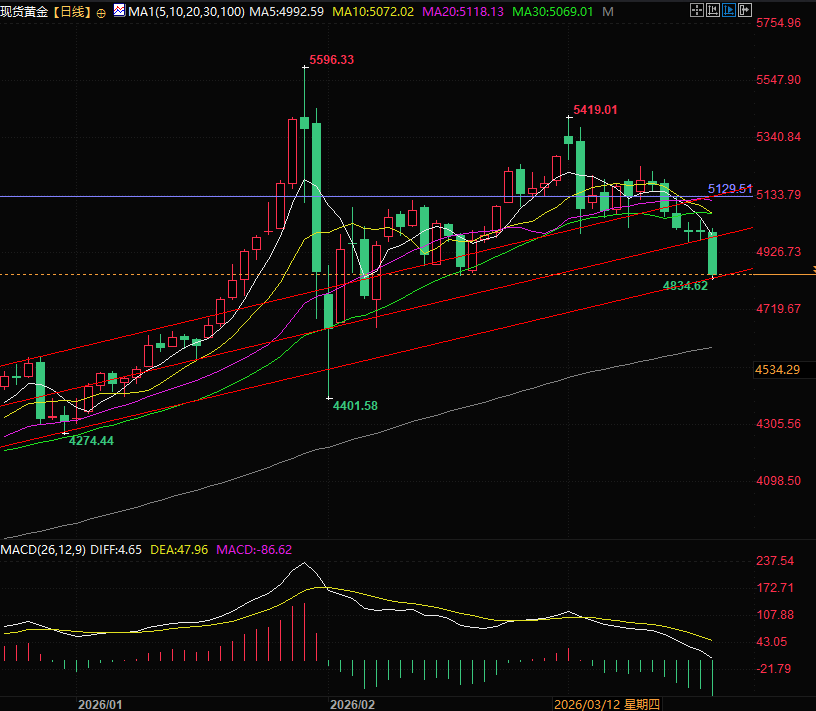
(Spot gold daily chart, source: FX678)
WTI crude oil futures contracts have returned to above 94.66 and the 5-day moving average. If they hold, crude oil prices are likely to continue rising.
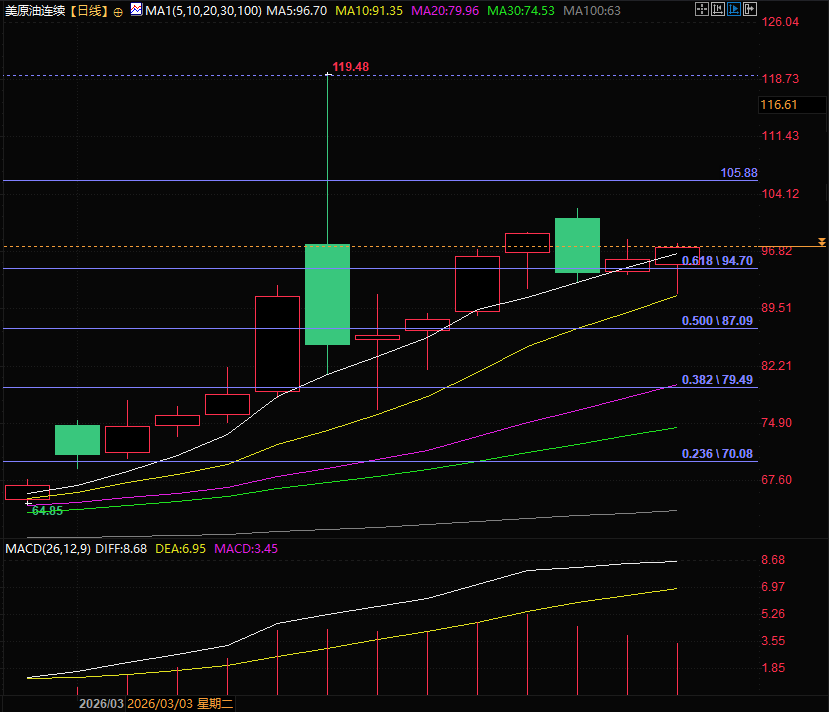
(WTI crude oil futures daily chart, source: EasyForex)
At 21:40 Beijing time, spot gold was trading at $4868, and WTI crude oil futures were trading at $97.48 per barrel.
This targeted strike hit a nerve in global energy supply, sparking widespread market concerns about the security of energy facilities in the Middle East.
Iran responded swiftly and forcefully. Iranian media outlet FarsNews reported that Iran will retaliate for the attacks on energy infrastructure, targeting previously "safe" enemy energy facilities.
In its statement, the Iranian Revolutionary Guard explicitly listed its retaliatory targets, including key Middle Eastern energy assets such as the Samref refinery and Jubail petrochemical complex in Saudi Arabia, the Hassan gas field in the UAE, the Messaied petrochemical complex, Messaied Holding Company, and the Ras Lafan refinery in Qatar.
As the US and Iran continue to test each other's bottom lines regarding energy infrastructure, the market is generally concerned that the conflict will escalate further—if the situation gets out of control, Middle Eastern energy facilities could be engulfed in flames, and global energy supply would face the risk of a historic disruption.
Gold Price Volatility: Geopolitical Safe-Haven Demand Fails, Cooling Interest Rate Cut Expectations Trigger Plunge
Unlike the traditional logic of gold rising as a safe haven during geopolitical conflicts, the escalation of the US-Iran conflict has instead triggered a sharp drop in gold prices.
Spot gold plunged 150 points in a single day, a drop of more than 3%, falling to a new monthly low ahead of the Federal Reserve's interest rate decision. As of press time, it was trading at $4,861 per ounce, after maintaining a narrow trading range over the past two trading days.
The core driver of the gold price crash comes from three pressures: First, the rapid rise in real interest rates - rising energy prices have boosted global inflation expectations, and the 10-year US Treasury yield has rebounded rapidly after hitting a low. As a non-interest-bearing asset, gold is extremely sensitive to changes in real interest rates.
Secondly, Trump's statement on "quickly resolving the Iran issue" weakened risk aversion, and market risk appetite rebounded briefly.
Third, the market reacted in advance to expectations of the Fed's policy – the market generally anticipated that the Fed would maintain the benchmark interest rate range of 3.50%-3.75% for the second consecutive meeting, and might even release a hawkish signal that "there is no possibility of interest rate cuts in the near future". US Democratic Senator Warren directly accused Trump of obstructing the Fed from cutting interest rates.
Investors will be closely watching Federal Reserve Chairman Jerome Powell's post-meeting remarks and the updated Summary of Economic Projections (SEP) dot plot to determine whether the Fed will maintain its expectation of one rate cut in 2026 or shift to a more tightening stance.
Crude oil price surge: Supply crisis expectations escalate, institutions warn of growth risks.
In stark contrast to the weakness in gold, crude oil prices have embarked on a sustained upward trend following the escalation of the conflict. WTI crude oil futures have risen for the second consecutive day, gaining 2.26% to $97.71 per barrel, after previously falling as much as -4.5% earlier in the day.
The core logic behind this round of oil price increases is the soaring supply-side risk premium. As the core channel for 20% of global crude oil seaborne trade, the Strait of Hormuz is still severely disrupted, with most shipping activities essentially at a standstill. Furthermore, Iran's retaliatory threats against surrounding energy facilities have further exacerbated concerns about supply disruptions.
Although the International Energy Agency (IEA) coordinated the release of 400 million barrels of strategic oil reserves by member countries (the largest release since the agency's inception), the market generally believes that this is only a "painkiller"—based on a daily strait traffic volume of 20 million barrels, the strategic reserves can only make up for 1/10 of the supply gap, and need to be released gradually over 6-12 months, which cannot solve the structural supply crisis.
Institutions have issued strong warnings about the future trend of oil prices: Standard Chartered analysts Madur Jha and Ethan Lester pointed out that historical data shows that sustained oil price shocks often drive up global inflation and are often a leading indicator of a global recession;
If Brent crude oil prices approach $135 per barrel, the market focus will shift from inflation risks to growth risks.
Some institutions predict that if the Strait of Hormuz remains blocked, Brent crude oil could break through $150 per barrel, or even reach $200 per barrel, triggering the most severe supply disruption risk since the 1970s. Historically, since the 1950s, four out of five global recessions have been accompanied by a significant rise in oil prices (at least doubling), and the sensitivity of global inflation to oil price shocks has increased significantly since the pandemic.
Gold and crude oil moving in tandem: Geopolitical and policy interplay reshapes pricing logic.
The recent US-Iran conflict has resulted in a rare "inverse correlation" between gold and crude oil, primarily due to the interplay between geopolitical risks and monetary policies reshaping asset pricing logic.
From a traditional perspective, escalating geopolitical conflicts should simultaneously boost both crude oil (supply concerns) and gold (safe-haven demand). However, in this conflict, the "inflation → high interest rate" transmission chain triggered by rising oil prices has instead suppressed gold's safe-haven attributes. This phenomenon highlights the core contradiction in the current market: the influence of monetary policy on asset prices has temporarily surpassed geopolitical risk aversion.
In the long run, the positive correlation between the two remains unchanged: if Iran's retaliatory actions are carried out, the scope of damage to Middle Eastern energy facilities will expand, and the blockade of the Strait of Hormuz will be escalated, which will drive oil prices to surge further, thereby exacerbating the risk of global stagflation.
If the Federal Reserve is forced to adjust its policy due to economic growth pressures, leading to a decline in real interest rates, this will reactivate gold's safe-haven and inflation-hedging properties, and gold and crude oil may return to a trend of rising in the same direction. However, it is currently very difficult for real interest rates to decline.
Furthermore, disruptions to the petrodollar system will also affect the linkage between the two: rising oil prices increase global import costs and impact the dollar liquidity system; if emerging market debt risks erupt, it may trigger a new wave of risk aversion, driving gold and crude oil to rise in tandem.
Summary and Technical Analysis:
The current gold and crude oil markets have entered a high-volatility phase driven by geopolitical conflicts and sensitive to monetary policy. Their future trends will depend on two key variables:
Firstly, the extent of the escalation of geopolitical conflict. If Iran only takes symbolic retaliation and does not substantially damage Middle Eastern energy facilities and shipping routes, oil prices may fall, while gold will focus on the Federal Reserve's policy signals.
If the conflict spirals out of control and leads to continued supply disruptions, oil prices could break through the key threshold of $135 per barrel, increasing the risk of global stagflation. Gold is expected to resume its upward trend after interest rates peak.
Secondly, the Fed's policy shift is imminent. In the short term, the narrative of "long-term high interest rates" will continue to suppress gold. However, in the long term, the downside risks to growth caused by rising oil prices may force central banks to adjust their tightening stance. Once expectations of interest rate cuts are restarted, gold will have an opportunity for valuation repair.
Technical aspects:
Spot gold has now fallen to the lower support level of the channel, and the market has confirmed the weakness in gold after the price broke through 5130, as mentioned in a previous article.
(Spot gold daily chart, source: FX678)
WTI crude oil futures contracts have returned to above 94.66 and the 5-day moving average. If they hold, crude oil prices are likely to continue rising.
(WTI crude oil futures daily chart, source: EasyForex)
At 21:40 Beijing time, spot gold was trading at $4868, and WTI crude oil futures were trading at $97.48 per barrel.
- Risk Warning and Disclaimer
- The market involves risk, and trading may not be suitable for all investors. This article is for reference only and does not constitute personal investment advice, nor does it take into account certain users’ specific investment objectives, financial situation, or other needs. Any investment decisions made based on this information are at your own risk.