The Middle East energy shock, coupled with inflationary uncertainty, led the Bank of Japan to keep its interest rate unchanged at 0.75%, pushing the USD/JPY exchange rate close to the 160 mark.
2026-03-19 09:43:12
Amidst heightened volatility in global energy markets, the Bank of Japan's upcoming interest rate decision is drawing significant market attention. The market widely expects the Bank of Japan to maintain its benchmark interest rate at 0.75% , marking another period of policy inaction following previous rate hikes and subsequent pauses. Unlike previous instances, the core influencing factor for this policy decision has shifted from domestic economic data to external shocks, particularly the uncertainty surrounding energy prices stemming from the situation in the Middle East.
As a typical energy-importing economy, Japan is highly sensitive to fluctuations in international oil prices. The recent escalation of conflict in the Middle East has driven oil prices rapidly, putting Japan under increasing pressure from imported inflation. On the one hand, rising energy prices will push up overall inflation; on the other hand, they will also suppress corporate profits and household consumption, creating a dual challenge of "rising inflation + pressure on growth." Against this backdrop, the Bank of Japan has had to adopt a more cautious policy approach to avoid prematurely tightening monetary policy and causing economic shocks.
From a domestic perspective, the Japanese economy remains resilient. Economic growth remains stable, and the results of the spring wage negotiations showed a clear upward trend in wages, providing continued support for inflation. The market generally believes that wage growth is one of the important prerequisites for the Bank of Japan to proceed with policy normalization. However, policymakers still hope to wait for more complete data verification, including the sustainability of wage growth and changes in corporate investment intentions, to enhance the certainty of policy adjustments.
In terms of policy communication, the Bank of Japan is expected to continue emphasizing the "data-dependent" principle and maintain flexibility. Governor Kazuo Ueda is expected to reiterate that the path to policy normalization remains intact, but will also point out that uncertainties surrounding energy prices and the global financial environment necessitate a gradual approach to policy adjustments. Market surveys show that all economists surveyed expect interest rates to remain unchanged at this meeting, while expectations for a rate hike in April have risen significantly, with approximately 37% of respondents believing action could occur as early as April, up from 17% previously.
Meanwhile, policy disagreements within the Bank of Japan are gradually emerging. Some members favor tightening policy ahead of schedule to address imported inflationary pressures from the continued depreciation of the yen. This divergence reflects the complexity of the current policy environment, which seeks to both guard against inflation risks and prevent the economy from cooling down too quickly.
In the currency market, the continued strengthening of the US dollar against the Japanese yen has become the most important external variable. Driven by the strength of the dollar and the inflow of safe-haven funds, the exchange rate has approached the key psychological level of 160. The depreciation of the yen exacerbates rising import costs, further pushing up inflation; on the other hand, it also poses a challenge to the credibility of the Bank of Japan's policies. Against this backdrop, the Japanese government has strengthened its verbal intervention efforts, and market expectations for actual intervention have clearly intensified.
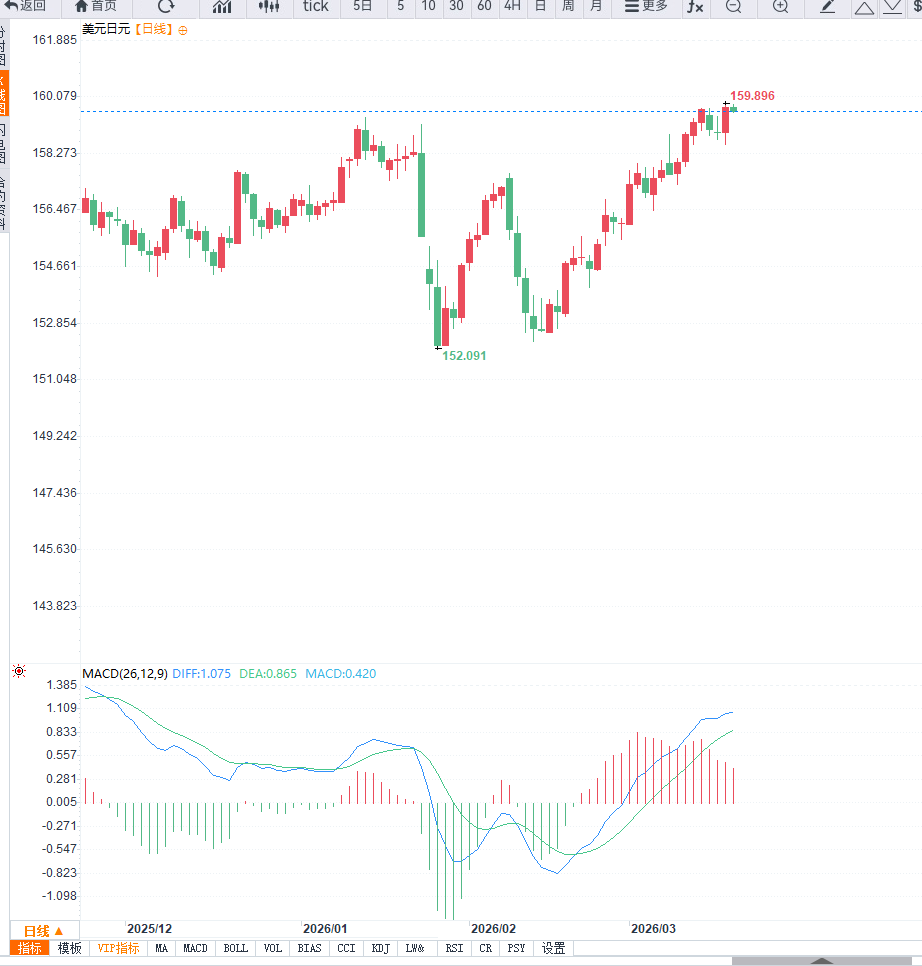
From a technical perspective, analyzing the daily chart, USD/JPY maintains an overall upward trend, with the price trading above the medium- and long-term moving averages, and the trend structure remaining intact. Key support levels have gradually moved up to the 156-157 range, while resistance is concentrated at the psychological level of 160. A break above this level would open up further upside potential, and momentum indicators show that the bulls remain in control. Looking at the 4-hour chart, the price is holding above the 50- and 100-period moving averages, and the short-term bullish structure remains intact. The previous slight pullback from the high of 159.75 was a technical consolidation, with the RSI falling back to near neutral territory, indicating a slight cooling of momentum but no trend reversal signal. Meanwhile, the price is still trading above the 23.6% Fibonacci retracement level of 157.99 , indicating that the overall upward structure remains solid. A break below this level could lead to a further test of the support around 156.8; conversely, a break above the 159.75 high could potentially push for new highs above 160.
Overall, the Bank of Japan is currently at a critical juncture in its policy shift, but significantly increased external uncertainties are forcing it to slow its pace. Energy price volatility, exchange rate pressures, and changes in the global monetary environment are the main constraints on its future policy path.
Editor's Summary : The Bank of Japan's decision to keep interest rates unchanged reflects its cautious balance between inflation and growth. While the direction of policy normalization remains unchanged, the pace has been clearly influenced by external shocks. In the short term, the yen will continue to be pressured by both a strong dollar and energy prices, while expectations of interest rate hikes are a potential supporting factor. The key to the future market lies in the development of the situation in the Middle East and the sustainability of wage growth, which will directly determine the Bank of Japan's policy path and exchange rate trend.
Frequently Asked Questions (FAQ)
1. Why did the Bank of Japan choose to hold its policy unchanged in the current environment?
The Bank of Japan chose to maintain its interest rate unchanged primarily due to the high degree of uncertainty in the current economic environment. The situation in the Middle East has led to rising energy prices, putting Japan under imported inflationary pressure, but also negatively impacting economic growth. In this environment of "rising inflation but pressured growth," raising interest rates prematurely could further suppress consumption and investment. Furthermore, the Bank of Japan has already implemented some degree of policy tightening, and time is needed to observe its lagged effects. Therefore, maintaining the current interest rate is a more prudent choice until the data becomes fully clear.
2. Why has the depreciation of the yen become a major concern for the Bank of Japan?
A weaker yen directly pushes up the prices of imported goods, especially energy and raw materials, thus exacerbating inflationary pressures. This effect is particularly pronounced for Japan, which is heavily reliant on imported energy. At the same time, continued currency depreciation could weaken market confidence in monetary policy and even trigger capital outflows. Therefore, the Bank of Japan needs to pay attention not only to inflation and economic growth but also to exchange rate stability to maintain overall financial market stability.
3. Why does the market expect the Bank of Japan to raise interest rates in April?
Market expectations for an April rate hike are primarily based on two factors: first, a clear trend of wage growth, with the results of Japan's spring wage negotiations showing wage increases, providing endogenous impetus for inflation; and second, inflation gradually approaching or reaching the target range, creating conditions for policy normalization. Furthermore, some members within the Bank of Japan have expressed a hawkish stance, which has also strengthened market expectations for a rate hike. However, these expectations still depend on energy price trends and changes in the global economic environment.
4. How will the Middle East energy shock affect the Japanese economy?
The Middle East energy shock primarily impacts the Japanese economy through rising oil prices. Firstly, rising energy costs increase production costs for businesses, squeezing profit margins. Secondly, increased living costs for residents may suppress consumer demand, thus affecting economic growth. Furthermore, high oil prices could exacerbate inflation, presenting the Bank of Japan with more complex policy choices. If energy prices remain high, the Japanese economy may face a coexistence of cost-push inflation and weak demand, putting pressure on the overall economy.
As a typical energy-importing economy, Japan is highly sensitive to fluctuations in international oil prices. The recent escalation of conflict in the Middle East has driven oil prices rapidly, putting Japan under increasing pressure from imported inflation. On the one hand, rising energy prices will push up overall inflation; on the other hand, they will also suppress corporate profits and household consumption, creating a dual challenge of "rising inflation + pressure on growth." Against this backdrop, the Bank of Japan has had to adopt a more cautious policy approach to avoid prematurely tightening monetary policy and causing economic shocks.
From a domestic perspective, the Japanese economy remains resilient. Economic growth remains stable, and the results of the spring wage negotiations showed a clear upward trend in wages, providing continued support for inflation. The market generally believes that wage growth is one of the important prerequisites for the Bank of Japan to proceed with policy normalization. However, policymakers still hope to wait for more complete data verification, including the sustainability of wage growth and changes in corporate investment intentions, to enhance the certainty of policy adjustments.
In terms of policy communication, the Bank of Japan is expected to continue emphasizing the "data-dependent" principle and maintain flexibility. Governor Kazuo Ueda is expected to reiterate that the path to policy normalization remains intact, but will also point out that uncertainties surrounding energy prices and the global financial environment necessitate a gradual approach to policy adjustments. Market surveys show that all economists surveyed expect interest rates to remain unchanged at this meeting, while expectations for a rate hike in April have risen significantly, with approximately 37% of respondents believing action could occur as early as April, up from 17% previously.
Meanwhile, policy disagreements within the Bank of Japan are gradually emerging. Some members favor tightening policy ahead of schedule to address imported inflationary pressures from the continued depreciation of the yen. This divergence reflects the complexity of the current policy environment, which seeks to both guard against inflation risks and prevent the economy from cooling down too quickly.
In the currency market, the continued strengthening of the US dollar against the Japanese yen has become the most important external variable. Driven by the strength of the dollar and the inflow of safe-haven funds, the exchange rate has approached the key psychological level of 160. The depreciation of the yen exacerbates rising import costs, further pushing up inflation; on the other hand, it also poses a challenge to the credibility of the Bank of Japan's policies. Against this backdrop, the Japanese government has strengthened its verbal intervention efforts, and market expectations for actual intervention have clearly intensified.
From a technical perspective, analyzing the daily chart, USD/JPY maintains an overall upward trend, with the price trading above the medium- and long-term moving averages, and the trend structure remaining intact. Key support levels have gradually moved up to the 156-157 range, while resistance is concentrated at the psychological level of 160. A break above this level would open up further upside potential, and momentum indicators show that the bulls remain in control. Looking at the 4-hour chart, the price is holding above the 50- and 100-period moving averages, and the short-term bullish structure remains intact. The previous slight pullback from the high of 159.75 was a technical consolidation, with the RSI falling back to near neutral territory, indicating a slight cooling of momentum but no trend reversal signal. Meanwhile, the price is still trading above the 23.6% Fibonacci retracement level of 157.99 , indicating that the overall upward structure remains solid. A break below this level could lead to a further test of the support around 156.8; conversely, a break above the 159.75 high could potentially push for new highs above 160.
Overall, the Bank of Japan is currently at a critical juncture in its policy shift, but significantly increased external uncertainties are forcing it to slow its pace. Energy price volatility, exchange rate pressures, and changes in the global monetary environment are the main constraints on its future policy path.
Editor's Summary : The Bank of Japan's decision to keep interest rates unchanged reflects its cautious balance between inflation and growth. While the direction of policy normalization remains unchanged, the pace has been clearly influenced by external shocks. In the short term, the yen will continue to be pressured by both a strong dollar and energy prices, while expectations of interest rate hikes are a potential supporting factor. The key to the future market lies in the development of the situation in the Middle East and the sustainability of wage growth, which will directly determine the Bank of Japan's policy path and exchange rate trend.
Frequently Asked Questions (FAQ)
1. Why did the Bank of Japan choose to hold its policy unchanged in the current environment?
The Bank of Japan chose to maintain its interest rate unchanged primarily due to the high degree of uncertainty in the current economic environment. The situation in the Middle East has led to rising energy prices, putting Japan under imported inflationary pressure, but also negatively impacting economic growth. In this environment of "rising inflation but pressured growth," raising interest rates prematurely could further suppress consumption and investment. Furthermore, the Bank of Japan has already implemented some degree of policy tightening, and time is needed to observe its lagged effects. Therefore, maintaining the current interest rate is a more prudent choice until the data becomes fully clear.
2. Why has the depreciation of the yen become a major concern for the Bank of Japan?
A weaker yen directly pushes up the prices of imported goods, especially energy and raw materials, thus exacerbating inflationary pressures. This effect is particularly pronounced for Japan, which is heavily reliant on imported energy. At the same time, continued currency depreciation could weaken market confidence in monetary policy and even trigger capital outflows. Therefore, the Bank of Japan needs to pay attention not only to inflation and economic growth but also to exchange rate stability to maintain overall financial market stability.
3. Why does the market expect the Bank of Japan to raise interest rates in April?
Market expectations for an April rate hike are primarily based on two factors: first, a clear trend of wage growth, with the results of Japan's spring wage negotiations showing wage increases, providing endogenous impetus for inflation; and second, inflation gradually approaching or reaching the target range, creating conditions for policy normalization. Furthermore, some members within the Bank of Japan have expressed a hawkish stance, which has also strengthened market expectations for a rate hike. However, these expectations still depend on energy price trends and changes in the global economic environment.
4. How will the Middle East energy shock affect the Japanese economy?
The Middle East energy shock primarily impacts the Japanese economy through rising oil prices. Firstly, rising energy costs increase production costs for businesses, squeezing profit margins. Secondly, increased living costs for residents may suppress consumer demand, thus affecting economic growth. Furthermore, high oil prices could exacerbate inflation, presenting the Bank of Japan with more complex policy choices. If energy prices remain high, the Japanese economy may face a coexistence of cost-push inflation and weak demand, putting pressure on the overall economy.
- Risk Warning and Disclaimer
- The market involves risk, and trading may not be suitable for all investors. This article is for reference only and does not constitute personal investment advice, nor does it take into account certain users’ specific investment objectives, financial situation, or other needs. Any investment decisions made based on this information are at your own risk.