Geopolitical disturbances reshaping interest rate expectations, coupled with a stronger dollar, could open up room for gold to adjust downwards.
2026-03-19 14:18:23
The gold market is currently in a phase of both short-term pressure and medium-term support. In the short term, gold's price movement is clearly suppressed by two factors. First, escalating geopolitical tensions, while pushing up inflation expectations, have also disrupted market expectations regarding the Federal Reserve's interest rate cut path, increasing uncertainty in monetary policy and forcing the market to repric the interest rate path, thereby weakening gold's upward momentum. Second, in an environment of heightened risk aversion, funds have not flowed entirely into gold, but rather more into more liquid assets such as the US dollar, pushing the dollar stronger and directly suppressing gold.

Under the combined influence of the above factors, gold lacks sustained upward momentum in the short term, and is mainly expected to fluctuate and adjust, with the possibility of further declines not ruled out. From a technical perspective, the current gold price is clearly constrained by the key resistance level of $4,900, which has become a significant resistance zone for short-term bullish rebounds. Multiple tests have failed to break through this level effectively, indicating that selling pressure is relatively concentrated above.
On the downside, $4800 is a key short-term support level. A decisive break below this level could shift the market structure from consolidation to a downward trend, potentially leading to a test of the $4500 area. $4500 will become a crucial dividing line between bullish and bearish sentiment in the next phase; a breach of this level would indicate a further expansion of the short-term pullback.
From a medium-term perspective, gold remains in an overall uptrend, but is currently in a consolidation phase. The market needs to pay close attention to the trend support around $4700, which not only corresponds to the medium-term uptrend line but also represents a significant support area during the previous upward movement. If this trend line holds, the medium-term uptrend is likely to continue; conversely, a break below this support could indicate a breakdown in the medium-term trend, leading to a deeper correction.
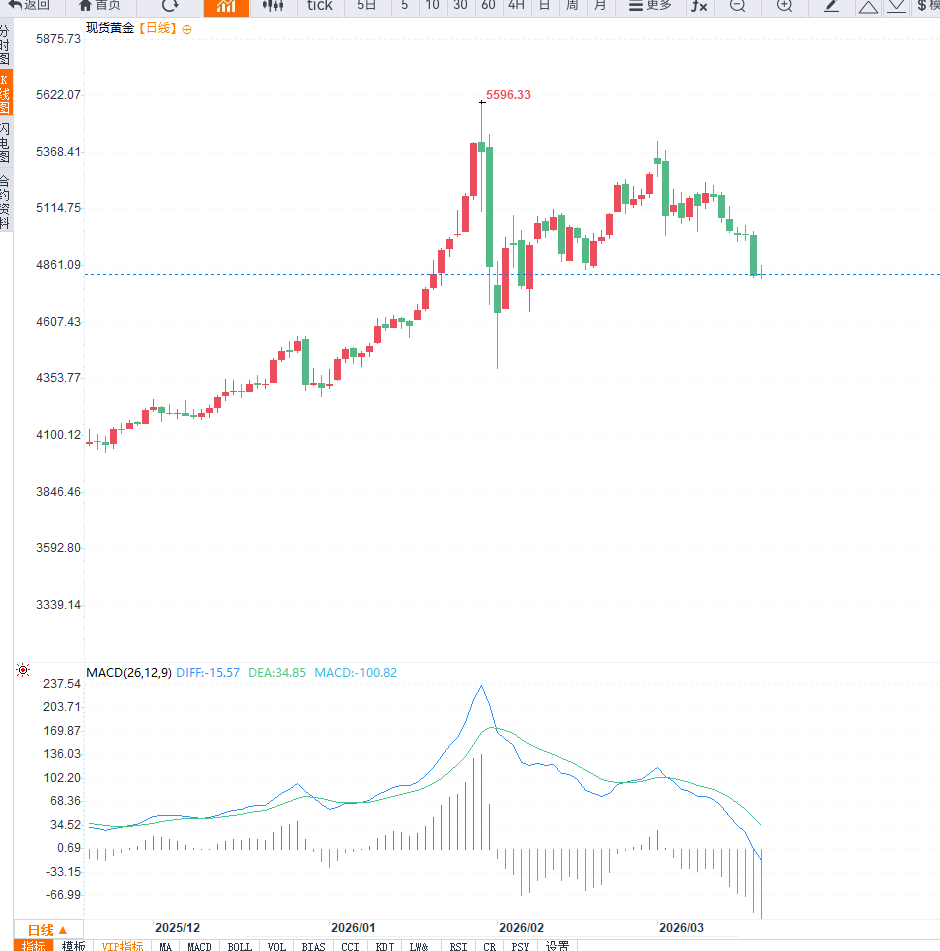
Overall, gold is currently constrained by the $4,900 resistance level and is trending weakly, mainly consolidating with potential for further downside. In the medium term, however, it still has the foundation to regain strength, and its future trend will depend on the evolution of geopolitical risks, changes in interest rate cut expectations, and the success or failure of key technical levels.
Editor's Summary : Gold is currently in a critical phase of "short-term pressure, but medium-term support." $4900 represents significant resistance, while $4800 serves as a short-term support level; a break below this level could lead to the $4500 area. In the medium term, the effectiveness of the $4700 trend support level needs close monitoring. The overall strategy is to maintain a slightly bearish bias in the short term, while focusing on opportunities for a bullish resurgence after pullbacks in the medium term. The core strategy lies in the interplay between macroeconomic expectations and key support levels.
Frequently Asked Questions (FAQ )
1. Why does geopolitical tensions suppress gold price increases?
Geopolitical conflicts typically increase demand for safe-haven assets, but in the current market environment, the US dollar also possesses strong safe-haven characteristics. When risks rise, funds tend to flow into dollar assets, thus pushing the dollar higher and putting downward pressure on gold. Simultaneously, geopolitical conflicts fuel inflation expectations, prolonging the period of high interest rates, further limiting the upside potential for gold.
2. Why were expectations for interest rate cuts disrupted by geopolitical tensions?
Geopolitical conflicts could drive up energy prices, leading to higher inflation. With renewed inflationary pressures, the Federal Reserve is more inclined to maintain high interest rates to control inflation, which will delay the rate-cutting process. Therefore, previous expectations of easing are being repriced, negatively impacting gold prices.
3. Why is gold trading range-bound in the short term?
The current market is characterized by a mix of bullish and bearish factors: on the one hand, safe-haven demand is supporting gold, while on the other hand, high interest rates and a stronger dollar are suppressing gold prices. In the absence of a clear unilateral driver, prices are more likely to fluctuate within a range rather than forming a clear trend.
Under the combined influence of the above factors, gold lacks sustained upward momentum in the short term, and is mainly expected to fluctuate and adjust, with the possibility of further declines not ruled out. From a technical perspective, the current gold price is clearly constrained by the key resistance level of $4,900, which has become a significant resistance zone for short-term bullish rebounds. Multiple tests have failed to break through this level effectively, indicating that selling pressure is relatively concentrated above.
On the downside, $4800 is a key short-term support level. A decisive break below this level could shift the market structure from consolidation to a downward trend, potentially leading to a test of the $4500 area. $4500 will become a crucial dividing line between bullish and bearish sentiment in the next phase; a breach of this level would indicate a further expansion of the short-term pullback.
From a medium-term perspective, gold remains in an overall uptrend, but is currently in a consolidation phase. The market needs to pay close attention to the trend support around $4700, which not only corresponds to the medium-term uptrend line but also represents a significant support area during the previous upward movement. If this trend line holds, the medium-term uptrend is likely to continue; conversely, a break below this support could indicate a breakdown in the medium-term trend, leading to a deeper correction.
Overall, gold is currently constrained by the $4,900 resistance level and is trending weakly, mainly consolidating with potential for further downside. In the medium term, however, it still has the foundation to regain strength, and its future trend will depend on the evolution of geopolitical risks, changes in interest rate cut expectations, and the success or failure of key technical levels.
Editor's Summary : Gold is currently in a critical phase of "short-term pressure, but medium-term support." $4900 represents significant resistance, while $4800 serves as a short-term support level; a break below this level could lead to the $4500 area. In the medium term, the effectiveness of the $4700 trend support level needs close monitoring. The overall strategy is to maintain a slightly bearish bias in the short term, while focusing on opportunities for a bullish resurgence after pullbacks in the medium term. The core strategy lies in the interplay between macroeconomic expectations and key support levels.
Frequently Asked Questions (FAQ )
1. Why does geopolitical tensions suppress gold price increases?
Geopolitical conflicts typically increase demand for safe-haven assets, but in the current market environment, the US dollar also possesses strong safe-haven characteristics. When risks rise, funds tend to flow into dollar assets, thus pushing the dollar higher and putting downward pressure on gold. Simultaneously, geopolitical conflicts fuel inflation expectations, prolonging the period of high interest rates, further limiting the upside potential for gold.
2. Why were expectations for interest rate cuts disrupted by geopolitical tensions?
Geopolitical conflicts could drive up energy prices, leading to higher inflation. With renewed inflationary pressures, the Federal Reserve is more inclined to maintain high interest rates to control inflation, which will delay the rate-cutting process. Therefore, previous expectations of easing are being repriced, negatively impacting gold prices.
3. Why is gold trading range-bound in the short term?
The current market is characterized by a mix of bullish and bearish factors: on the one hand, safe-haven demand is supporting gold, while on the other hand, high interest rates and a stronger dollar are suppressing gold prices. In the absence of a clear unilateral driver, prices are more likely to fluctuate within a range rather than forming a clear trend.
- Risk Warning and Disclaimer
- The market involves risk, and trading may not be suitable for all investors. This article is for reference only and does not constitute personal investment advice, nor does it take into account certain users’ specific investment objectives, financial situation, or other needs. Any investment decisions made based on this information are at your own risk.