The Middle East energy shock pushed up oil prices, while the Bank of Canada's cautious stance caused the USD/CAD to fall back to around 1.3720.
2026-03-19 13:25:18
Amid the escalating tensions in the Middle East, increased volatility in the global energy market has driven a rebound in crude oil prices, directly impacting the foreign exchange market. The US dollar retreated against the Canadian dollar after rising in the previous trading day, trading around 1.3720 during the Asian session. The primary driver of this pullback was the support provided by stronger oil prices to the Canadian dollar, resulting in a temporary rebound for this typical commodity currency.
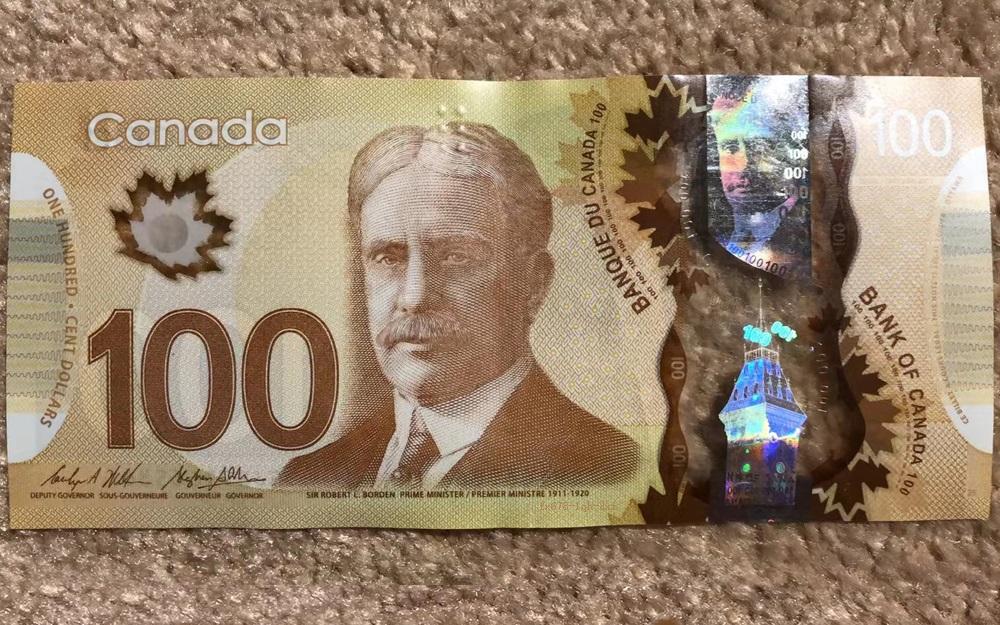
Escalating geopolitical risks have become a key catalyst for rising oil prices. Successive attacks on critical energy facilities have rapidly heightened market concerns about disruptions to global oil and gas supplies. As a major global energy exporter, Canada's economy is highly correlated with oil price movements; rising oil prices typically improve its terms of trade, thus boosting the Canadian dollar. In the current environment of heightened supply uncertainty, rising energy prices are clearly beneficial to the Canadian dollar.
Meanwhile, the Bank of Canada kept its benchmark interest rate unchanged at 2.25% , in line with market expectations. However, the policy statement sent a more cautious signal, noting that economic growth momentum was weaker than expected, while inflation faced upside risks. The central bank emphasized that recent economic activity was weaker than previously forecast, putting downward pressure on the growth outlook, while rising energy prices could push up inflation in the near term. This combination of "slowing growth + rising inflation" complicates the policy outlook.
At the press conference, the Governor of the Bank of Canada clearly stated that the impact of the Middle East situation on the economy will depend on the duration of the conflict, and emphasized that future policy will continue to be assessed on a "meeting-by-meeting" basis. This indicates that in a highly uncertain environment, the Bank of Canada prefers to maintain flexibility rather than lock in its policy path in advance.
On the other hand, the Federal Reserve also kept interest rates unchanged at 3.50%-3.75% and released a hawkish signal. The Fed noted that while inflation is expected to gradually decline, the process may be slower than previously anticipated, and rising oil prices could push up inflation in the short term. This statement strengthened the fundamental support for the US dollar, limiting the downside potential of USD/CAD.
Therefore, the current exchange rate trend exhibits a clear characteristic of a battle between bulls and bears: on the one hand, rising oil prices support the Canadian dollar; on the other hand, the Federal Reserve's tight policy supports the US dollar, making it difficult for the exchange rate to form a one-sided trend. The market is reassessing the interplay between the policy paths of both countries and changes in the energy market.
From a technical perspective, the USD/CAD daily chart shows that the exchange rate has entered a consolidation phase after its previous rise, with short-term upward momentum weakening. The upper resistance level to watch is around 1.3800, while the lower support level is in the 1.3650 area. A break below this level could lead to a further test of the 1.3600 level. Overall momentum indicators suggest that bullish strength is waning. Observing the 4-hour chart, the exchange rate has shown a pullback from its highs, with short-term moving averages gradually flattening and showing signs of weakening, indicating that the market has entered a consolidation phase. Currently, the price is fluctuating around 1.3700. If oil prices continue to rise, the exchange rate may further test the support area; conversely, if the US dollar strengthens again, a retest of 1.3800 cannot be ruled out.
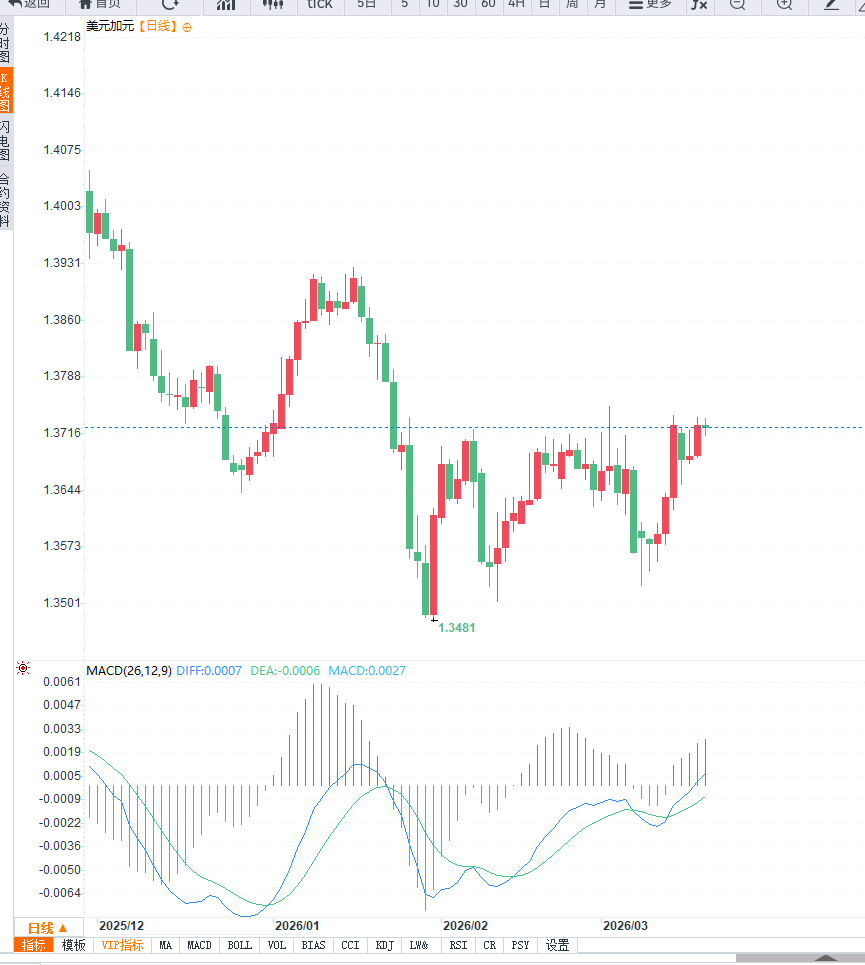
Overall, the USD/CAD exchange rate is being driven by both the energy market and monetary policy. In the short term, oil price fluctuations will be the dominant factor, while the medium- to long-term trend will depend on changes in the economic fundamentals and policy paths of both countries.
Editor's Summary
The USD/CAD pair is currently in a phase of complex interplay among multiple factors. Rising oil prices are providing support for the Canadian dollar, but the Federal Reserve's hawkish stance is limiting downside potential. Meanwhile, slowing Canadian economic growth coupled with inflationary pressures is increasing uncertainty about the policy outlook. Future price movements will heavily depend on developments in the Middle East and changes in energy prices; the pair is likely to remain range-bound in the short term.
Escalating geopolitical risks have become a key catalyst for rising oil prices. Successive attacks on critical energy facilities have rapidly heightened market concerns about disruptions to global oil and gas supplies. As a major global energy exporter, Canada's economy is highly correlated with oil price movements; rising oil prices typically improve its terms of trade, thus boosting the Canadian dollar. In the current environment of heightened supply uncertainty, rising energy prices are clearly beneficial to the Canadian dollar.
Meanwhile, the Bank of Canada kept its benchmark interest rate unchanged at 2.25% , in line with market expectations. However, the policy statement sent a more cautious signal, noting that economic growth momentum was weaker than expected, while inflation faced upside risks. The central bank emphasized that recent economic activity was weaker than previously forecast, putting downward pressure on the growth outlook, while rising energy prices could push up inflation in the near term. This combination of "slowing growth + rising inflation" complicates the policy outlook.
At the press conference, the Governor of the Bank of Canada clearly stated that the impact of the Middle East situation on the economy will depend on the duration of the conflict, and emphasized that future policy will continue to be assessed on a "meeting-by-meeting" basis. This indicates that in a highly uncertain environment, the Bank of Canada prefers to maintain flexibility rather than lock in its policy path in advance.
On the other hand, the Federal Reserve also kept interest rates unchanged at 3.50%-3.75% and released a hawkish signal. The Fed noted that while inflation is expected to gradually decline, the process may be slower than previously anticipated, and rising oil prices could push up inflation in the short term. This statement strengthened the fundamental support for the US dollar, limiting the downside potential of USD/CAD.
Therefore, the current exchange rate trend exhibits a clear characteristic of a battle between bulls and bears: on the one hand, rising oil prices support the Canadian dollar; on the other hand, the Federal Reserve's tight policy supports the US dollar, making it difficult for the exchange rate to form a one-sided trend. The market is reassessing the interplay between the policy paths of both countries and changes in the energy market.
From a technical perspective, the USD/CAD daily chart shows that the exchange rate has entered a consolidation phase after its previous rise, with short-term upward momentum weakening. The upper resistance level to watch is around 1.3800, while the lower support level is in the 1.3650 area. A break below this level could lead to a further test of the 1.3600 level. Overall momentum indicators suggest that bullish strength is waning. Observing the 4-hour chart, the exchange rate has shown a pullback from its highs, with short-term moving averages gradually flattening and showing signs of weakening, indicating that the market has entered a consolidation phase. Currently, the price is fluctuating around 1.3700. If oil prices continue to rise, the exchange rate may further test the support area; conversely, if the US dollar strengthens again, a retest of 1.3800 cannot be ruled out.
Overall, the USD/CAD exchange rate is being driven by both the energy market and monetary policy. In the short term, oil price fluctuations will be the dominant factor, while the medium- to long-term trend will depend on changes in the economic fundamentals and policy paths of both countries.
Editor's Summary
The USD/CAD pair is currently in a phase of complex interplay among multiple factors. Rising oil prices are providing support for the Canadian dollar, but the Federal Reserve's hawkish stance is limiting downside potential. Meanwhile, slowing Canadian economic growth coupled with inflationary pressures is increasing uncertainty about the policy outlook. Future price movements will heavily depend on developments in the Middle East and changes in energy prices; the pair is likely to remain range-bound in the short term.
- Risk Warning and Disclaimer
- The market involves risk, and trading may not be suitable for all investors. This article is for reference only and does not constitute personal investment advice, nor does it take into account certain users’ specific investment objectives, financial situation, or other needs. Any investment decisions made based on this information are at your own risk.