Amid geopolitical uncertainties, disagreements have resurfaced regarding the Bank of Japan's interest rate hikes.
2026-03-19 13:31:45
According to APP, Nomura Holdings' wholesale head , Wilcox, stated that despite the shadow cast by the Iranian war on the economic outlook, he still expects the Bank of Japan to raise interest rates next month. He believes the Middle East conflict makes an April rate hike more likely. Japan has already embarked on the path of monetary policy normalization regardless, so we have consistently expected a rate hike this year. Given the uncertainty of the Middle East situation, Wilcox is less certain whether the Bank of Japan will continue to raise rates after April. One factor that Japanese policymakers need to consider is the impact of yen depreciation on inflation.
In a recent discussion on the Middle East conflict, Shigeto Nagai, Head of Japan Economics at Oxford Economics, noted that given the potential for stagflation in the Japanese economy, they now expect the Bank of Japan to postpone its next interest rate hike from June to July. Following this, they anticipate continued gradual rate hikes in the first and third quarters of 2027. In the short term, rising energy costs will re-accelerate supply-side driven inflation. They now believe core CPI will not return to 2% until the second quarter of 2027, rather than the fourth quarter of 2026. Despite a strong expected outcome from the spring wage negotiations, higher inflation will limit real income growth. Therefore, they have lowered their 2026 real GDP growth forecast by 0.4 percentage points to 0.3%. While concerned about inflationary pressures and a weaker yen, they believe the Bank of Japan may become more cautious about raising interest rates, prioritizing the impact on corporate profits and real household income.
The latest market data shows that the Bank of Japan's current policy rate remains at 0.75%, and the market still prices in a 60%-70% probability of a rate hike in April. The core of the disagreement between the two institutions lies in their assessment of the sustainability of the energy shock: the conflict in Iran, coupled with tight global liquefied natural gas supplies, has pushed up the cost of imported energy, directly amplifying the dilemma of interest rate decisions—both curbing inflation and avoiding a hard landing for the economy.
The profound impact of this event on the Japanese economy is multi-dimensional. While the yen's depreciation has provided a short-term boost to exports, it has amplified inflationary pressures through the transmission of energy import prices. Although the spring wage negotiations brought nominal income growth, real purchasing power was eroded by rising energy and food prices. At the corporate level, rapid interest rate hikes could squeeze financing costs and profit margins for small and medium-sized enterprises (SMEs). At the household level, slower real income growth will suppress consumption, becoming a new bottleneck for economic growth. Analysts reasonably speculate that if the conflict extends into the second quarter, the impact of energy costs on supply-side inflation will exceed expectations, forcing the Bank of Japan to repeatedly weigh the options between "stabilizing growth" and "controlling prices."
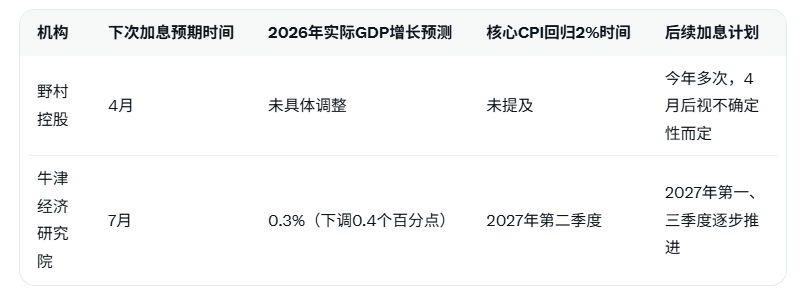
To visually illustrate the differences in institutional perspectives, the following table compares the latest interest rate hike paths with economic forecasts:
Editor's Summary : The Iranian conflict has pushed the normalization process of Japan's monetary policy into a complex phase. The probability of a slower pace of interest rate hikes in the short term has increased, but the long-term path still depends on the speed of energy price declines and the stability of the yen exchange rate. Businesses and investors need to continuously monitor the Bank of Japan's meeting minutes, wage negotiation results, and international oil and gas price dynamics, and adjust their asset allocations in advance to cope with potential volatility.
Frequently Asked Questions
1. Why does Nomura Holdings still maintain that an April rate hike is more likely?
Wilcox believes Japan has already embarked on the path of monetary normalization. While the conflict with Iran brings uncertainty, it has not changed the overall direction of interest rate hikes. The situation in the Middle East, on the contrary, has intensified inflationary pressures through rising energy prices, making an April rate hike a more pressing option; the latest market pricing also indicates a 60%-70% probability of a rate hike in April, consistent with Nomura's assessment.
2. Why did Oxford Economics postpone the interest rate hike until July?
Shigeto Nagai points out that soaring energy costs are creating stagflation risks—supply-side inflation is accelerating while demand is weak. The Japanese economy may face both slowing growth and high prices simultaneously. The central bank needs to prioritize protecting corporate profits and household real income. Therefore, it has postponed the planned June interest rate hike to July, and will gradually implement it in two phases in 2027 to avoid a hard landing caused by too rapid tightening.
3. What is the core reason for the downward revision of the 2026 GDP forecast by 0.4 percentage points to 0.3%?
Higher inflation will offset real income growth from spring wage negotiations, putting pressure on both consumption and investment. Rising energy prices will directly drag down import-dependent economies, while a weaker yen, while boosting exports, will amplify inflation, resulting in weakened growth momentum. Oxford has therefore significantly revised its forecasts to reflect the lasting impact of the conflict on the real economy.
4. Why has the core CPI return to 2% been postponed to the second quarter of 2027?
Rising energy costs in the short term will continue to push up supply-side inflation, while even strong wage negotiations will be hampered by limited real income growth, which will suppress demand-side price pressures. Oxford believes that the target will be difficult to achieve in the fourth quarter of 2026 and will not be stable until the second quarter of 2027. This gives the Bank of Japan more time to observe and avoid tightening policy prematurely.
In a recent discussion on the Middle East conflict, Shigeto Nagai, Head of Japan Economics at Oxford Economics, noted that given the potential for stagflation in the Japanese economy, they now expect the Bank of Japan to postpone its next interest rate hike from June to July. Following this, they anticipate continued gradual rate hikes in the first and third quarters of 2027. In the short term, rising energy costs will re-accelerate supply-side driven inflation. They now believe core CPI will not return to 2% until the second quarter of 2027, rather than the fourth quarter of 2026. Despite a strong expected outcome from the spring wage negotiations, higher inflation will limit real income growth. Therefore, they have lowered their 2026 real GDP growth forecast by 0.4 percentage points to 0.3%. While concerned about inflationary pressures and a weaker yen, they believe the Bank of Japan may become more cautious about raising interest rates, prioritizing the impact on corporate profits and real household income.
The latest market data shows that the Bank of Japan's current policy rate remains at 0.75%, and the market still prices in a 60%-70% probability of a rate hike in April. The core of the disagreement between the two institutions lies in their assessment of the sustainability of the energy shock: the conflict in Iran, coupled with tight global liquefied natural gas supplies, has pushed up the cost of imported energy, directly amplifying the dilemma of interest rate decisions—both curbing inflation and avoiding a hard landing for the economy.
The profound impact of this event on the Japanese economy is multi-dimensional. While the yen's depreciation has provided a short-term boost to exports, it has amplified inflationary pressures through the transmission of energy import prices. Although the spring wage negotiations brought nominal income growth, real purchasing power was eroded by rising energy and food prices. At the corporate level, rapid interest rate hikes could squeeze financing costs and profit margins for small and medium-sized enterprises (SMEs). At the household level, slower real income growth will suppress consumption, becoming a new bottleneck for economic growth. Analysts reasonably speculate that if the conflict extends into the second quarter, the impact of energy costs on supply-side inflation will exceed expectations, forcing the Bank of Japan to repeatedly weigh the options between "stabilizing growth" and "controlling prices."
To visually illustrate the differences in institutional perspectives, the following table compares the latest interest rate hike paths with economic forecasts:
Editor's Summary : The Iranian conflict has pushed the normalization process of Japan's monetary policy into a complex phase. The probability of a slower pace of interest rate hikes in the short term has increased, but the long-term path still depends on the speed of energy price declines and the stability of the yen exchange rate. Businesses and investors need to continuously monitor the Bank of Japan's meeting minutes, wage negotiation results, and international oil and gas price dynamics, and adjust their asset allocations in advance to cope with potential volatility.
Frequently Asked Questions
1. Why does Nomura Holdings still maintain that an April rate hike is more likely?
Wilcox believes Japan has already embarked on the path of monetary normalization. While the conflict with Iran brings uncertainty, it has not changed the overall direction of interest rate hikes. The situation in the Middle East, on the contrary, has intensified inflationary pressures through rising energy prices, making an April rate hike a more pressing option; the latest market pricing also indicates a 60%-70% probability of a rate hike in April, consistent with Nomura's assessment.
2. Why did Oxford Economics postpone the interest rate hike until July?
Shigeto Nagai points out that soaring energy costs are creating stagflation risks—supply-side inflation is accelerating while demand is weak. The Japanese economy may face both slowing growth and high prices simultaneously. The central bank needs to prioritize protecting corporate profits and household real income. Therefore, it has postponed the planned June interest rate hike to July, and will gradually implement it in two phases in 2027 to avoid a hard landing caused by too rapid tightening.
3. What is the core reason for the downward revision of the 2026 GDP forecast by 0.4 percentage points to 0.3%?
Higher inflation will offset real income growth from spring wage negotiations, putting pressure on both consumption and investment. Rising energy prices will directly drag down import-dependent economies, while a weaker yen, while boosting exports, will amplify inflation, resulting in weakened growth momentum. Oxford has therefore significantly revised its forecasts to reflect the lasting impact of the conflict on the real economy.
4. Why has the core CPI return to 2% been postponed to the second quarter of 2027?
Rising energy costs in the short term will continue to push up supply-side inflation, while even strong wage negotiations will be hampered by limited real income growth, which will suppress demand-side price pressures. Oxford believes that the target will be difficult to achieve in the fourth quarter of 2026 and will not be stable until the second quarter of 2027. This gives the Bank of Japan more time to observe and avoid tightening policy prematurely.
- Risk Warning and Disclaimer
- The market involves risk, and trading may not be suitable for all investors. This article is for reference only and does not constitute personal investment advice, nor does it take into account certain users’ specific investment objectives, financial situation, or other needs. Any investment decisions made based on this information are at your own risk.