Divergent Australian employment data coupled with hawkish expectations from the Federal Reserve limited the rebound of AUD/USD.
2026-03-19 09:57:22
The Australian dollar rebounded slightly against the US dollar during the Asian session, rising to around 0.7040 , but the overall trend still lacks sustained upward momentum. This rebound was mainly driven by a short-term boost following the release of Australian employment data, but the mixed structure within the data kept market sentiment cautious.

Data shows that Australia's unemployment rate rose to 4.3% in February, higher than the market expectation of 4.1% , indicating a certain degree of marginal weakening in the labor market. However, the number of employed people increased significantly to 48,900 , significantly higher than the expected 20,300 . This combination of "strong employment growth but rising unemployment" reflects a faster increase in the labor supply, leading to differing interpretations of the true state of the economy in the market.
On the monetary policy front, the Reserve Bank of Australia (RBA) previously raised interest rates by 25 basis points and clearly signaled a hawkish stance, emphasizing that the risk of rising energy prices due to the Middle East situation could lead to inflation remaining high for a longer period. RBA officials indicated that the current policy direction remains towards further tightening to ensure inflation returns to the target range. Market pricing suggests that investors expect two more rate hikes this year, which provides some support for the Australian dollar.
However, external factors are exerting significant downward pressure on the Australian dollar. The Federal Reserve recently raised its economic growth and inflation forecasts while emphasizing the risks posed by rising energy prices, further cooling market expectations for interest rate cuts. Currently, the market anticipates only one rate cut by the Fed this year, indicating a clear tightening of policy. This shift has strengthened the relative attractiveness of the US dollar, putting downward pressure on the Australian dollar.
Furthermore, continued tensions in the Middle East have fueled risk aversion, leading to capital flows into US dollar assets and further limiting the Australian dollar's upside potential. Against the backdrop of declining global risk appetite, commodity currencies are generally under pressure, making it difficult for the Australian dollar to establish an independent upward trend.
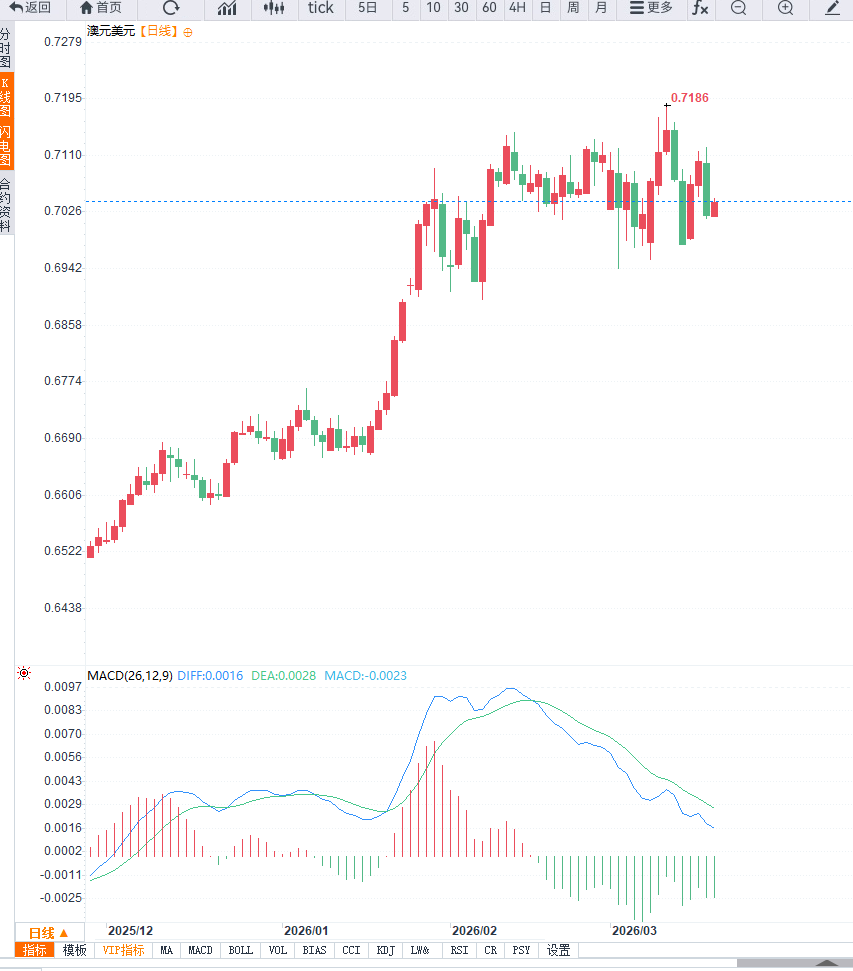
From a technical perspective, analyzing the daily chart, AUD/USD remains in a slightly bullish consolidation pattern, but significant resistance is evident, with the 0.7050-0.7100 range forming a key resistance zone. Support lies around 0.6950; a break below this level could open up further downside potential. Overall momentum indicators suggest weakening bullish momentum. On the 4-hour chart, the price maintains a range-bound structure, with short-term moving averages flattening, indicating a lack of clear market direction. Current price rebounds are limited, with multiple tests of the upper resistance failing to break through effectively, suggesting insufficient bullish confidence. A decisive break above 0.7050 could lead to a further test of the 0.7100 area; conversely, a break below the 0.7000 level could trigger a new round of pullback.
Overall, the Australian dollar is currently in a mixed environment of bullish and bearish factors. On the one hand, hawkish domestic policies and employment growth provide support; on the other hand, a stronger US dollar and global uncertainties limit upside potential, causing the exchange rate to maintain a volatile trading pattern.
Editor's Summary : The recent rebound in the Australian dollar against the US dollar is more of a technical correction than a trend reversal. Divergent employment data and uncertainty in the global macroeconomic environment have left the market lacking a clear direction. Future movements will depend on the Federal Reserve's policy path and developments in the Middle East. If the US dollar continues to strengthen, the upside potential for the Australian dollar will remain limited; however, if risk sentiment improves or commodity prices continue to rise, the Australian dollar may regain support.
Frequently Asked Questions (FAQ)
1. Why is the unemployment rate rising despite strong job growth?
This situation typically indicates that the labor market supply is expanding faster than demand. While businesses are increasing hiring, more people are entering the labor market to find work, leading to a rise in unemployment. This is not uncommon during economic expansion, especially when there is population growth or increased labor force participation. Structurally, this data combination does not necessarily indicate economic deterioration, but it increases the complexity of policy judgments, making central banks more reliant on subsequent data to confirm trends.
2. Why did the Reserve Bank of Australia's hawkish stance fail to drive a significant rise in the Australian dollar?
Despite the Reserve Bank of Australia's hawkish signals, exchange rate movements are relative variables, depending on policy differences between the two countries. Currently, the Federal Reserve is also maintaining a tight policy and lowering expectations for rate cuts, keeping the US dollar strong. Furthermore, global risk sentiment is cautious, with funds flowing more towards safe-haven assets, which weakens the Australian dollar's appeal as a risk currency. Therefore, even with a hawkish stance from the Reserve Bank of Australia, it is unlikely to drive a sustained rise in the Australian dollar on its own.
3. Why is the US dollar continuing to strengthen in the current environment?
The strengthening of the US dollar is mainly due to three factors: first, expectations of tighter Federal Reserve policy, which may prolong the period of high interest rates; second, rising global uncertainty, leading to capital flows into safe-haven assets; and third, relatively strong US economic performance, making dollar-denominated assets more attractive. These factors combined have enabled the US dollar to maintain its strong position among major global currencies.
4. What are the key factors that will influence the future trend of the Australian dollar?
The future trajectory of the Australian dollar will be primarily influenced by the following factors: firstly, the situation in the Middle East and changes in energy prices, which will affect global risk sentiment; secondly, the policy differences between the Federal Reserve and the Reserve Bank of Australia; and thirdly, commodity price trends, particularly iron ore and energy prices. Overall, the Australian dollar's performance will continue to be dominated by the external environment, and volatility is likely to remain high.
Data shows that Australia's unemployment rate rose to 4.3% in February, higher than the market expectation of 4.1% , indicating a certain degree of marginal weakening in the labor market. However, the number of employed people increased significantly to 48,900 , significantly higher than the expected 20,300 . This combination of "strong employment growth but rising unemployment" reflects a faster increase in the labor supply, leading to differing interpretations of the true state of the economy in the market.
On the monetary policy front, the Reserve Bank of Australia (RBA) previously raised interest rates by 25 basis points and clearly signaled a hawkish stance, emphasizing that the risk of rising energy prices due to the Middle East situation could lead to inflation remaining high for a longer period. RBA officials indicated that the current policy direction remains towards further tightening to ensure inflation returns to the target range. Market pricing suggests that investors expect two more rate hikes this year, which provides some support for the Australian dollar.
However, external factors are exerting significant downward pressure on the Australian dollar. The Federal Reserve recently raised its economic growth and inflation forecasts while emphasizing the risks posed by rising energy prices, further cooling market expectations for interest rate cuts. Currently, the market anticipates only one rate cut by the Fed this year, indicating a clear tightening of policy. This shift has strengthened the relative attractiveness of the US dollar, putting downward pressure on the Australian dollar.
Furthermore, continued tensions in the Middle East have fueled risk aversion, leading to capital flows into US dollar assets and further limiting the Australian dollar's upside potential. Against the backdrop of declining global risk appetite, commodity currencies are generally under pressure, making it difficult for the Australian dollar to establish an independent upward trend.
From a technical perspective, analyzing the daily chart, AUD/USD remains in a slightly bullish consolidation pattern, but significant resistance is evident, with the 0.7050-0.7100 range forming a key resistance zone. Support lies around 0.6950; a break below this level could open up further downside potential. Overall momentum indicators suggest weakening bullish momentum. On the 4-hour chart, the price maintains a range-bound structure, with short-term moving averages flattening, indicating a lack of clear market direction. Current price rebounds are limited, with multiple tests of the upper resistance failing to break through effectively, suggesting insufficient bullish confidence. A decisive break above 0.7050 could lead to a further test of the 0.7100 area; conversely, a break below the 0.7000 level could trigger a new round of pullback.
Overall, the Australian dollar is currently in a mixed environment of bullish and bearish factors. On the one hand, hawkish domestic policies and employment growth provide support; on the other hand, a stronger US dollar and global uncertainties limit upside potential, causing the exchange rate to maintain a volatile trading pattern.
Editor's Summary : The recent rebound in the Australian dollar against the US dollar is more of a technical correction than a trend reversal. Divergent employment data and uncertainty in the global macroeconomic environment have left the market lacking a clear direction. Future movements will depend on the Federal Reserve's policy path and developments in the Middle East. If the US dollar continues to strengthen, the upside potential for the Australian dollar will remain limited; however, if risk sentiment improves or commodity prices continue to rise, the Australian dollar may regain support.
Frequently Asked Questions (FAQ)
1. Why is the unemployment rate rising despite strong job growth?
This situation typically indicates that the labor market supply is expanding faster than demand. While businesses are increasing hiring, more people are entering the labor market to find work, leading to a rise in unemployment. This is not uncommon during economic expansion, especially when there is population growth or increased labor force participation. Structurally, this data combination does not necessarily indicate economic deterioration, but it increases the complexity of policy judgments, making central banks more reliant on subsequent data to confirm trends.
2. Why did the Reserve Bank of Australia's hawkish stance fail to drive a significant rise in the Australian dollar?
Despite the Reserve Bank of Australia's hawkish signals, exchange rate movements are relative variables, depending on policy differences between the two countries. Currently, the Federal Reserve is also maintaining a tight policy and lowering expectations for rate cuts, keeping the US dollar strong. Furthermore, global risk sentiment is cautious, with funds flowing more towards safe-haven assets, which weakens the Australian dollar's appeal as a risk currency. Therefore, even with a hawkish stance from the Reserve Bank of Australia, it is unlikely to drive a sustained rise in the Australian dollar on its own.
3. Why is the US dollar continuing to strengthen in the current environment?
The strengthening of the US dollar is mainly due to three factors: first, expectations of tighter Federal Reserve policy, which may prolong the period of high interest rates; second, rising global uncertainty, leading to capital flows into safe-haven assets; and third, relatively strong US economic performance, making dollar-denominated assets more attractive. These factors combined have enabled the US dollar to maintain its strong position among major global currencies.
4. What are the key factors that will influence the future trend of the Australian dollar?
The future trajectory of the Australian dollar will be primarily influenced by the following factors: firstly, the situation in the Middle East and changes in energy prices, which will affect global risk sentiment; secondly, the policy differences between the Federal Reserve and the Reserve Bank of Australia; and thirdly, commodity price trends, particularly iron ore and energy prices. Overall, the Australian dollar's performance will continue to be dominated by the external environment, and volatility is likely to remain high.
- Risk Warning and Disclaimer
- The market involves risk, and trading may not be suitable for all investors. This article is for reference only and does not constitute personal investment advice, nor does it take into account certain users’ specific investment objectives, financial situation, or other needs. Any investment decisions made based on this information are at your own risk.