Mutual bombing of energy facilities! The Iraq War between the US and Israel has reached its most critical moment, causing oil prices to soar.
2026-03-19 14:32:10
The escalating attacks on oil and gas infrastructure in the Persian Gulf region have pushed the conflict between the United States, Israel, and Iran into an extremely dangerous new phase. This tit-for-tat strike against the world's most critical energy hubs not only exacerbates regional tensions but also directly threatens global energy supply security, potentially triggering more severe supply disruptions and soaring prices.
On Thursday (March 19), during the Asian and European sessions, US crude oil prices fluctuated upwards and are currently trading around $96.70 per barrel, with a daily increase of about 1.3%.
On Wednesday, Israel launched an attack on the South Pars gas field, a core asset of Iran's energy industry. This field, shared by Iran and Qatar, is the world's largest gas field, with Iran's daily production recently reaching a record high of approximately 730 million cubic meters, primarily supplying its domestic power generation and fertilizer production needs.
Israel’s move is seen as an attempt to cut off a key source of revenue for Iran’s Islamic Revolutionary Guard Corps (IRGC), which is responsible for protecting the Iranian regime and has been accused of violently cracking down on protests in January.
Sources familiar with the matter revealed that the United States was aware of Israel's attack plans beforehand and did not object. Previously, the US had pledged to restrain strikes against Iranian energy facilities, but this operation received tacit approval from the White House.
U.S. officials said President Trump approved the action to pressure Iran to reopen the Strait of Hormuz—a strategic choke point for about 20% of the world’s oil and liquefied natural gas transport, which is currently effectively closed due to the conflict.
Iran retaliated swiftly, launching two missile strikes on Wednesday and early Thursday morning at Qatar’s main gas processing hub, Ras Laffan, which processes natural gas extracted from the Qatari side of the shared North Field gas field.
The attack caused widespread destruction and fires. Although some missiles were intercepted, one still hit its target. Iran also launched a large number of missiles at the Saudi capital, Riyadh, with debris landing near an oil refinery.
On Wednesday evening, Trump denied on social media that the United States had prior knowledge of the specific attack on South Pars, saying, "The United States knew nothing about this particular attack."
Trump accused Iran of “unjustly” attacking Qatari facilities without knowing the facts, and claimed that “Israel will not launch any more attacks.”
However, Trump immediately issued a strong warning: if Iran attacks the Qatari gas hub again, the United States will "bomb the entire South Pars gas field with unprecedented intensity and power."
News of the attack spread quickly, and European natural gas prices surged by as much as 6%. Markets are digesting the risk that Iran may continue to target Gulf energy facilities, after the conflict has already disrupted millions of barrels of global oil supply.
It is estimated that by the end of this week, the reduction in oil and petroleum product supply may approach 12 million barrels per day, exceeding 10% of global daily demand.
Analyst Natasha Kaneva stated that, given the global supply shortage of nearly 7 million barrels per day, the only way for the market to rebalance is for consumption to decrease by an equal amount.
Neil Crosby of Sparta Commodities noted that this round of attacks "opens the door to more infrastructure incidents in the region." Martin Senior, head of liquefied natural gas pricing at Argus Media, warned that attacks on these facilities would have "new energy implications that exceed the closure of the Strait of Hormuz," as facility repairs could take longer than the war itself.
Tom Mazek-Manser of Wood Mackenzie added that if Iran further cuts its gas supplies to Turkey, it will trigger a chain reaction, potentially requiring Turkey to increase its imports from Russia or bid for gas cargoes, impacting global markets.
Arab governments are strongly dissatisfied with the Israeli attacks and the US failure to stop them. They had repeatedly lobbied the Trump administration to stop the strikes against Iranian energy facilities, but now feel they themselves have become targets.
Qatari Prime Minister's advisor Majid Ansari said that Israel's strikes on facilities connected to Qatar's northern gas fields were "a dangerous and irresponsible step."
As the war enters its third week, the Gulf states have experienced unprecedented production shutdowns. Iran's closure of the Strait of Hormuz and attacks on multiple key facilities have further exacerbated the energy crisis. The Gulf states have repeatedly warned the United States that the oil and gas industry is crucial to their and the global economy, but appear to have limited influence over Washington.
This conflict has escalated from military confrontation into an energy war, posing a severe test to the global energy market. Any further escalation in the coming days could trigger even larger supply shocks and price volatility.
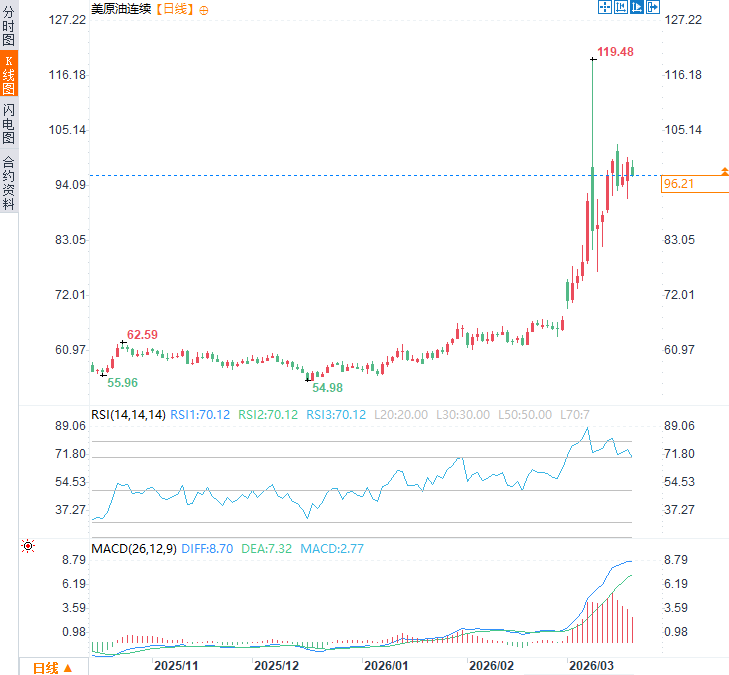
(US crude oil daily chart, source: FX678)
At 14:31 Beijing time, US crude oil futures were trading at $96.71 per barrel.
On Thursday (March 19), during the Asian and European sessions, US crude oil prices fluctuated upwards and are currently trading around $96.70 per barrel, with a daily increase of about 1.3%.
Israel raids South Pars gas field, crown jewel
On Wednesday, Israel launched an attack on the South Pars gas field, a core asset of Iran's energy industry. This field, shared by Iran and Qatar, is the world's largest gas field, with Iran's daily production recently reaching a record high of approximately 730 million cubic meters, primarily supplying its domestic power generation and fertilizer production needs.
Israel’s move is seen as an attempt to cut off a key source of revenue for Iran’s Islamic Revolutionary Guard Corps (IRGC), which is responsible for protecting the Iranian regime and has been accused of violently cracking down on protests in January.
Sources familiar with the matter revealed that the United States was aware of Israel's attack plans beforehand and did not object. Previously, the US had pledged to restrain strikes against Iranian energy facilities, but this operation received tacit approval from the White House.
U.S. officials said President Trump approved the action to pressure Iran to reopen the Strait of Hormuz—a strategic choke point for about 20% of the world’s oil and liquefied natural gas transport, which is currently effectively closed due to the conflict.
Iran retaliates swiftly: attacks Qatari hub and threats against Saudi Arabia
Iran retaliated swiftly, launching two missile strikes on Wednesday and early Thursday morning at Qatar’s main gas processing hub, Ras Laffan, which processes natural gas extracted from the Qatari side of the shared North Field gas field.
The attack caused widespread destruction and fires. Although some missiles were intercepted, one still hit its target. Iran also launched a large number of missiles at the Saudi capital, Riyadh, with debris landing near an oil refinery.
Trump denies prior knowledge and issues strong warning.
On Wednesday evening, Trump denied on social media that the United States had prior knowledge of the specific attack on South Pars, saying, "The United States knew nothing about this particular attack."
Trump accused Iran of “unjustly” attacking Qatari facilities without knowing the facts, and claimed that “Israel will not launch any more attacks.”
However, Trump immediately issued a strong warning: if Iran attacks the Qatari gas hub again, the United States will "bomb the entire South Pars gas field with unprecedented intensity and power."
Energy markets experience dramatic volatility: oil and gas prices surge.
News of the attack spread quickly, and European natural gas prices surged by as much as 6%. Markets are digesting the risk that Iran may continue to target Gulf energy facilities, after the conflict has already disrupted millions of barrels of global oil supply.
It is estimated that by the end of this week, the reduction in oil and petroleum product supply may approach 12 million barrels per day, exceeding 10% of global daily demand.
Analyst Natasha Kaneva stated that, given the global supply shortage of nearly 7 million barrels per day, the only way for the market to rebalance is for consumption to decrease by an equal amount.
Experts warn: Repair time may exceed the duration of the war.
Neil Crosby of Sparta Commodities noted that this round of attacks "opens the door to more infrastructure incidents in the region." Martin Senior, head of liquefied natural gas pricing at Argus Media, warned that attacks on these facilities would have "new energy implications that exceed the closure of the Strait of Hormuz," as facility repairs could take longer than the war itself.
Tom Mazek-Manser of Wood Mackenzie added that if Iran further cuts its gas supplies to Turkey, it will trigger a chain reaction, potentially requiring Turkey to increase its imports from Russia or bid for gas cargoes, impacting global markets.
Gulf allies are furious: deeply disappointed by US and Israeli actions.
Arab governments are strongly dissatisfied with the Israeli attacks and the US failure to stop them. They had repeatedly lobbied the Trump administration to stop the strikes against Iranian energy facilities, but now feel they themselves have become targets.
Qatari Prime Minister's advisor Majid Ansari said that Israel's strikes on facilities connected to Qatar's northern gas fields were "a dangerous and irresponsible step."
As the war enters its third week, the Gulf states have experienced unprecedented production shutdowns. Iran's closure of the Strait of Hormuz and attacks on multiple key facilities have further exacerbated the energy crisis. The Gulf states have repeatedly warned the United States that the oil and gas industry is crucial to their and the global economy, but appear to have limited influence over Washington.
This conflict has escalated from military confrontation into an energy war, posing a severe test to the global energy market. Any further escalation in the coming days could trigger even larger supply shocks and price volatility.
(US crude oil daily chart, source: FX678)
At 14:31 Beijing time, US crude oil futures were trading at $96.71 per barrel.
- Risk Warning and Disclaimer
- The market involves risk, and trading may not be suitable for all investors. This article is for reference only and does not constitute personal investment advice, nor does it take into account certain users’ specific investment objectives, financial situation, or other needs. Any investment decisions made based on this information are at your own risk.