Deutsche Bank expects the European Central Bank to keep interest rates steady but acknowledges that the Iranian conflict and soaring oil prices have increased the upside risk to inflation.
2026-03-19 15:47:46
According to APP, Deutsche Bank economists expect the European Central Bank (ECB) to keep interest rates unchanged, but will acknowledge greater uncertainty due to the Iranian conflict and soaring oil prices, as well as upside risks to near-term inflation. The market has already priced in at least one ECB rate hike in July and two more before the end of the year, resulting in a significant upward shift across the entire inflation swap curve.

The market is pricing in a new round of tightening. Looking ahead, central banks will once again be in focus, with the European Central Bank (ECB) and the Bank of England announcing their latest decisions today. For the ECB , the market widely expects it to follow the Federal Reserve and the Bank of Japan in keeping interest rates unchanged. However, the conflict in Iran has led to a significant shift in pricing since the last meeting, with the market now pricing in one ECB rate hike in July and two by the end of the year.
Today's focus is on communication style. Deutsche Bank's European economists believe they will acknowledge higher uncertainty and upside risks to near-term inflation. They also expect a strong message emphasizing the ECB's commitment to price stability and its willingness to take action to avoid a repeat of the 2022-23 inflation shock. In fact, they point out that clearly and loudly expressing this may be the best way to ensure inflation expectations remain well anchored. Today also marks the start of the EU leaders' summit. Higher energy prices will be a key issue, although economists expect the current policy response to focus on energy tax breaks at the national level.
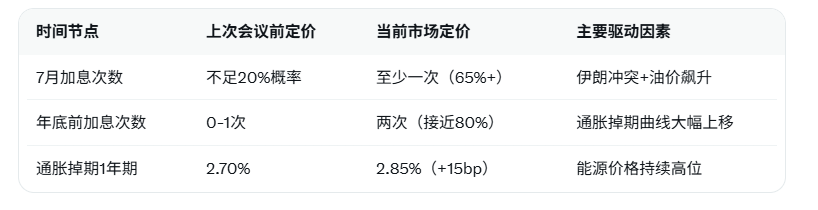
Latest market data shows that the European Central Bank's deposit rate is currently maintained at 4.50%, and the probability of a rate hike in July has surged from less than 20% last month to over 65%, with the pricing probability of two rate hikes this year approaching 80%. The 1-year inflation swap curve rose to 2.85%, up 15 basis points from last week, while the 2-year rate rose to 2.65%. The conflict in Iran, coupled with global energy supply disruptions, has pushed oil prices above $111 per barrel, directly amplifying imported inflationary pressures in the Eurozone and forcing the central bank to rebalance between "stabilizing growth" and "controlling prices."
The events have a profound and multi-dimensional impact on the Eurozone economy. High oil prices have increased business costs and household expenses, suppressing consumption and investment. Meanwhile, rising inflation expectations may force Eurozone countries to shift their fiscal policies towards subsidies rather than austerity. Analysts reasonably speculate that if the conflict continues into the second quarter, the European Central Bank's annual interest rate hikes may increase from zero to two, putting short-term pressure on the euro exchange rate but providing long-term support due to austerity expectations. At the business level, rising financing costs for energy-intensive industries are squeezing profit margins; at the household level, slower real income growth will drag down retail demand.
To visually illustrate changes in market pricing, the following is a comparison table of the latest ECB interest rate hike paths:
Editor's Summary : The Iranian conflict has directly translated the energy price shock into pressure for monetary policy tightening in the Eurozone. The European Central Bank's communication tone has shifted to a cautiously hawkish stance, and market pricing has adjusted rapidly. Increased volatility in Eurozone assets is inevitable in the short term, but the medium-term path still depends on the speed of conflict easing, the decline in oil prices, and the strength of EU fiscal coordination. Investors and businesses need to closely monitor today's ECB press conference, the outcome of the EU summit, and real-time changes in inflation swaps.
Frequently Asked Questions
1. Why does Deutsche Bank expect the European Central Bank to keep interest rates unchanged today?
Economists believe the European Central Bank will follow the Federal Reserve and the Bank of Japan in maintaining policy stability in the short term. However, the Iranian conflict has led to a surge in oil prices, significantly altering market pricing. Central banks need to anchor inflation expectations through communication rather than concrete actions to avoid premature tightening that could trigger a slowdown in economic growth.
2. Why did the market suddenly price in a July rate hike and two rate hikes throughout the year?
Since the last meeting, the Iranian conflict has pushed up global oil and gas prices, causing inflation swap curves to shift upward by more than 15 basis points across the board. The market believes that the upside risk to near-term inflation has exceeded previous expectations, with the probability of a July rate hike surging to 65% and the pricing of two rate hikes by the end of the year approaching 80%, reflecting a significant reassessment of the Eurozone's inflation path due to the energy shock.
3. How will the European Central Bank communicate uncertainty and upside risks?
Deutsche Bank expects the central bank to explicitly acknowledge the greater uncertainty stemming from the Iranian conflict and the near-term upward pressure on inflation, while simultaneously issuing a strong commitment to take necessary actions to prevent a repeat of the 2022-23 inflation shock. This "loud and clear" statement is seen as the best approach to effectively anchor inflation expectations and prevent a wage-price spiral.
The market is pricing in a new round of tightening. Looking ahead, central banks will once again be in focus, with the European Central Bank (ECB) and the Bank of England announcing their latest decisions today. For the ECB , the market widely expects it to follow the Federal Reserve and the Bank of Japan in keeping interest rates unchanged. However, the conflict in Iran has led to a significant shift in pricing since the last meeting, with the market now pricing in one ECB rate hike in July and two by the end of the year.
Today's focus is on communication style. Deutsche Bank's European economists believe they will acknowledge higher uncertainty and upside risks to near-term inflation. They also expect a strong message emphasizing the ECB's commitment to price stability and its willingness to take action to avoid a repeat of the 2022-23 inflation shock. In fact, they point out that clearly and loudly expressing this may be the best way to ensure inflation expectations remain well anchored. Today also marks the start of the EU leaders' summit. Higher energy prices will be a key issue, although economists expect the current policy response to focus on energy tax breaks at the national level.
Latest market data shows that the European Central Bank's deposit rate is currently maintained at 4.50%, and the probability of a rate hike in July has surged from less than 20% last month to over 65%, with the pricing probability of two rate hikes this year approaching 80%. The 1-year inflation swap curve rose to 2.85%, up 15 basis points from last week, while the 2-year rate rose to 2.65%. The conflict in Iran, coupled with global energy supply disruptions, has pushed oil prices above $111 per barrel, directly amplifying imported inflationary pressures in the Eurozone and forcing the central bank to rebalance between "stabilizing growth" and "controlling prices."
The events have a profound and multi-dimensional impact on the Eurozone economy. High oil prices have increased business costs and household expenses, suppressing consumption and investment. Meanwhile, rising inflation expectations may force Eurozone countries to shift their fiscal policies towards subsidies rather than austerity. Analysts reasonably speculate that if the conflict continues into the second quarter, the European Central Bank's annual interest rate hikes may increase from zero to two, putting short-term pressure on the euro exchange rate but providing long-term support due to austerity expectations. At the business level, rising financing costs for energy-intensive industries are squeezing profit margins; at the household level, slower real income growth will drag down retail demand.
To visually illustrate changes in market pricing, the following is a comparison table of the latest ECB interest rate hike paths:
Editor's Summary : The Iranian conflict has directly translated the energy price shock into pressure for monetary policy tightening in the Eurozone. The European Central Bank's communication tone has shifted to a cautiously hawkish stance, and market pricing has adjusted rapidly. Increased volatility in Eurozone assets is inevitable in the short term, but the medium-term path still depends on the speed of conflict easing, the decline in oil prices, and the strength of EU fiscal coordination. Investors and businesses need to closely monitor today's ECB press conference, the outcome of the EU summit, and real-time changes in inflation swaps.
Frequently Asked Questions
1. Why does Deutsche Bank expect the European Central Bank to keep interest rates unchanged today?
Economists believe the European Central Bank will follow the Federal Reserve and the Bank of Japan in maintaining policy stability in the short term. However, the Iranian conflict has led to a surge in oil prices, significantly altering market pricing. Central banks need to anchor inflation expectations through communication rather than concrete actions to avoid premature tightening that could trigger a slowdown in economic growth.
2. Why did the market suddenly price in a July rate hike and two rate hikes throughout the year?
Since the last meeting, the Iranian conflict has pushed up global oil and gas prices, causing inflation swap curves to shift upward by more than 15 basis points across the board. The market believes that the upside risk to near-term inflation has exceeded previous expectations, with the probability of a July rate hike surging to 65% and the pricing of two rate hikes by the end of the year approaching 80%, reflecting a significant reassessment of the Eurozone's inflation path due to the energy shock.
3. How will the European Central Bank communicate uncertainty and upside risks?
Deutsche Bank expects the central bank to explicitly acknowledge the greater uncertainty stemming from the Iranian conflict and the near-term upward pressure on inflation, while simultaneously issuing a strong commitment to take necessary actions to prevent a repeat of the 2022-23 inflation shock. This "loud and clear" statement is seen as the best approach to effectively anchor inflation expectations and prevent a wage-price spiral.
- Risk Warning and Disclaimer
- The market involves risk, and trading may not be suitable for all investors. This article is for reference only and does not constitute personal investment advice, nor does it take into account certain users’ specific investment objectives, financial situation, or other needs. Any investment decisions made based on this information are at your own risk.