Double inflation countdown begins! The Bank of England holds firm at 3.75%, the battle for the pound at the 1.33 mark has begun.
2026-03-19 20:13:07
On Thursday (March 19), the Bank of England (BoE) released its latest Monetary Policy Committee (MPC) decision. Against the backdrop of a complex situation where global energy prices have risen significantly due to volatility in the Middle East, the BoE announced it would maintain its benchmark interest rate at 3.75%. While this decision was in line with mainstream market expectations, the unexpected change in the internal voting ratio and the subsequent policy statement triggered significant volatility in financial markets.
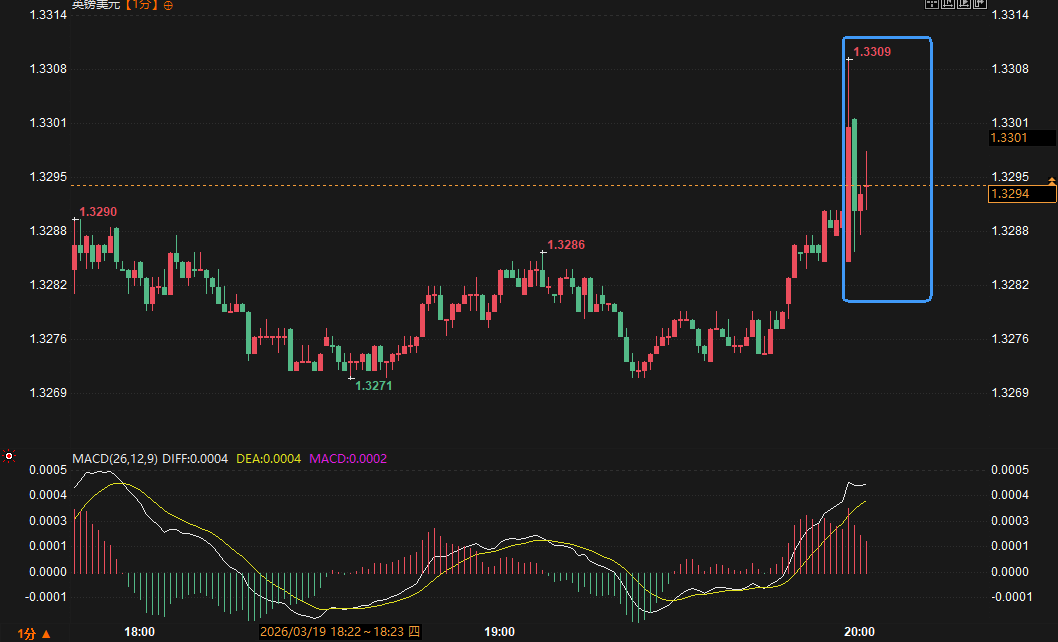
Prior to the decision, the market widely expected the Bank of England to keep interest rates unchanged, but there was disagreement regarding the voting ratio. A Reuters poll had previously predicted a 7:2 vote (7 in favor of maintaining rates, 2 in favor of a rate cut). However, the actual result showed that the MPC unanimously voted 9:0 to keep rates unchanged, with no members voting in favor of a rate cut. This shift to a hawkish consensus reflects the UK policymakers' high level of vigilance regarding the current risk of double-inflation. Immediately after the decision was announced, the pound sterling against the dollar (GBP/USD) surged by about 25 points, reaching a high of 1.3309, before fluctuating and falling back due to market concerns about the UK's economic growth prospects, currently trading around 1.3295.
From a fundamental perspective, the Bank of England's stance has undergone a subtle but firm shift. Previously, the market focused on slowing domestic inflation and declining wage growth in the UK, anticipating multiple interest rate cuts this year. However, the latest policy summary clearly states that rising global energy and commodity prices due to the Middle East situation will directly increase energy bills for UK households and production costs for businesses. Bank of England staff have raised their inflation forecasts, expecting the CPI to be around 3% in the second quarter and potentially climb further to 3.5% in the third quarter, significantly higher than the previous estimate of 2.1%.
A comparison of institutional and retail investor opinions reveals a significant discrepancy in expectations. Prior to the decision, mainstream retail sentiment leaned dovish, believing that with UK wage growth falling to its lowest level since 2020, the central bank should signal a clear interest rate cut. However, prominent institutions such as Goldman Sachs and JPMorgan Chase had warned beforehand that the energy shock would force the central bank to adopt a more cautious wait-and-see approach. After the decision, institutional analysis pointed out that the Bank of England was repeating its "better safe than sorry" approach to inflation, while retail investors began to focus on the weak UK Q1 GDP growth of only 0.1%-0.2%. This shift in focus from "interest rate differentials" to "fundamental resilience" explains the pound's initial surge followed by a decline.
Looking ahead, the Bank of England's policy path will be highly dependent on the developments in the Middle East and the secondary impact of energy prices on domestic price settings. Since the MPC has clearly stated that a more restrictive policy stance may be necessary if the energy shock persists or expands, this means the door to interest rate cuts in the near term is essentially closed.
Based on market logic, the GBP/USD pair is likely to remain range-bound between 1.3180 and 1.3350 in the short term. If future economic data confirms that the UK economy can maintain slight growth despite high energy consumption, the pound may gain momentum for a second upward move. Conversely, if high interest rates have a greater-than-expected dampening effect on economic activity—i.e., a significant rise in unemployment or a sharp drop in consumer spending—the market will repric its expectations for interest rate cuts, at which point the pound will face pressure to retrace to the Bollinger Band middle line and previous support levels.
Q: Why is the Bank of England refusing to cut interest rates despite weak economic growth?
A: The Bank of England's primary statutory mandate is to maintain price stability, namely, to restore the CPI inflation rate to the 2% target. Although current UK GDP growth is weak (Q1 is projected to be only 0.1%-0.2%), the energy price shocks triggered by the Middle East situation pose an imminent risk of upward inflation. The MPC is concerned that cutting interest rates at this time could exacerbate inflation expectations, leading to a secondary effect of an upward wage-price spiral. Therefore, the central bank has chosen to maintain high interest rates to offset price pressures from external supply shocks.
Q: What signal does the 9:0 vote ratio send?
A: This unanimous result is far more hawkish than the expected 7-2. It sends a clear signal: dovish members who initially supported rate cuts (such as Alan Taylor) have backed down in the face of the energy crisis. This indicates that the MPC has reached a consensus that it is premature to discuss monetary easing before the energy market stabilizes. This high degree of internal unity strengthens market confidence in the central bank's determination to combat inflation, but it also raises market expectations for future rate hikes if necessary.
Q: What is the specific impact of rising energy prices on UK inflation?
A: Bank of England staff have significantly raised their inflation forecasts, increasing their second-quarter CPI prediction from 2.1% to 3%, and potentially as high as 3.5% in the third quarter. This adjustment directly reflects the impact of energy price changes on transport, fuel, and subsequent household utility bills. It is worth noting that this external shock is uncertain, and if the situation continues to worsen, the inflation peak could shift further to the 4%-5% range.
Q: What are the differences in policy paths between the Bank of England, the Federal Reserve, and the European Central Bank?
A: Compared to the Federal Reserve's cautious approach of maintaining interest rates and hinting at possible future rate cuts at its recent meeting, and the European Central Bank facing more pressing pressure to cut rates due to the sluggish Eurozone economy, the Bank of England appears more "indecisive." Given the inherent rigidity of the UK labor market (e.g., agent surveys show wage settlements will remain at a high level of 3.6% in 2026) and its high energy dependence, the Bank of England appears more hesitant and passive in its shift towards an easing path.
Q: How is the market currently pricing in future interest rate trends in the UK?
A: Following this decision, the swap market has revised its previous optimistic expectations. The market had initially bet on two rate cuts this year, but investors are now pricing in the possibility of a rate hike before the end of the year, with some even suggesting a second rate hike. This dramatic revision of expectations reflects market concerns about the risk of "stagflation," where interest rates have to remain high or even rise while economic growth approaches stagnation.
Prior to the decision, the market widely expected the Bank of England to keep interest rates unchanged, but there was disagreement regarding the voting ratio. A Reuters poll had previously predicted a 7:2 vote (7 in favor of maintaining rates, 2 in favor of a rate cut). However, the actual result showed that the MPC unanimously voted 9:0 to keep rates unchanged, with no members voting in favor of a rate cut. This shift to a hawkish consensus reflects the UK policymakers' high level of vigilance regarding the current risk of double-inflation. Immediately after the decision was announced, the pound sterling against the dollar (GBP/USD) surged by about 25 points, reaching a high of 1.3309, before fluctuating and falling back due to market concerns about the UK's economic growth prospects, currently trading around 1.3295.
Deep interconnect analysis
From a fundamental perspective, the Bank of England's stance has undergone a subtle but firm shift. Previously, the market focused on slowing domestic inflation and declining wage growth in the UK, anticipating multiple interest rate cuts this year. However, the latest policy summary clearly states that rising global energy and commodity prices due to the Middle East situation will directly increase energy bills for UK households and production costs for businesses. Bank of England staff have raised their inflation forecasts, expecting the CPI to be around 3% in the second quarter and potentially climb further to 3.5% in the third quarter, significantly higher than the previous estimate of 2.1%.
A comparison of institutional and retail investor opinions reveals a significant discrepancy in expectations. Prior to the decision, mainstream retail sentiment leaned dovish, believing that with UK wage growth falling to its lowest level since 2020, the central bank should signal a clear interest rate cut. However, prominent institutions such as Goldman Sachs and JPMorgan Chase had warned beforehand that the energy shock would force the central bank to adopt a more cautious wait-and-see approach. After the decision, institutional analysis pointed out that the Bank of England was repeating its "better safe than sorry" approach to inflation, while retail investors began to focus on the weak UK Q1 GDP growth of only 0.1%-0.2%. This shift in focus from "interest rate differentials" to "fundamental resilience" explains the pound's initial surge followed by a decline.
Trend Outlook
Looking ahead, the Bank of England's policy path will be highly dependent on the developments in the Middle East and the secondary impact of energy prices on domestic price settings. Since the MPC has clearly stated that a more restrictive policy stance may be necessary if the energy shock persists or expands, this means the door to interest rate cuts in the near term is essentially closed.
Based on market logic, the GBP/USD pair is likely to remain range-bound between 1.3180 and 1.3350 in the short term. If future economic data confirms that the UK economy can maintain slight growth despite high energy consumption, the pound may gain momentum for a second upward move. Conversely, if high interest rates have a greater-than-expected dampening effect on economic activity—i.e., a significant rise in unemployment or a sharp drop in consumer spending—the market will repric its expectations for interest rate cuts, at which point the pound will face pressure to retrace to the Bollinger Band middle line and previous support levels.
Frequently Asked Questions
Q: Why is the Bank of England refusing to cut interest rates despite weak economic growth?
A: The Bank of England's primary statutory mandate is to maintain price stability, namely, to restore the CPI inflation rate to the 2% target. Although current UK GDP growth is weak (Q1 is projected to be only 0.1%-0.2%), the energy price shocks triggered by the Middle East situation pose an imminent risk of upward inflation. The MPC is concerned that cutting interest rates at this time could exacerbate inflation expectations, leading to a secondary effect of an upward wage-price spiral. Therefore, the central bank has chosen to maintain high interest rates to offset price pressures from external supply shocks.
Q: What signal does the 9:0 vote ratio send?
A: This unanimous result is far more hawkish than the expected 7-2. It sends a clear signal: dovish members who initially supported rate cuts (such as Alan Taylor) have backed down in the face of the energy crisis. This indicates that the MPC has reached a consensus that it is premature to discuss monetary easing before the energy market stabilizes. This high degree of internal unity strengthens market confidence in the central bank's determination to combat inflation, but it also raises market expectations for future rate hikes if necessary.
Q: What is the specific impact of rising energy prices on UK inflation?
A: Bank of England staff have significantly raised their inflation forecasts, increasing their second-quarter CPI prediction from 2.1% to 3%, and potentially as high as 3.5% in the third quarter. This adjustment directly reflects the impact of energy price changes on transport, fuel, and subsequent household utility bills. It is worth noting that this external shock is uncertain, and if the situation continues to worsen, the inflation peak could shift further to the 4%-5% range.
Q: What are the differences in policy paths between the Bank of England, the Federal Reserve, and the European Central Bank?
A: Compared to the Federal Reserve's cautious approach of maintaining interest rates and hinting at possible future rate cuts at its recent meeting, and the European Central Bank facing more pressing pressure to cut rates due to the sluggish Eurozone economy, the Bank of England appears more "indecisive." Given the inherent rigidity of the UK labor market (e.g., agent surveys show wage settlements will remain at a high level of 3.6% in 2026) and its high energy dependence, the Bank of England appears more hesitant and passive in its shift towards an easing path.
Q: How is the market currently pricing in future interest rate trends in the UK?
A: Following this decision, the swap market has revised its previous optimistic expectations. The market had initially bet on two rate cuts this year, but investors are now pricing in the possibility of a rate hike before the end of the year, with some even suggesting a second rate hike. This dramatic revision of expectations reflects market concerns about the risk of "stagflation," where interest rates have to remain high or even rise while economic growth approaches stagnation.
- Risk Warning and Disclaimer
- The market involves risk, and trading may not be suitable for all investors. This article is for reference only and does not constitute personal investment advice, nor does it take into account certain users’ specific investment objectives, financial situation, or other needs. Any investment decisions made based on this information are at your own risk.