With oil prices falling and central bank policy remaining cautious, the USD/CAD exchange rate awaits a directional move.
2026-03-20 11:08:05
The Canadian dollar has shown some resilience recently, remaining relatively stable overall despite the adverse effects of a pullback in oil prices. The USD/CAD exchange rate fell slightly to around 1.3735 during the Asian session, after previously touching a more than two-week high of 1.3748, indicating a weakening of the US dollar's short-term momentum. In terms of driving factors, the Canadian dollar's movements are mainly influenced by energy prices, central bank policies, and US dollar fluctuations.

From a fundamental perspective, as the largest exporter of crude oil to the United States, Canada's currency is highly sensitive to oil price fluctuations. Recently, WTI crude oil prices have fallen significantly from their highs, dropping to around $92.5, directly putting downward pressure on the Canadian dollar. The main reason for the price decline is the marginal easing of geopolitical tensions. US President Donald Trump has explicitly stated his opposition to further attacks on energy facilities, while Israel's actions have become more restrained, reducing market concerns about supply disruptions. Furthermore, signals from Europe and Japan indicating their commitment to ensuring unimpeded energy transportation routes have also weakened the risk premium associated with oil prices. It is important to emphasize that falling oil prices typically weaken the export support for the Canadian dollar , which is one of the key reasons why the USD/CAD exchange rate has remained high recently.
Regarding monetary policy, the Bank of Canada's latest decision kept interest rates unchanged at 2.25%, indicating that the policy remains in a wait-and-see phase. Despite persistent inflationary pressures, limited economic growth momentum has made the central bank cautious about further rate hikes. This neutral policy stance has, to some extent, limited the upside potential of the Canadian dollar.
Meanwhile, the US dollar's performance also significantly impacted the USD/CAD exchange rate. The dollar index had previously fallen by more than 1%, but subsequently stabilized and rebounded around 99.3. Behind this dollar volatility is the convergence of policy stances among major global central banks. The Bank of Japan, the Bank of England, and the European Central Bank have all released hawkish signals, reducing market expectations for the Federal Reserve's policy independence and thus weakening the dollar's relative advantage. However, it's important to note that the Federal Reserve is maintaining relatively high interest rates, providing continued support for the dollar in the medium term.
From a data perspective, the market is focused on the upcoming Canadian retail sales figures, which are expected to show a month-over-month increase of approximately 1.5%. Strong data would help alleviate market concerns about an economic slowdown, thus supporting the Canadian dollar. Conversely, weaker-than-expected data could further amplify upward pressure on USD/CAD.
From a technical perspective, the USD/CAD pair remains within a slightly upward-trending channel on the daily chart, with the price holding above 1.36, indicating a continued bullish medium-term trend. The current price is approaching the previous high area, with a key short-term resistance level around 1.3750. A break above this level could lead to further gains towards the 1.38 area. Support levels are located at 1.3680 and 1.3600; a break below these levels would weaken the upward momentum.
From a 4-hour chart perspective, USD/CAD is exhibiting a high-level consolidation pattern in the short term. The price has repeatedly tested above 1.3740 but failed to break through effectively, indicating strong selling pressure. Short-term moving averages are flattening, and momentum indicators suggest the market is entering a consolidation phase. A break below 1.3680 could trigger a short-term pullback; conversely, a break above 1.3750 could lead to a continuation of the short-term upward trend.
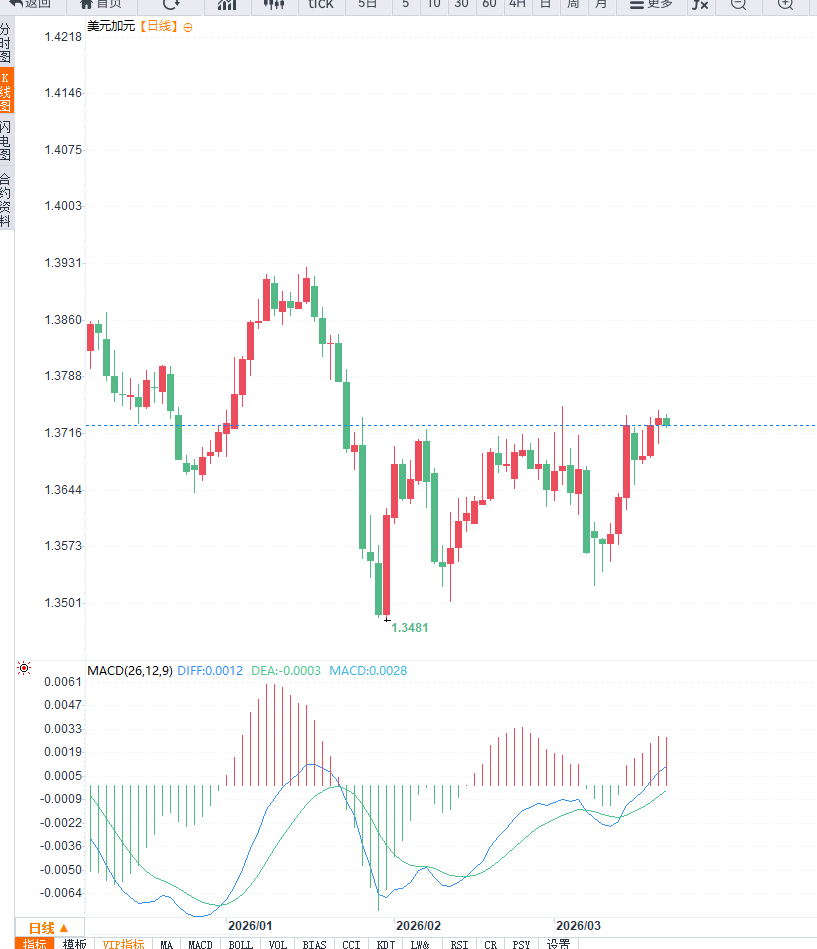
In summary, the current USD/CAD exchange rate is in a phase of balancing between oil price drivers and dollar volatility . The short-term direction is still unclear, but volatility may persist.
Editor's Summary:
The core dilemma facing the Canadian dollar lies in the combined impact of oil price corrections and US dollar volatility. Given the lack of sustained upward momentum in oil prices, a sustained appreciation of the Canadian dollar in the short term is unlikely . Its future trajectory will depend on energy price changes, Canadian economic data, and the policy paths of global central banks. Overall, USD/CAD is likely to remain range-bound in the short term, while in the medium term, attention should be paid to whether there are any new changes in the oil price trend.
From a fundamental perspective, as the largest exporter of crude oil to the United States, Canada's currency is highly sensitive to oil price fluctuations. Recently, WTI crude oil prices have fallen significantly from their highs, dropping to around $92.5, directly putting downward pressure on the Canadian dollar. The main reason for the price decline is the marginal easing of geopolitical tensions. US President Donald Trump has explicitly stated his opposition to further attacks on energy facilities, while Israel's actions have become more restrained, reducing market concerns about supply disruptions. Furthermore, signals from Europe and Japan indicating their commitment to ensuring unimpeded energy transportation routes have also weakened the risk premium associated with oil prices. It is important to emphasize that falling oil prices typically weaken the export support for the Canadian dollar , which is one of the key reasons why the USD/CAD exchange rate has remained high recently.
Regarding monetary policy, the Bank of Canada's latest decision kept interest rates unchanged at 2.25%, indicating that the policy remains in a wait-and-see phase. Despite persistent inflationary pressures, limited economic growth momentum has made the central bank cautious about further rate hikes. This neutral policy stance has, to some extent, limited the upside potential of the Canadian dollar.
Meanwhile, the US dollar's performance also significantly impacted the USD/CAD exchange rate. The dollar index had previously fallen by more than 1%, but subsequently stabilized and rebounded around 99.3. Behind this dollar volatility is the convergence of policy stances among major global central banks. The Bank of Japan, the Bank of England, and the European Central Bank have all released hawkish signals, reducing market expectations for the Federal Reserve's policy independence and thus weakening the dollar's relative advantage. However, it's important to note that the Federal Reserve is maintaining relatively high interest rates, providing continued support for the dollar in the medium term.
From a data perspective, the market is focused on the upcoming Canadian retail sales figures, which are expected to show a month-over-month increase of approximately 1.5%. Strong data would help alleviate market concerns about an economic slowdown, thus supporting the Canadian dollar. Conversely, weaker-than-expected data could further amplify upward pressure on USD/CAD.
From a technical perspective, the USD/CAD pair remains within a slightly upward-trending channel on the daily chart, with the price holding above 1.36, indicating a continued bullish medium-term trend. The current price is approaching the previous high area, with a key short-term resistance level around 1.3750. A break above this level could lead to further gains towards the 1.38 area. Support levels are located at 1.3680 and 1.3600; a break below these levels would weaken the upward momentum.
From a 4-hour chart perspective, USD/CAD is exhibiting a high-level consolidation pattern in the short term. The price has repeatedly tested above 1.3740 but failed to break through effectively, indicating strong selling pressure. Short-term moving averages are flattening, and momentum indicators suggest the market is entering a consolidation phase. A break below 1.3680 could trigger a short-term pullback; conversely, a break above 1.3750 could lead to a continuation of the short-term upward trend.
In summary, the current USD/CAD exchange rate is in a phase of balancing between oil price drivers and dollar volatility . The short-term direction is still unclear, but volatility may persist.
Editor's Summary:
The core dilemma facing the Canadian dollar lies in the combined impact of oil price corrections and US dollar volatility. Given the lack of sustained upward momentum in oil prices, a sustained appreciation of the Canadian dollar in the short term is unlikely . Its future trajectory will depend on energy price changes, Canadian economic data, and the policy paths of global central banks. Overall, USD/CAD is likely to remain range-bound in the short term, while in the medium term, attention should be paid to whether there are any new changes in the oil price trend.
- Risk Warning and Disclaimer
- The market involves risk, and trading may not be suitable for all investors. This article is for reference only and does not constitute personal investment advice, nor does it take into account certain users’ specific investment objectives, financial situation, or other needs. Any investment decisions made based on this information are at your own risk.