Trump's emergency halt to Israel's actions, the G7's joint efforts, and the US's oil stimulus—is the oil price correction a temporary fix?
2026-03-20 11:21:50
On Friday (March 20) during Asian trading hours, US crude oil prices saw a significant pullback, trending downwards and currently trading around $93.45 per barrel, a daily decline of approximately 2.2%. Brent crude futures fell 2.5% to $105.04 per barrel during the session, while US crude fell as much as 3.2% to $92.47 per barrel. Despite this, Brent crude is still on track for a cumulative increase of over 3% this week, mainly supported by the widespread production shutdowns caused by Iran's attacks on oil and gas facilities in Gulf countries. US crude, however, may fall by over 5% this week, marking its first weekly decline after five consecutive weeks of gains. Currently, the price difference between US and Brent crude has widened to its largest level in 11 years, reflecting that global supply disruption concerns are mainly concentrated on Middle Eastern exports, while US domestic supply remains relatively stable.
The UK, Canada, France, Germany, Italy, the Netherlands, and Japan issued a joint statement on Friday, stating their "readiness to make appropriate contributions to ensuring safe navigation in the Strait of Hormuz." While the statement did not specify details of military deployments, it is seen as the first time the G7 has collectively expressed its position on the security of this energy route, aiming to alleviate extreme market concerns about a potential blockade or prolonged disruption of the strait.
Previously, many countries had adopted a cautious stance, with German Chancellor Merz emphasizing that no military intervention would be used during a prolonged war. This statement marks progress in coordination among allies and may help to curb the panic premium in oil prices.
U.S. Treasury Secretary Bessant stated that the U.S. may "soon" lift sanctions on Iranian oil stranded on tankers in order to increase global crude oil supply and lower oil prices. This statement directly addresses concerns about domestic inflation and voter pressure stemming from recent high oil prices.
If sanctions are eased, it will release some of Iran's crude oil reserves (estimated to be millions of barrels), replenishing market supply in the short term and directly impacting oil prices. However, the actual implementation will require a balance between geopolitical risks and the effectiveness of pressuring Iran, and the timing and scale of its implementation remain uncertain.
Trump reiterated that he had told Israeli Prime Minister Netanyahu "not to attack Iranian energy facilities," and said Israel had agreed. Iran's previous retaliatory strikes against Qatari gas facilities, Saudi Red Sea ports, and other energy assets were triggered by Israel's airstrikes on the South Pars gas field.
Trump's public warning aimed to prevent the conflict from escalating into a full-blown energy war and to avoid a runaway surge in oil prices that could impact the global economy and American voter support. Although Israel has outwardly agreed, the dynamics of the conflict remain highly sensitive, and any new attack could reverse the current downward trend in oil prices.
North Dakota, the third-largest oil-producing state in the U.S., said crude oil production will steadily increase this month and in the coming months as operators restart idle wells and winter operating restrictions are gradually eased. This move will further strengthen the resilience of domestic supply and partially hedge against the risk of supply disruptions from the Middle East.
However, the speed of production recovery depends on whether oil prices can remain high (to incentivize drilling activity), and major oil companies have largely finalized their 2026 capital expenditure budgets, making a significant increase in production unlikely in the short term. Increased production signals from North Dakota provide long-term bottom support for oil prices, but are unlikely to quickly reverse the current geopolitically driven volatility pattern.
The pullback in oil prices during Friday's Asian session was mainly due to a confluence of negative factors, including the G7 joint statement signaling coordination, the US considering easing sanctions on Iranian oil, Trump's renewed restraints on Israel to avoid energy attacks, and expectations of a production rebound in North Dakota. These factors temporarily alleviated the market's extreme panic over long-term supply disruptions.
However, Brent crude oil prices are still highly likely to rise this week, indicating that geopolitical risk premiums have not completely subsided. The WTI-Brent price spread hit an 11-year high, highlighting that Middle East supply shocks have a greater impact on Europe and Asia, while the flexibility of US domestic production provides a buffer.
If the G7 takes concrete actions and sanctions are eased, oil prices may enter a period of adjustment; conversely, if the conflict with Iran escalates again or navigation in the Taiwan Strait is disrupted, high oil prices will quickly return, and global inflationary and economic growth pressures will continue to intensify.
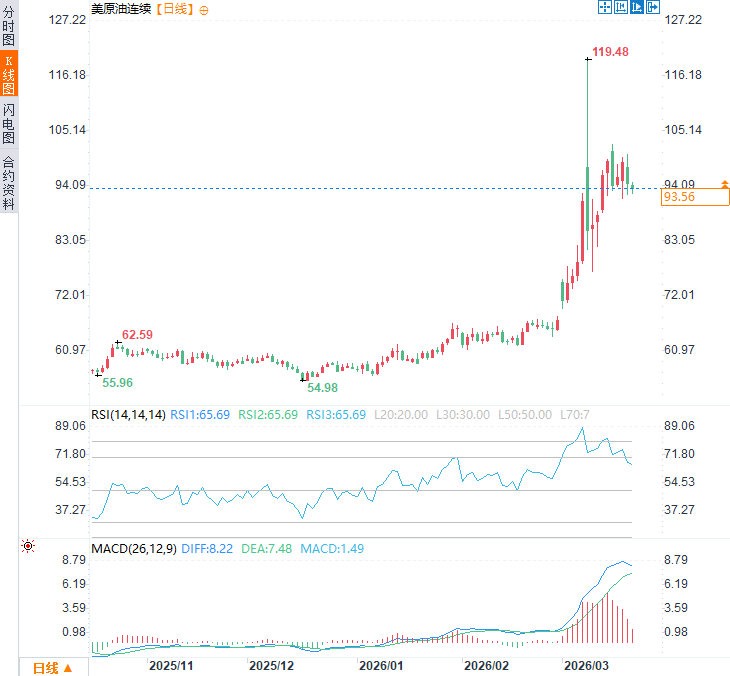
(US crude oil daily chart, source: FX678)
At 11:21 Beijing time, US crude oil futures were trading at $93.65 per barrel.
G7 Joint Statement Safeguards the Strait of Hormuz
The UK, Canada, France, Germany, Italy, the Netherlands, and Japan issued a joint statement on Friday, stating their "readiness to make appropriate contributions to ensuring safe navigation in the Strait of Hormuz." While the statement did not specify details of military deployments, it is seen as the first time the G7 has collectively expressed its position on the security of this energy route, aiming to alleviate extreme market concerns about a potential blockade or prolonged disruption of the strait.
Previously, many countries had adopted a cautious stance, with German Chancellor Merz emphasizing that no military intervention would be used during a prolonged war. This statement marks progress in coordination among allies and may help to curb the panic premium in oil prices.
US Treasury Secretary Hints at Possible Lifting of Sanctions on Iranian Oil
U.S. Treasury Secretary Bessant stated that the U.S. may "soon" lift sanctions on Iranian oil stranded on tankers in order to increase global crude oil supply and lower oil prices. This statement directly addresses concerns about domestic inflation and voter pressure stemming from recent high oil prices.
If sanctions are eased, it will release some of Iran's crude oil reserves (estimated to be millions of barrels), replenishing market supply in the short term and directly impacting oil prices. However, the actual implementation will require a balance between geopolitical risks and the effectiveness of pressuring Iran, and the timing and scale of its implementation remain uncertain.
Trump again warns Israel to avoid energy targets
Trump reiterated that he had told Israeli Prime Minister Netanyahu "not to attack Iranian energy facilities," and said Israel had agreed. Iran's previous retaliatory strikes against Qatari gas facilities, Saudi Red Sea ports, and other energy assets were triggered by Israel's airstrikes on the South Pars gas field.
Trump's public warning aimed to prevent the conflict from escalating into a full-blown energy war and to avoid a runaway surge in oil prices that could impact the global economy and American voter support. Although Israel has outwardly agreed, the dynamics of the conflict remain highly sensitive, and any new attack could reverse the current downward trend in oil prices.
North Dakota crude oil production is expected to rebound.
North Dakota, the third-largest oil-producing state in the U.S., said crude oil production will steadily increase this month and in the coming months as operators restart idle wells and winter operating restrictions are gradually eased. This move will further strengthen the resilience of domestic supply and partially hedge against the risk of supply disruptions from the Middle East.
However, the speed of production recovery depends on whether oil prices can remain high (to incentivize drilling activity), and major oil companies have largely finalized their 2026 capital expenditure budgets, making a significant increase in production unlikely in the short term. Increased production signals from North Dakota provide long-term bottom support for oil prices, but are unlikely to quickly reverse the current geopolitically driven volatility pattern.
Editor's Summary
The pullback in oil prices during Friday's Asian session was mainly due to a confluence of negative factors, including the G7 joint statement signaling coordination, the US considering easing sanctions on Iranian oil, Trump's renewed restraints on Israel to avoid energy attacks, and expectations of a production rebound in North Dakota. These factors temporarily alleviated the market's extreme panic over long-term supply disruptions.
However, Brent crude oil prices are still highly likely to rise this week, indicating that geopolitical risk premiums have not completely subsided. The WTI-Brent price spread hit an 11-year high, highlighting that Middle East supply shocks have a greater impact on Europe and Asia, while the flexibility of US domestic production provides a buffer.
If the G7 takes concrete actions and sanctions are eased, oil prices may enter a period of adjustment; conversely, if the conflict with Iran escalates again or navigation in the Taiwan Strait is disrupted, high oil prices will quickly return, and global inflationary and economic growth pressures will continue to intensify.
(US crude oil daily chart, source: FX678)
At 11:21 Beijing time, US crude oil futures were trading at $93.65 per barrel.
- Risk Warning and Disclaimer
- The market involves risk, and trading may not be suitable for all investors. This article is for reference only and does not constitute personal investment advice, nor does it take into account certain users’ specific investment objectives, financial situation, or other needs. Any investment decisions made based on this information are at your own risk.