USD/JPY 160 becomes an impenetrable barrier again! Is the yen poised to correct its decline?
2026-03-20 13:08:58
According to APP, Philip Wee , a foreign exchange strategist at DBS Group Research, emphasized that the 160 level for the USD/JPY exchange rate has once again proven to be a difficult barrier to overcome. With the current exchange rate hovering around 158, the market is generally reluctant to risk testing the Japanese Finance Minister's clear warnings of "decisive measures and direct intervention." The Japanese government and central bank have clearly identified the continued weakness of the yen as a major driver of imported cost-push inflation, a judgment that could significantly limit the upside potential of the dollar and shift market focus to a correction in the USD/JPY rally this month.
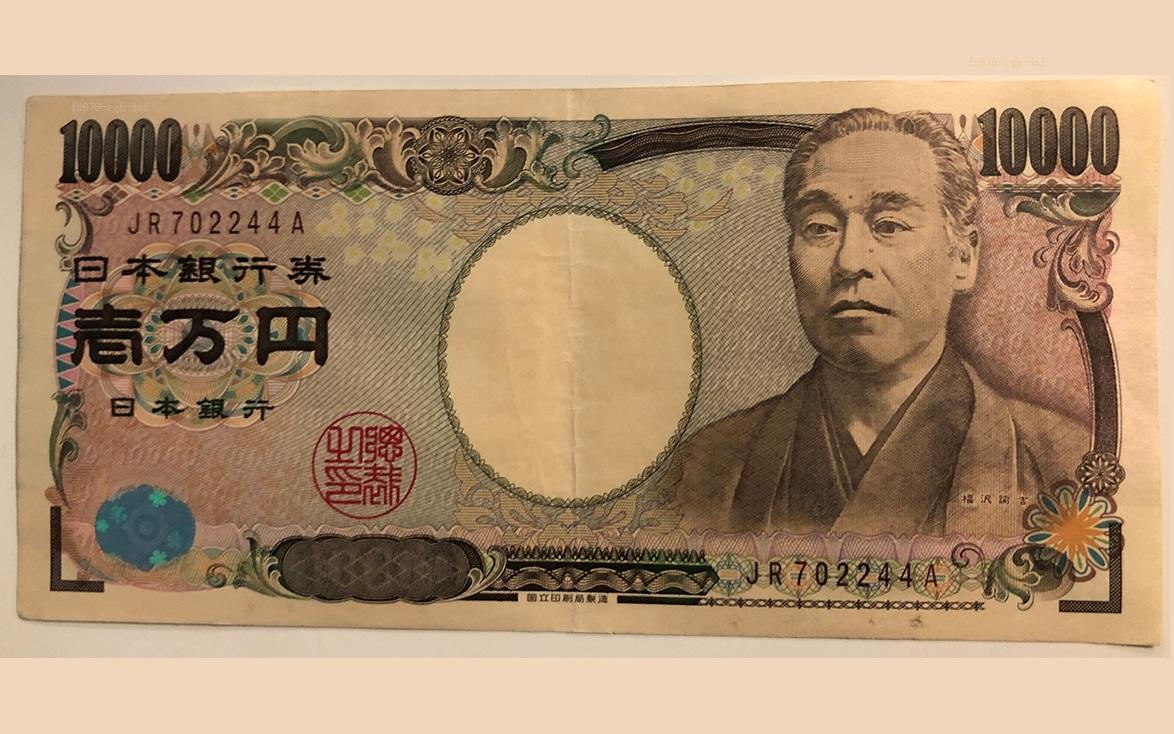
Philip Wee's recent analysis points out that "the USD/JPY exchange rate is approaching the psychological level of 160, significantly increasing the risk of direct official intervention. Japan and South Korea issued a rare joint statement over the weekend, expressing serious concern about the rapid depreciation of the yen and won." This statement is highly consistent with the latest warning from Japanese Finance Minister Satsuki Katayama, who explicitly stated that "the authorities are fully prepared to take any necessary action on exchange rate fluctuations if necessary," and emphasized the need to be wary of speculative volatility. Katayama's strong wording has directly led the market to adopt a wait-and-see approach in the short term, avoiding crossing the intervention red line.
Japanese authorities' concerns stem from the substantial impact of the weak yen on the domestic economy. The prices of imported energy, raw materials, and food have risen sharply due to the currency depreciation, directly increasing production costs for businesses and transmitting this to consumer prices, creating typical imported inflationary pressures. Central bank data shows that for every 10 yen depreciation, the contribution of imported inflation increases by approximately 0.5-0.8 percentage points, which conflicts with Japan's current policy objective of a wage-price spiral. Therefore, the government and central bank prefer to stabilize the exchange rate and anchor inflation expectations through verbal intervention and even actual market intervention to sell dollars and buy yen.
This development also sends a clear signal to the global foreign exchange market: while the US dollar is supported by the US-Japan interest rate differential, its upside potential above 160 has been significantly reduced. In the short term, the cumulative gains this month may face profit-taking pressure, with a potential correction target of 155-157. If actual Japanese intervention occurs, the correction could widen further; conversely, if the US dollar index falls due to expectations of Fed policy, the yen's rebound momentum will strengthen further.
The following is a comparison of key psychological levels and intervention risks for USD/JPY (based on the latest market data as of March 20, 2026):
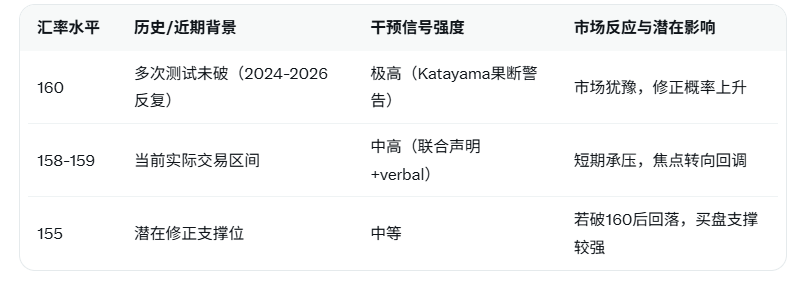
Overall, the USD/JPY exchange rate is experiencing increased volatility in the short term, with the 160 level and Japan's determination to intervene forming a double resistance. Investors need to closely monitor the actual actions of the Japanese authorities and policy signals from the Federal Reserve to seize opportunities for exchange rate corrections.
Editor's Summary:
The 160 level for USD/JPY has once again validated its status as a key psychological support level. Philip Wee's analysis and Japanese Finance Minister Satsuki Katayama's decisive warning have reinforced expectations of intervention. The official stance that the yen's weakness is primarily a cause of imported inflation not only limits the dollar's upside but also shifts market attention to a correction in this month's gains. Future exchange rate movements will depend on the pace of intervention and the global interest rate environment. Investors should prioritize risk management and focus on the dynamic game within the 155-160 range.
Frequently Asked Questions
Q1: Why has the USD/JPY exchange rate of 160 become an insurmountable barrier again?
A: 160 is a long-term psychological red line for the Japanese authorities, and historically, interventions have occurred near this level. Philip Wee points out that although the dollar is supported by interest rate differentials, the market is currently unwilling to risk testing it, as Japanese Finance Minister Satsuki Katayama has explicitly warned of "decisive measures and direct intervention." Latest data shows the exchange rate hovering around 158, with investors choosing to wait and see to avoid triggering actual dollar-to-yen sales, effectively limiting upward movement above 160.
Q2: Why do the Japanese government and central bank regard the weak yen as the main cause of imported cost-push inflation?
A: The depreciation of the yen directly increases the cost of imported energy, raw materials, and food. This increased production cost for businesses is then passed on to consumer prices, creating cost-push inflation. The Bank of Japan's calculations show that for every 10 yen depreciation, import inflation contributes approximately 0.5-0.8 percentage points. This conflicts with the current benign inflation target driven by wage growth. Therefore, the authorities view exchange rate stability as a core tool for controlling inflation. Philip Wee emphasizes that this assessment will constrain the long-term appreciation of the US dollar.
Q3: What is the probability of a correction in the USD/JPY rally this month, and what is the potential target range?
A: Philip Wee believes that intervention risks and inflation concerns will limit the dollar's upside, and the focus has shifted to a correction. If the dollar fails to break through 160 from its current level of around 158, profit-taking pressure will push the exchange rate down, with a reasonable target of 155-157. If actual Japanese intervention occurs or the Fed's signals become dovish, the correction could extend to deeper support levels. Overall, the probability of a correction is higher than a continued upward move.
Philip Wee's recent analysis points out that "the USD/JPY exchange rate is approaching the psychological level of 160, significantly increasing the risk of direct official intervention. Japan and South Korea issued a rare joint statement over the weekend, expressing serious concern about the rapid depreciation of the yen and won." This statement is highly consistent with the latest warning from Japanese Finance Minister Satsuki Katayama, who explicitly stated that "the authorities are fully prepared to take any necessary action on exchange rate fluctuations if necessary," and emphasized the need to be wary of speculative volatility. Katayama's strong wording has directly led the market to adopt a wait-and-see approach in the short term, avoiding crossing the intervention red line.
Japanese authorities' concerns stem from the substantial impact of the weak yen on the domestic economy. The prices of imported energy, raw materials, and food have risen sharply due to the currency depreciation, directly increasing production costs for businesses and transmitting this to consumer prices, creating typical imported inflationary pressures. Central bank data shows that for every 10 yen depreciation, the contribution of imported inflation increases by approximately 0.5-0.8 percentage points, which conflicts with Japan's current policy objective of a wage-price spiral. Therefore, the government and central bank prefer to stabilize the exchange rate and anchor inflation expectations through verbal intervention and even actual market intervention to sell dollars and buy yen.
This development also sends a clear signal to the global foreign exchange market: while the US dollar is supported by the US-Japan interest rate differential, its upside potential above 160 has been significantly reduced. In the short term, the cumulative gains this month may face profit-taking pressure, with a potential correction target of 155-157. If actual Japanese intervention occurs, the correction could widen further; conversely, if the US dollar index falls due to expectations of Fed policy, the yen's rebound momentum will strengthen further.
The following is a comparison of key psychological levels and intervention risks for USD/JPY (based on the latest market data as of March 20, 2026):
Overall, the USD/JPY exchange rate is experiencing increased volatility in the short term, with the 160 level and Japan's determination to intervene forming a double resistance. Investors need to closely monitor the actual actions of the Japanese authorities and policy signals from the Federal Reserve to seize opportunities for exchange rate corrections.
Editor's Summary:
The 160 level for USD/JPY has once again validated its status as a key psychological support level. Philip Wee's analysis and Japanese Finance Minister Satsuki Katayama's decisive warning have reinforced expectations of intervention. The official stance that the yen's weakness is primarily a cause of imported inflation not only limits the dollar's upside but also shifts market attention to a correction in this month's gains. Future exchange rate movements will depend on the pace of intervention and the global interest rate environment. Investors should prioritize risk management and focus on the dynamic game within the 155-160 range.
Frequently Asked Questions
Q1: Why has the USD/JPY exchange rate of 160 become an insurmountable barrier again?
A: 160 is a long-term psychological red line for the Japanese authorities, and historically, interventions have occurred near this level. Philip Wee points out that although the dollar is supported by interest rate differentials, the market is currently unwilling to risk testing it, as Japanese Finance Minister Satsuki Katayama has explicitly warned of "decisive measures and direct intervention." Latest data shows the exchange rate hovering around 158, with investors choosing to wait and see to avoid triggering actual dollar-to-yen sales, effectively limiting upward movement above 160.
Q2: Why do the Japanese government and central bank regard the weak yen as the main cause of imported cost-push inflation?
A: The depreciation of the yen directly increases the cost of imported energy, raw materials, and food. This increased production cost for businesses is then passed on to consumer prices, creating cost-push inflation. The Bank of Japan's calculations show that for every 10 yen depreciation, import inflation contributes approximately 0.5-0.8 percentage points. This conflicts with the current benign inflation target driven by wage growth. Therefore, the authorities view exchange rate stability as a core tool for controlling inflation. Philip Wee emphasizes that this assessment will constrain the long-term appreciation of the US dollar.
Q3: What is the probability of a correction in the USD/JPY rally this month, and what is the potential target range?
A: Philip Wee believes that intervention risks and inflation concerns will limit the dollar's upside, and the focus has shifted to a correction. If the dollar fails to break through 160 from its current level of around 158, profit-taking pressure will push the exchange rate down, with a reasonable target of 155-157. If actual Japanese intervention occurs or the Fed's signals become dovish, the correction could extend to deeper support levels. Overall, the probability of a correction is higher than a continued upward move.
- Risk Warning and Disclaimer
- The market involves risk, and trading may not be suitable for all investors. This article is for reference only and does not constitute personal investment advice, nor does it take into account certain users’ specific investment objectives, financial situation, or other needs. Any investment decisions made based on this information are at your own risk.