Silver rebounded slightly; is the correction over or just a continuation pattern?
2026-03-20 11:25:47
The silver market has seen a technical rebound after a sharp decline, with prices currently hovering around $74. This rebound was primarily driven by a significant drop in the US dollar index and a temporary increase in market risk aversion. From a macroeconomic perspective, the US dollar index fell to around 99 in the previous trading day, a drop of over 1%, increasing the attractiveness of dollar-denominated precious metals and providing buying support for silver. Although the dollar subsequently rebounded slightly, it remains in a short-term correction phase.
From a policy perspective, the stances of major central banks globally are converging. Major central banks, including the Bank of Japan, the Bank of England, and the European Central Bank, have all signaled a commitment to maintaining relatively tight policies. This shift has somewhat weakened previous market expectations of an "independently accommodative" Federal Reserve policy, putting short-term pressure on the US dollar. However, at the same time, this environment of "high interest rates remaining for a longer period" theoretically puts downward pressure on precious metals, which do not generate interest income.
In the US, Federal Reserve Chairman Jerome Powell explicitly stated that there are no conditions for interest rate cuts until inflation sustainably falls back to the 2% target. This means that market expectations for rapid rate cuts are being revised, thus putting medium-term pressure on precious metals such as gold and silver. It is important to emphasize that a high-interest-rate environment increases the opportunity cost of holding silver , which is one of the key factors limiting its upside potential.
Nevertheless, geopolitical risks continue to provide some support for silver. Against the backdrop of ongoing tensions in the Middle East, market demand for safe-haven assets remains, and investors often allocate some funds to precious metals when risks rise. This safe-haven attribute currently acts as a "floor" for silver , preventing a sharp decline.
From a market structure perspective, this round of silver price increases is largely a technical correction. Previously, prices had fallen sharply from above $90 to around $64, creating a short-term demand for a rebound. Simultaneously, funds were reallocating to precious metals during the dollar's correction, further driving the price rebound.
From a technical perspective, the daily chart shows silver remains in a clear downtrend. The price continues to trade below the 20-day exponential moving average, currently around $81 , which is acting as dynamic resistance. The previous continuous decline from the $90 area has formed a clear "lower lows, lower highs" structure, indicating that the bearish trend still dominates. In terms of momentum indicators, the RSI has fallen below 40, showing bearish market momentum, but it has not yet entered extreme oversold territory, meaning there is still room for further downside.
From a key price level perspective, the initial resistance level is at 76.50 , which is a short-term rebound high and coincides with the downtrend line. Further resistance is around $81; a break above this area is needed to potentially change the current bearish structure. On the downside, $70 is a significant psychological level; a break below this level could lead to a further test of the $65.50 area, which is the previous low.
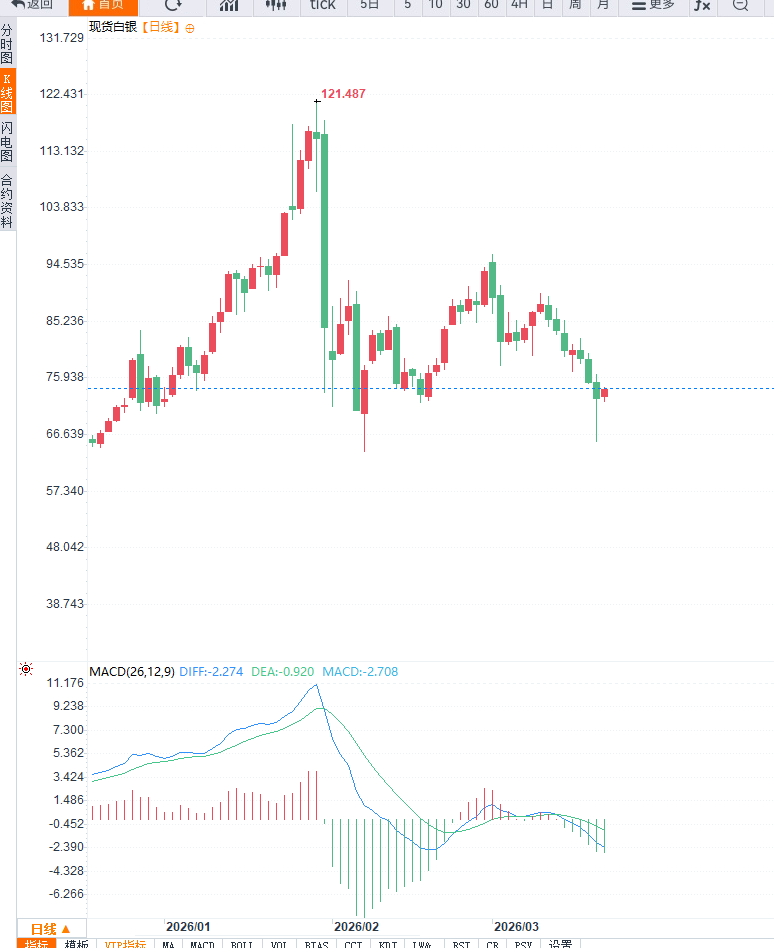
In summary, the current silver price movement is in a consolidation phase within a weak rebound, with the overall trend still bearish . Short-term fluctuations will be influenced by both the US dollar's performance and geopolitical risks.
Editor's Summary:
The rebound in silver prices was mainly driven by a weaker dollar and safe-haven demand, but the medium-term outlook remains constrained by the high-interest-rate environment. Given the global central banks' continued tightening stance, silver is unlikely to establish a sustained upward trend . Future price movements will depend on the direction of the dollar, interest rate expectations, and changes in geopolitical risks; overall, a weak and volatile pattern is expected.
From a policy perspective, the stances of major central banks globally are converging. Major central banks, including the Bank of Japan, the Bank of England, and the European Central Bank, have all signaled a commitment to maintaining relatively tight policies. This shift has somewhat weakened previous market expectations of an "independently accommodative" Federal Reserve policy, putting short-term pressure on the US dollar. However, at the same time, this environment of "high interest rates remaining for a longer period" theoretically puts downward pressure on precious metals, which do not generate interest income.
In the US, Federal Reserve Chairman Jerome Powell explicitly stated that there are no conditions for interest rate cuts until inflation sustainably falls back to the 2% target. This means that market expectations for rapid rate cuts are being revised, thus putting medium-term pressure on precious metals such as gold and silver. It is important to emphasize that a high-interest-rate environment increases the opportunity cost of holding silver , which is one of the key factors limiting its upside potential.
Nevertheless, geopolitical risks continue to provide some support for silver. Against the backdrop of ongoing tensions in the Middle East, market demand for safe-haven assets remains, and investors often allocate some funds to precious metals when risks rise. This safe-haven attribute currently acts as a "floor" for silver , preventing a sharp decline.
From a market structure perspective, this round of silver price increases is largely a technical correction. Previously, prices had fallen sharply from above $90 to around $64, creating a short-term demand for a rebound. Simultaneously, funds were reallocating to precious metals during the dollar's correction, further driving the price rebound.
From a technical perspective, the daily chart shows silver remains in a clear downtrend. The price continues to trade below the 20-day exponential moving average, currently around $81 , which is acting as dynamic resistance. The previous continuous decline from the $90 area has formed a clear "lower lows, lower highs" structure, indicating that the bearish trend still dominates. In terms of momentum indicators, the RSI has fallen below 40, showing bearish market momentum, but it has not yet entered extreme oversold territory, meaning there is still room for further downside.
From a key price level perspective, the initial resistance level is at 76.50 , which is a short-term rebound high and coincides with the downtrend line. Further resistance is around $81; a break above this area is needed to potentially change the current bearish structure. On the downside, $70 is a significant psychological level; a break below this level could lead to a further test of the $65.50 area, which is the previous low.
In summary, the current silver price movement is in a consolidation phase within a weak rebound, with the overall trend still bearish . Short-term fluctuations will be influenced by both the US dollar's performance and geopolitical risks.
Editor's Summary:
The rebound in silver prices was mainly driven by a weaker dollar and safe-haven demand, but the medium-term outlook remains constrained by the high-interest-rate environment. Given the global central banks' continued tightening stance, silver is unlikely to establish a sustained upward trend . Future price movements will depend on the direction of the dollar, interest rate expectations, and changes in geopolitical risks; overall, a weak and volatile pattern is expected.
- Risk Warning and Disclaimer
- The market involves risk, and trading may not be suitable for all investors. This article is for reference only and does not constitute personal investment advice, nor does it take into account certain users’ specific investment objectives, financial situation, or other needs. Any investment decisions made based on this information are at your own risk.