Crude oil trading alert: Escalating geopolitical tensions drive oil prices to retest the $100 mark.
2026-03-23 09:18:09
On Monday, WTI crude oil prices continued their strong upward trend from last week, surging quickly after the opening and briefly breaking through the $100 mark, indicating that market sentiment had clearly turned tense after the weekend events. Oil prices had already risen by about 3.5% on Friday, and this further increase was mainly driven by the rapidly escalating situation in the Middle East.
The United States sent a strong signal over the weekend, demanding that key energy transport routes be reopened within a specified time, or it would take extreme measures against related energy facilities. This statement quickly triggered high market vigilance regarding supply disruptions. As a core choke point for global energy transportation, the Strait of Hormuz handles approximately 20% of global seaborne crude oil shipments , and any potential blockade or conflict there would directly impact the global crude oil supply and demand balance.

Meanwhile, the situation in the Middle East has further deteriorated. Iran has made it clear that it will retaliate against surrounding energy and infrastructure projects should any such threats materialize. This tit-for-tat stance has significantly increased the risk of spillover effects from the regional conflict. Furthermore, a long-range missile attack on a southern Israeli city, injuring approximately 160 people , has further reinforced market expectations of an escalation of the conflict.
Against this backdrop, market concerns about the security of the crude oil supply chain have rapidly intensified. On the one hand, if passage through the Strait of Hormuz is restricted, it will directly impact the export capacity of major oil-producing countries in the Middle East; on the other hand, if energy infrastructure becomes a target of attack, it will prolong the supply recovery cycle, thereby pushing up the medium- to long-term oil price level. Investors' risk aversion has significantly increased, and funds are flowing into crude oil and other commodity assets at an accelerated pace.
From a macro perspective, this round of price increases not only reflects the return of geopolitical risk premiums but also reflects current market concerns about supply-side elasticity. Given that global inventory levels have not fully recovered and uncertainties remain regarding oil-producing countries' policies, any unexpected event could be amplified and interpreted by the market, leading to rapid price fluctuations.
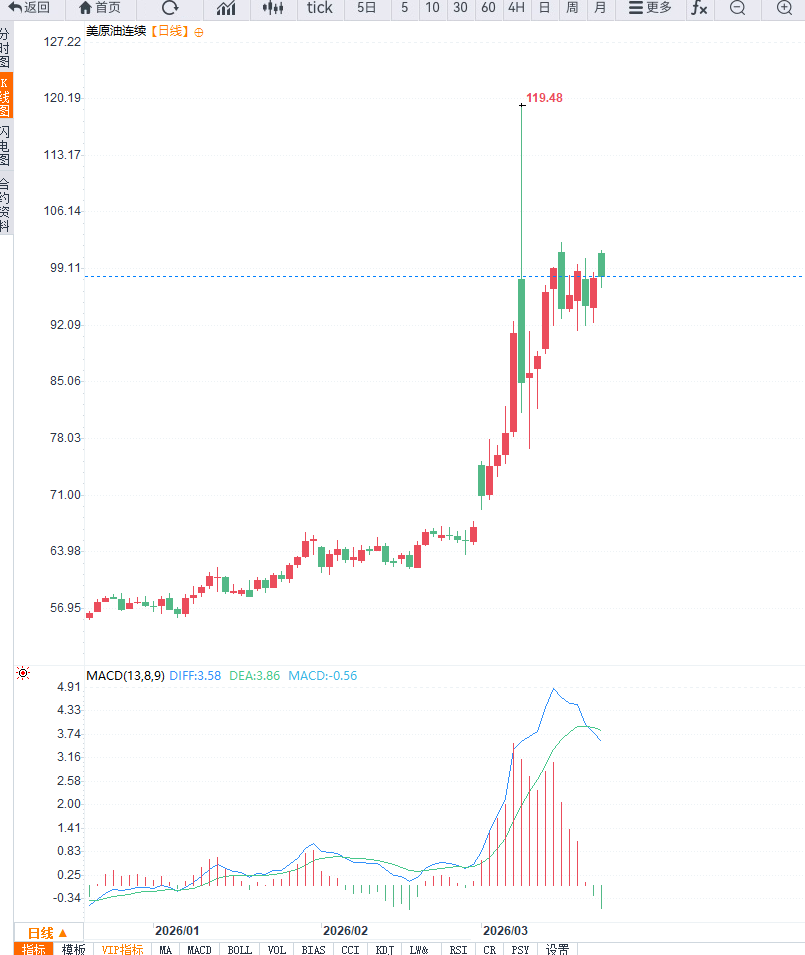
From a technical perspective, on the daily chart, WTI crude oil previously found support around $95, then quickly broke through the key resistance level of $98 driven by risk events, and tested the psychological level of $100 . The current price structure shows a clear upward channel, and the moving average system is beginning to diverge upwards again, indicating a strong medium-term trend. In terms of momentum indicators, the RSI has entered the high zone but has not yet formed a significant divergence, suggesting that the bulls still dominate, but the risk of a pullback due to short-term overheating should be noted. Support levels to watch are the $98 and $95 areas. If it can effectively hold above $100, it may further test the $103-$105 range.
From a 4-hour chart perspective, oil prices are showing an accelerating upward trend, with short-term moving averages clearly in a bullish alignment and prices trading along the upper Bollinger Band, indicating extremely bullish market sentiment. However, the MACD indicator is beginning to show signs of overbought conditions, suggesting that while the upward momentum is strong, it is weakening at the margin. If a short-term pullback occurs, pay attention to the effectiveness of the support level in the $97-$98 range; if it continues to break through with increased volume, the short-term target may be around $102.
Editor's Summary:
Overall, the core driver of this round of oil price increases lies in the supply uncertainty brought about by escalating geopolitical conflicts, rather than a substantial improvement in fundamental supply and demand. In the current context, the market is more prone to overreacting to unexpected events, leading to increased price volatility. In the short term, WTI oil price movements will be highly dependent on further developments in the Middle East, particularly the passage through the Strait of Hormuz. Once the situation eases, the risk premium may quickly decline; however, if the conflict escalates, further upside potential for oil prices will be unlocked. Investors need to pay close attention to geopolitical dynamics and the security of key transportation routes, while also being wary of the risks associated with high-level volatility.
The United States sent a strong signal over the weekend, demanding that key energy transport routes be reopened within a specified time, or it would take extreme measures against related energy facilities. This statement quickly triggered high market vigilance regarding supply disruptions. As a core choke point for global energy transportation, the Strait of Hormuz handles approximately 20% of global seaborne crude oil shipments , and any potential blockade or conflict there would directly impact the global crude oil supply and demand balance.
Meanwhile, the situation in the Middle East has further deteriorated. Iran has made it clear that it will retaliate against surrounding energy and infrastructure projects should any such threats materialize. This tit-for-tat stance has significantly increased the risk of spillover effects from the regional conflict. Furthermore, a long-range missile attack on a southern Israeli city, injuring approximately 160 people , has further reinforced market expectations of an escalation of the conflict.
Against this backdrop, market concerns about the security of the crude oil supply chain have rapidly intensified. On the one hand, if passage through the Strait of Hormuz is restricted, it will directly impact the export capacity of major oil-producing countries in the Middle East; on the other hand, if energy infrastructure becomes a target of attack, it will prolong the supply recovery cycle, thereby pushing up the medium- to long-term oil price level. Investors' risk aversion has significantly increased, and funds are flowing into crude oil and other commodity assets at an accelerated pace.
From a macro perspective, this round of price increases not only reflects the return of geopolitical risk premiums but also reflects current market concerns about supply-side elasticity. Given that global inventory levels have not fully recovered and uncertainties remain regarding oil-producing countries' policies, any unexpected event could be amplified and interpreted by the market, leading to rapid price fluctuations.
From a technical perspective, on the daily chart, WTI crude oil previously found support around $95, then quickly broke through the key resistance level of $98 driven by risk events, and tested the psychological level of $100 . The current price structure shows a clear upward channel, and the moving average system is beginning to diverge upwards again, indicating a strong medium-term trend. In terms of momentum indicators, the RSI has entered the high zone but has not yet formed a significant divergence, suggesting that the bulls still dominate, but the risk of a pullback due to short-term overheating should be noted. Support levels to watch are the $98 and $95 areas. If it can effectively hold above $100, it may further test the $103-$105 range.
From a 4-hour chart perspective, oil prices are showing an accelerating upward trend, with short-term moving averages clearly in a bullish alignment and prices trading along the upper Bollinger Band, indicating extremely bullish market sentiment. However, the MACD indicator is beginning to show signs of overbought conditions, suggesting that while the upward momentum is strong, it is weakening at the margin. If a short-term pullback occurs, pay attention to the effectiveness of the support level in the $97-$98 range; if it continues to break through with increased volume, the short-term target may be around $102.
Editor's Summary:
Overall, the core driver of this round of oil price increases lies in the supply uncertainty brought about by escalating geopolitical conflicts, rather than a substantial improvement in fundamental supply and demand. In the current context, the market is more prone to overreacting to unexpected events, leading to increased price volatility. In the short term, WTI oil price movements will be highly dependent on further developments in the Middle East, particularly the passage through the Strait of Hormuz. Once the situation eases, the risk premium may quickly decline; however, if the conflict escalates, further upside potential for oil prices will be unlocked. Investors need to pay close attention to geopolitical dynamics and the security of key transportation routes, while also being wary of the risks associated with high-level volatility.
- Risk Warning and Disclaimer
- The market involves risk, and trading may not be suitable for all investors. This article is for reference only and does not constitute personal investment advice, nor does it take into account certain users’ specific investment objectives, financial situation, or other needs. Any investment decisions made based on this information are at your own risk.