A stronger dollar and hawkish interest rate expectations signal the start of a gold price correction.
2026-03-23 09:29:50
Gold prices remained under pressure during Monday's Asian trading session, falling back to around $4426 , continuing the previous downward trend. Multiple macroeconomic factors combined to create significant selling pressure in the short term, and market sentiment is gradually turning cautious.

From a driving factor perspective, the strengthening US dollar has become one of the core variables suppressing gold prices. As tensions continue in the Middle East, rising energy prices have fueled global inflation expectations, significantly cooling market expectations for a Federal Reserve interest rate cut. Against this backdrop, US Treasury yields have risen in tandem, increasing the attractiveness of holding dollar-denominated assets and thus weakening the allocation value of gold as a non-interest-bearing asset. The combined effect of rising interest rates and a strengthening dollar has created a "resonance suppression," becoming the main reason for the decline in gold prices.
Meanwhile, the latest policy signals from the Federal Reserve have reinforced hawkish expectations in the market. At its March meeting, the Fed kept interest rates unchanged at 3.50%-3.75% . The dot plot shows that while a 25-basis-point rate cut is still generally expected in 2026, some officials have shifted to a "no rate cut throughout the year" stance. This divergence reflects uncertainty about the policy path and implies that interest rates will remain high for a longer period, thus exerting continued downward pressure on gold.
Furthermore, the escalating conflict in the Middle East has led to rising energy prices, indirectly impacting gold prices. Rising oil prices not only strengthen inflation stickiness but also reduce market expectations for further easing policies, weakening gold's safe-haven appeal due to policy constraints. In other words, while geopolitical risks should ideally benefit gold, their impact is currently offset by interest rate expectations.
However, from a medium- to long-term perspective, gold still has some support. The continued increase in gold reserves by major Asian central banks is a key variable. Data shows that their gold reserves have reached 2,309 tons , marking 16 consecutive months of increases. This structural demand reflects the changing trend in global reserve asset allocation and provides a floor for gold prices. Furthermore, as one of the world's largest producers of precious metals, their demand changes have a significant impact on the global market.
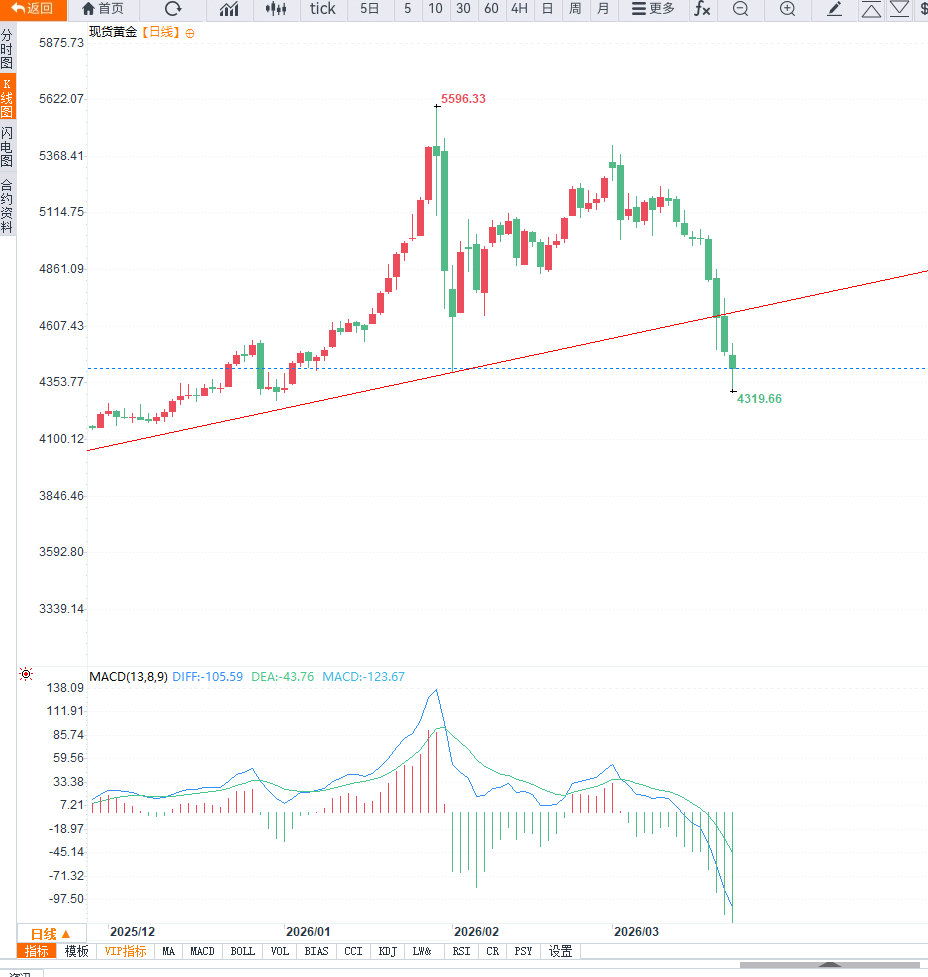
From a technical perspective, on the daily chart, gold experienced a significant pullback after its previous surge, currently breaking below short-term moving average support, shifting the overall trend from strong to weak and range-bound. The price quickly retreated after encountering resistance above $4500, indicating heavy selling pressure. The key support level is currently at $4400 ; a break below this level could lead to a further test of the $4350 area. Resistance is seen in the $4500-$4550 range. In terms of momentum indicators, the RSI has fallen from its highs to neutral territory, suggesting a significant weakening of bullish momentum.
From a 4-hour chart perspective, gold is exhibiting a downward trend with short-term moving averages in a bearish alignment. The price is trading between the middle and lower Bollinger Bands, indicating a short-term weak bias. The MACD indicator is below the zero line, suggesting that bearish momentum is still releasing, but the downward momentum has slowed, implying a potential technical rebound in the short term. If a rebound occurs, the resistance zone to watch is $4480-$4500; if the decline continues, a break below the $4400 support level should be anticipated.
Editor's Summary:
The current gold market is characterized by a coexistence of macroeconomic pressure and structural support. On the one hand, a stronger dollar and rising interest rate expectations continue to exert downward pressure on gold prices; on the other hand, central bank gold purchases and geopolitical risks provide a floor for prices. In the short term, gold's price movement will depend more on changes in the Federal Reserve's policy expectations and the dollar's performance; in the medium to long term, attention should be paid to global reserve asset allocation trends. Overall, gold remains in a high-level consolidation phase with significantly increased volatility, and investors should remain cautious.
From a driving factor perspective, the strengthening US dollar has become one of the core variables suppressing gold prices. As tensions continue in the Middle East, rising energy prices have fueled global inflation expectations, significantly cooling market expectations for a Federal Reserve interest rate cut. Against this backdrop, US Treasury yields have risen in tandem, increasing the attractiveness of holding dollar-denominated assets and thus weakening the allocation value of gold as a non-interest-bearing asset. The combined effect of rising interest rates and a strengthening dollar has created a "resonance suppression," becoming the main reason for the decline in gold prices.
Meanwhile, the latest policy signals from the Federal Reserve have reinforced hawkish expectations in the market. At its March meeting, the Fed kept interest rates unchanged at 3.50%-3.75% . The dot plot shows that while a 25-basis-point rate cut is still generally expected in 2026, some officials have shifted to a "no rate cut throughout the year" stance. This divergence reflects uncertainty about the policy path and implies that interest rates will remain high for a longer period, thus exerting continued downward pressure on gold.
Furthermore, the escalating conflict in the Middle East has led to rising energy prices, indirectly impacting gold prices. Rising oil prices not only strengthen inflation stickiness but also reduce market expectations for further easing policies, weakening gold's safe-haven appeal due to policy constraints. In other words, while geopolitical risks should ideally benefit gold, their impact is currently offset by interest rate expectations.
However, from a medium- to long-term perspective, gold still has some support. The continued increase in gold reserves by major Asian central banks is a key variable. Data shows that their gold reserves have reached 2,309 tons , marking 16 consecutive months of increases. This structural demand reflects the changing trend in global reserve asset allocation and provides a floor for gold prices. Furthermore, as one of the world's largest producers of precious metals, their demand changes have a significant impact on the global market.
From a technical perspective, on the daily chart, gold experienced a significant pullback after its previous surge, currently breaking below short-term moving average support, shifting the overall trend from strong to weak and range-bound. The price quickly retreated after encountering resistance above $4500, indicating heavy selling pressure. The key support level is currently at $4400 ; a break below this level could lead to a further test of the $4350 area. Resistance is seen in the $4500-$4550 range. In terms of momentum indicators, the RSI has fallen from its highs to neutral territory, suggesting a significant weakening of bullish momentum.
From a 4-hour chart perspective, gold is exhibiting a downward trend with short-term moving averages in a bearish alignment. The price is trading between the middle and lower Bollinger Bands, indicating a short-term weak bias. The MACD indicator is below the zero line, suggesting that bearish momentum is still releasing, but the downward momentum has slowed, implying a potential technical rebound in the short term. If a rebound occurs, the resistance zone to watch is $4480-$4500; if the decline continues, a break below the $4400 support level should be anticipated.
Editor's Summary:
The current gold market is characterized by a coexistence of macroeconomic pressure and structural support. On the one hand, a stronger dollar and rising interest rate expectations continue to exert downward pressure on gold prices; on the other hand, central bank gold purchases and geopolitical risks provide a floor for prices. In the short term, gold's price movement will depend more on changes in the Federal Reserve's policy expectations and the dollar's performance; in the medium to long term, attention should be paid to global reserve asset allocation trends. Overall, gold remains in a high-level consolidation phase with significantly increased volatility, and investors should remain cautious.
- Risk Warning and Disclaimer
- The market involves risk, and trading may not be suitable for all investors. This article is for reference only and does not constitute personal investment advice, nor does it take into account certain users’ specific investment objectives, financial situation, or other needs. Any investment decisions made based on this information are at your own risk.