The Middle East conflict has triggered global inflation fears, causing the yield on Japan's 10-year government bonds to surge to 2.32%.
2026-03-23 10:43:33
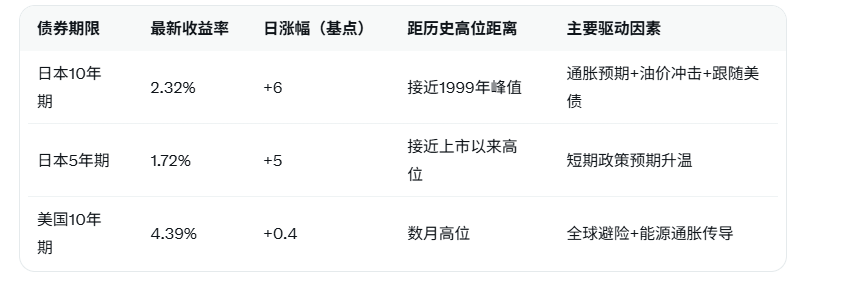
According to APP, Japanese government bond prices fell on Monday morning, with yields climbing back to multi-decade highs. Market concerns that escalating conflict in the Middle East will push up inflation are weighing on prices. Latest bond market data shows that the 10-year Japanese government bond yield rose 6 basis points to 2.32%, nearing its all-time high set in January 1999. The 5-year yield rose 5 basis points to 1.72%, just shy of its record high.
This change largely followed the trend of US Treasury yields, which have been in multi-month highs for several weeks, last quoted at 4.39%. Tensions in the Middle East show no signs of easing, with Trump issuing a 48-hour ultimatum to Tehran demanding the opening of the Strait of Hormuz , or he would launch attacks on Iranian power plants. The deadline expires Monday night New York time. In a recent post on Truth Social, Trump stated explicitly: "If Iran does not fully open the Strait of Hormuz without threat, I will destroy their power plants within 48 hours, starting with the biggest ones."
The escalating conflict has directly amplified energy price risks, with crude oil futures fluctuating sharply due to potential disruptions in the Taiwan Strait, pushing up global expectations of imported inflation. As a major energy importer, Japan is likely to see its core CPI rise by an additional 0.3-0.5 percentage points for every $10 increase per barrel in oil prices. This, coupled with downward pressure on the yen, has further spurred bond selling. Interbank market quotes show that the 10-year yield has already jumped more than 10 basis points since the beginning of this week compared to last Friday, as traders are pricing in a significantly increased probability of a Bank of Japan rate hike in the coming months.
Comparison of changes in major bond yields
Despite the Bank of Japan keeping its policy rate unchanged last week, disagreements arose among its board members, with one member proposing a 25-basis-point rate hike in two consecutive meetings, citing the upside inflation risk from the Middle East conflict. The market has now raised the probability of another rate hike by the Bank of Japan this year to over 70%, resulting in a significantly steeper yield curve.
This incident highlights the extreme sensitivity of the global bond market to geopolitics. The Strait of Hormuz, a vital choke point for 20% of global energy trade, will, if continuously obstructed, transmit costs to major Asian economies through oil and natural gas prices, indirectly increasing financing costs and suppressing consumption and investment. Japanese export-oriented companies, in particular, face the dual pressure of exchange rate and interest rate squeezes, and the downward pressure on both the stock and bond markets is intensifying.
Editor's Summary : From an objective perspective, the recent rapid rise in Japanese government bond yields is a typical manifestation of the spillover effects of Middle East geopolitical conflicts. Although the Bank of Japan is maintaining a prudent stance in the short term, the resonance between inflation expectations and high US Treasury yields has forced the market to pre-price a tightening path. Investors need to closely monitor the outcome of Trump's ultimatum. If the Strait of Hormuz reopens, yields may fall rapidly; conversely, the global interest rate environment will face a new round of upward risks, making diversified asset allocation a necessary response.
This change largely followed the trend of US Treasury yields, which have been in multi-month highs for several weeks, last quoted at 4.39%. Tensions in the Middle East show no signs of easing, with Trump issuing a 48-hour ultimatum to Tehran demanding the opening of the Strait of Hormuz , or he would launch attacks on Iranian power plants. The deadline expires Monday night New York time. In a recent post on Truth Social, Trump stated explicitly: "If Iran does not fully open the Strait of Hormuz without threat, I will destroy their power plants within 48 hours, starting with the biggest ones."
The escalating conflict has directly amplified energy price risks, with crude oil futures fluctuating sharply due to potential disruptions in the Taiwan Strait, pushing up global expectations of imported inflation. As a major energy importer, Japan is likely to see its core CPI rise by an additional 0.3-0.5 percentage points for every $10 increase per barrel in oil prices. This, coupled with downward pressure on the yen, has further spurred bond selling. Interbank market quotes show that the 10-year yield has already jumped more than 10 basis points since the beginning of this week compared to last Friday, as traders are pricing in a significantly increased probability of a Bank of Japan rate hike in the coming months.
Comparison of changes in major bond yields
Despite the Bank of Japan keeping its policy rate unchanged last week, disagreements arose among its board members, with one member proposing a 25-basis-point rate hike in two consecutive meetings, citing the upside inflation risk from the Middle East conflict. The market has now raised the probability of another rate hike by the Bank of Japan this year to over 70%, resulting in a significantly steeper yield curve.
This incident highlights the extreme sensitivity of the global bond market to geopolitics. The Strait of Hormuz, a vital choke point for 20% of global energy trade, will, if continuously obstructed, transmit costs to major Asian economies through oil and natural gas prices, indirectly increasing financing costs and suppressing consumption and investment. Japanese export-oriented companies, in particular, face the dual pressure of exchange rate and interest rate squeezes, and the downward pressure on both the stock and bond markets is intensifying.
Editor's Summary : From an objective perspective, the recent rapid rise in Japanese government bond yields is a typical manifestation of the spillover effects of Middle East geopolitical conflicts. Although the Bank of Japan is maintaining a prudent stance in the short term, the resonance between inflation expectations and high US Treasury yields has forced the market to pre-price a tightening path. Investors need to closely monitor the outcome of Trump's ultimatum. If the Strait of Hormuz reopens, yields may fall rapidly; conversely, the global interest rate environment will face a new round of upward risks, making diversified asset allocation a necessary response.
- Risk Warning and Disclaimer
- The market involves risk, and trading may not be suitable for all investors. This article is for reference only and does not constitute personal investment advice, nor does it take into account certain users’ specific investment objectives, financial situation, or other needs. Any investment decisions made based on this information are at your own risk.