Is there a turning point in the US-Iran conflict? Trump postpones military strikes, oil prices once fell by more than 10%, but Iran vehemently denies the threat.
2026-03-24 10:02:40
US President Donald Trump postponed a planned military strike against Iran by five days on Monday (March 23), citing "productive" dialogue, saying that US envoys and senior Iranian officials reached consensus on key issues. As a result, US crude oil prices plummeted by more than 10% on Monday, hitting a low of $84.37 per barrel, temporarily easing market concerns about supply disruptions in the Strait of Hormuz.
However, Iranian officials publicly denied that any talks had taken place, and market concerns gradually increased. On Tuesday in Asian trading, US crude oil prices fluctuated upwards and are currently trading around $91.50 per barrel, with a daily increase of about 3.85%.
US President Donald Trump publicly stated on Monday (March 23) that the US and Iran had held "productive" talks on "completely ending hostilities," and therefore decided to postpone the planned military strikes against Iran's power grid and energy facilities by five days. He revealed that special envoys Witkov and Kushner met with senior Iranian officials late into the night on Sunday and reached consensus on key issues. This sudden diplomatic signal quickly altered the course of tensions in the Middle East.
According to sources, while formal direct negotiations between the two countries have not yet begun, Egypt, Pakistan, and Gulf states are actively conveying messages. Pakistani officials confirmed that U.S. representatives will meet with Iranian officials in Islamabad as early as this week. Meanwhile, the Iranian Foreign Minister and Omani officials reviewed shipping security in the Strait of Hormuz, agreeing to maintain consultation channels. Trump emphasized that this dialogue provides a window of opportunity to avoid a larger-scale conflict.
Trump's statement immediately triggered a sharp drop in global energy markets. US crude oil prices plunged more than 10% on Monday, hitting a low of $84.37 per barrel, before recovering to around $91.65 per barrel. Market investors believe that the delay in the strike has alleviated the risk of disruption in the Strait of Hormuz, significantly reducing short-term supply concerns. Meanwhile, the three major US stock indices surged collectively, with the energy sector pulling back while airline and transportation stocks led the gains.
This volatility highlights the sensitivity of oil prices to geopolitical risk premiums. Trump's five-day grace period was seen as a breathing space for the market, but if the talks break down, oil prices could rebound quickly.
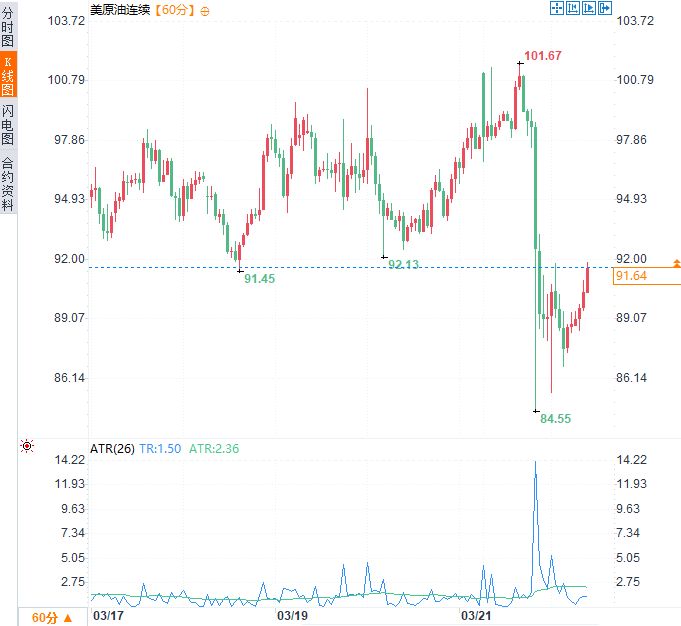
(US crude oil hourly chart, source: FX678)
Iran swiftly responded with a strong counterattack. Iranian Parliament Speaker Mohammad Ghalibaf posted on the X platform, explicitly denying any talks with the United States, calling it "fake news" aimed at manipulating the financial and oil markets.
His latest statement said, "The Iranian people demand a thorough punishment for the aggressors, and all Iranian officials will stand firmly behind the Supreme Leader." The Islamic Revolutionary Guard Corps characterized Trump's remarks as "psychological warfare," emphasizing that they had no impact on Tehran's fighting spirit.
The Iranian Foreign Ministry also reiterated through official media: "There has been no dialogue with the United States." This denial highlights the huge divergence between the two sides in their public narratives, although indirect channels are still in operation.
Following a phone call with Trump, Israeli Prime Minister Benjamin Netanyahu stated that Israel would continue its precision strikes in Lebanon and Iran, but acknowledged that Trump could leverage US-Israeli military achievements to advance an agreement. Sources familiar with the matter revealed that if substantial diplomatic progress is made, Israel might suspend its operations against Iranian energy facilities. An Israeli official indicated that the Iranian negotiator might be the increasingly influential Speaker of Parliament, Mohammad Ghalibaf.
Regional countries such as Egypt and Pakistan are playing a key mediating role in facilitating indirect communication between the US and Iran to prevent a full-scale escalation of the conflict.
The next five days will be a crucial observation window. Trump emphasized that both sides have reached a consensus on 15 key issues, including the possibility of joint control of the Strait of Hormuz. If the dialogue is successful, stable energy supplies in the Middle East will help lower global inflation; conversely, a resumption of military action could cause oil prices to return above $100 and trigger wider regional instability.
Analysts believe that this incident exposes the complex power struggle between the US and Iran at both public and private levels, and that third-party mediation is currently the only viable path.
Trump's postponement of military action under the pretext of dialogue has created short-term market optimism, but Iran's categorical denial reveals a persistent gap in the core positions of both sides. The current situation is shaped by continued military pressure from Israel and mediation efforts by regional countries. The five-day buffer period presents both diplomatic opportunities and amplifies risks, requiring global energy and financial markets to remain highly vigilant.
At 10:01 Beijing time, US crude oil futures were trading at $91.62 per barrel.
However, Iranian officials publicly denied that any talks had taken place, and market concerns gradually increased. On Tuesday in Asian trading, US crude oil prices fluctuated upwards and are currently trading around $91.50 per barrel, with a daily increase of about 3.85%.
Progress of secret talks between the US and Iran
US President Donald Trump publicly stated on Monday (March 23) that the US and Iran had held "productive" talks on "completely ending hostilities," and therefore decided to postpone the planned military strikes against Iran's power grid and energy facilities by five days. He revealed that special envoys Witkov and Kushner met with senior Iranian officials late into the night on Sunday and reached consensus on key issues. This sudden diplomatic signal quickly altered the course of tensions in the Middle East.
According to sources, while formal direct negotiations between the two countries have not yet begun, Egypt, Pakistan, and Gulf states are actively conveying messages. Pakistani officials confirmed that U.S. representatives will meet with Iranian officials in Islamabad as early as this week. Meanwhile, the Iranian Foreign Minister and Omani officials reviewed shipping security in the Strait of Hormuz, agreeing to maintain consultation channels. Trump emphasized that this dialogue provides a window of opportunity to avoid a larger-scale conflict.
Oil market reacts sharply
Trump's statement immediately triggered a sharp drop in global energy markets. US crude oil prices plunged more than 10% on Monday, hitting a low of $84.37 per barrel, before recovering to around $91.65 per barrel. Market investors believe that the delay in the strike has alleviated the risk of disruption in the Strait of Hormuz, significantly reducing short-term supply concerns. Meanwhile, the three major US stock indices surged collectively, with the energy sector pulling back while airline and transportation stocks led the gains.
This volatility highlights the sensitivity of oil prices to geopolitical risk premiums. Trump's five-day grace period was seen as a breathing space for the market, but if the talks break down, oil prices could rebound quickly.
(US crude oil hourly chart, source: FX678)
Iran's official response was strong.
Iran swiftly responded with a strong counterattack. Iranian Parliament Speaker Mohammad Ghalibaf posted on the X platform, explicitly denying any talks with the United States, calling it "fake news" aimed at manipulating the financial and oil markets.
His latest statement said, "The Iranian people demand a thorough punishment for the aggressors, and all Iranian officials will stand firmly behind the Supreme Leader." The Islamic Revolutionary Guard Corps characterized Trump's remarks as "psychological warfare," emphasizing that they had no impact on Tehran's fighting spirit.
The Iranian Foreign Ministry also reiterated through official media: "There has been no dialogue with the United States." This denial highlights the huge divergence between the two sides in their public narratives, although indirect channels are still in operation.
Israel and regional mediation
Following a phone call with Trump, Israeli Prime Minister Benjamin Netanyahu stated that Israel would continue its precision strikes in Lebanon and Iran, but acknowledged that Trump could leverage US-Israeli military achievements to advance an agreement. Sources familiar with the matter revealed that if substantial diplomatic progress is made, Israel might suspend its operations against Iranian energy facilities. An Israeli official indicated that the Iranian negotiator might be the increasingly influential Speaker of Parliament, Mohammad Ghalibaf.
Regional countries such as Egypt and Pakistan are playing a key mediating role in facilitating indirect communication between the US and Iran to prevent a full-scale escalation of the conflict.
Potential impact of diplomatic prospects
The next five days will be a crucial observation window. Trump emphasized that both sides have reached a consensus on 15 key issues, including the possibility of joint control of the Strait of Hormuz. If the dialogue is successful, stable energy supplies in the Middle East will help lower global inflation; conversely, a resumption of military action could cause oil prices to return above $100 and trigger wider regional instability.
Analysts believe that this incident exposes the complex power struggle between the US and Iran at both public and private levels, and that third-party mediation is currently the only viable path.
Editor's Summary
Trump's postponement of military action under the pretext of dialogue has created short-term market optimism, but Iran's categorical denial reveals a persistent gap in the core positions of both sides. The current situation is shaped by continued military pressure from Israel and mediation efforts by regional countries. The five-day buffer period presents both diplomatic opportunities and amplifies risks, requiring global energy and financial markets to remain highly vigilant.
At 10:01 Beijing time, US crude oil futures were trading at $91.62 per barrel.
- Risk Warning and Disclaimer
- The market involves risk, and trading may not be suitable for all investors. This article is for reference only and does not constitute personal investment advice, nor does it take into account certain users’ specific investment objectives, financial situation, or other needs. Any investment decisions made based on this information are at your own risk.