After significant fluctuations in gold prices, medium-term support remains in place, and bulls are making a comeback.
2026-03-24 10:31:47
According to APP, Fan Shaokai , Global Head of Central Banks at the World Gold Council, said on Tuesday that gold 's unique role as a strategic tool to hedge against de-dollarization and geopolitical risks is attracting more central banks that had previously been absent or suspended from gold purchases to enter the market. He pointed out that in recent months, central banks in Malaysia and Indonesia have begun to take action, either returning to the market after a long hiatus or making their first substantial increase in holdings. "In the past few months, some new central banks, or those that have been inactive or absent from the gold market for a long time, are entering the gold market. I think this trend may continue into 2026," Fan Shaokai added.
This assessment aligns closely with the World Gold Council's latest full-year data for 2025. Global central bank net gold purchases totaled 863 tons in 2025, a slight decrease from the peak of over 1000 tons for the previous three consecutive years, but still significantly higher than the annual average of 473 tons from 2010 to 2021. Entering January 2026, the pace of gold purchases slowed seasonally, with net purchases for the month falling below 20% of the 2025 monthly average. However, the base of sovereign demand is expanding—the emergence of new market entrants is a highlight.
Taking Malaysia as an example, the central bank added 3 tons of gold to its reserves in January, its first net increase since 2018, bringing its total reserves to 42 tons, accounting for approximately 5% of its total foreign exchange reserves. The Indonesian central bank also recorded an increase of 2 tons during the same period, continuing its trend as an active buyer in emerging markets. While the Guatemalan central bank's reserves have recently remained stable at around 13 tons, it showed a willingness to increase its holdings in the second half of 2025, becoming a typical example of a "new entrant" or returnee to the market. These actions are not isolated cases, but rather a concentrated manifestation of the diversified reserve strategies of emerging market central banks.
In his 2025 survey of central bank gold reserves, Fan Shaokai emphasized that "in today's world, filled with uncertainty and volatility, gold remains a strategic asset." This view is particularly relevant in the current environment. Many central banks choose to purchase gold directly from small-scale domestic producers, supporting the development of the domestic mining industry while effectively preventing resources from flowing into informal channels. This localized procurement model not only enhances supply chain security but also strengthens gold's status as a national strategic reserve.
Compared to the central bank's buying activity during the gold price correction last October (net purchases of 53 tons that month), it is too early to judge whether a similar opportunity-based buying will occur during the current decline in March 2026. Data from the World Gold Council shows that central bank gold purchasing decisions are driven more by long-term strategies than by short-term price fluctuations. The strong performance of net gold purchases of 230 tons in the fourth quarter of 2025 has already provided a solid ending to the year.
To visually illustrate the trend, the following is a comparison of global central bank net gold purchases in recent years:
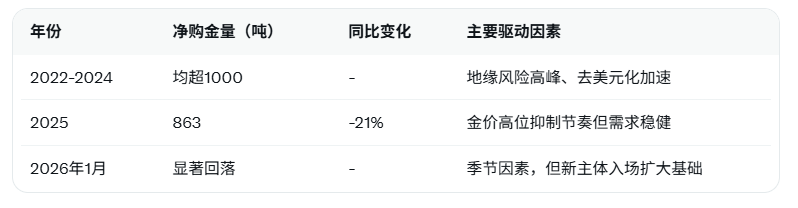
Looking ahead to 2026, Fan Shaokai's predictions have gained widespread acceptance. 95% of the surveyed central banks indicated they would continue to increase their gold holdings , with emerging markets showing a particularly high percentage. Geopolitical uncertainty, the Federal Reserve's policy path, and reserve currency diversification are three key factors that will collectively support sustained high gold demand throughout the year. Some institutions predict net gold purchases in 2026 will reach approximately 755 tons, lower than the peak but still significantly exceeding historical averages.
Editor's Summary : Latest data shows that although central bank gold purchases temporarily declined at the beginning of 2026, the entry of emerging market players such as Malaysia and Indonesia indicates a continued broadening of the demand base. Gold 's strategic value as a risk hedging and diversification tool remains unchanged, and its medium- to long-term attractiveness is expected to remain stable.
This assessment aligns closely with the World Gold Council's latest full-year data for 2025. Global central bank net gold purchases totaled 863 tons in 2025, a slight decrease from the peak of over 1000 tons for the previous three consecutive years, but still significantly higher than the annual average of 473 tons from 2010 to 2021. Entering January 2026, the pace of gold purchases slowed seasonally, with net purchases for the month falling below 20% of the 2025 monthly average. However, the base of sovereign demand is expanding—the emergence of new market entrants is a highlight.
Taking Malaysia as an example, the central bank added 3 tons of gold to its reserves in January, its first net increase since 2018, bringing its total reserves to 42 tons, accounting for approximately 5% of its total foreign exchange reserves. The Indonesian central bank also recorded an increase of 2 tons during the same period, continuing its trend as an active buyer in emerging markets. While the Guatemalan central bank's reserves have recently remained stable at around 13 tons, it showed a willingness to increase its holdings in the second half of 2025, becoming a typical example of a "new entrant" or returnee to the market. These actions are not isolated cases, but rather a concentrated manifestation of the diversified reserve strategies of emerging market central banks.
In his 2025 survey of central bank gold reserves, Fan Shaokai emphasized that "in today's world, filled with uncertainty and volatility, gold remains a strategic asset." This view is particularly relevant in the current environment. Many central banks choose to purchase gold directly from small-scale domestic producers, supporting the development of the domestic mining industry while effectively preventing resources from flowing into informal channels. This localized procurement model not only enhances supply chain security but also strengthens gold's status as a national strategic reserve.
Compared to the central bank's buying activity during the gold price correction last October (net purchases of 53 tons that month), it is too early to judge whether a similar opportunity-based buying will occur during the current decline in March 2026. Data from the World Gold Council shows that central bank gold purchasing decisions are driven more by long-term strategies than by short-term price fluctuations. The strong performance of net gold purchases of 230 tons in the fourth quarter of 2025 has already provided a solid ending to the year.
To visually illustrate the trend, the following is a comparison of global central bank net gold purchases in recent years:
Looking ahead to 2026, Fan Shaokai's predictions have gained widespread acceptance. 95% of the surveyed central banks indicated they would continue to increase their gold holdings , with emerging markets showing a particularly high percentage. Geopolitical uncertainty, the Federal Reserve's policy path, and reserve currency diversification are three key factors that will collectively support sustained high gold demand throughout the year. Some institutions predict net gold purchases in 2026 will reach approximately 755 tons, lower than the peak but still significantly exceeding historical averages.
Editor's Summary : Latest data shows that although central bank gold purchases temporarily declined at the beginning of 2026, the entry of emerging market players such as Malaysia and Indonesia indicates a continued broadening of the demand base. Gold 's strategic value as a risk hedging and diversification tool remains unchanged, and its medium- to long-term attractiveness is expected to remain stable.
- Risk Warning and Disclaimer
- The market involves risk, and trading may not be suitable for all investors. This article is for reference only and does not constitute personal investment advice, nor does it take into account certain users’ specific investment objectives, financial situation, or other needs. Any investment decisions made based on this information are at your own risk.