Goldman Sachs bombshell: US-Iran conflict triggers "biggest energy disruption in history"! Is oil prices breaking $100 just the beginning?
2026-03-24 15:24:43
Goldman Sachs Research released a report last Friday (March 20) titled "Iran Conflict: How Long, and How Bad?", which, through interviews with geopolitical experts, former U.S. military generals, and Goldman Sachs analysts, provides an in-depth analysis of the largest energy supply disruption in history caused by the joint U.S.-Israeli strike on Iran, as well as the duration of the conflict, its economic impact, and market effects.
The report emphasizes that the US-Iran conflict has brought shipping in the Strait of Hormuz to a near standstill and damaged regional energy infrastructure, with no end in sight. Iran views this as a battle for survival, while the US needs control of the strait to claim victory.
Goldman Sachs, citing multiple experts, believes the conflict is unlikely to end in the short term. Sanam Vakil, director of the Middle East and North Africa program at Chatham House, stated, "All the evidence points to the conflict continuing—Iran has not yet signaled a desire for an end, and the US has not yet achieved a claimable victory." Iran hopes to gain assurances such as sanctions relief through delays.
Dennis Ross, a senior fellow at the Washington Institute for Near East Policy and a former U.S. Middle East coordinator, points out that the war could continue for several more weeks; if the U.S. controls the Strait of Hormuz, it could weaken Iran's conventional threat capabilities for at least five years, but as long as Iran controls oil exports, the U.S. cannot claim victory. Mediation is a possibility, but the conditions are not yet ripe.
Retired U.S. Lieutenant General and former Fifth Fleet Commander Kevin Donegan believes that the U.S. military has largely achieved its goal of weakening Iran's missiles, drones, and navy, but regime change is difficult to achieve without ground troops. Escort missions can ensure some navigational safety, but can only restore up to 20% of oil flows; a full restoration requires incentives and trust from Iran.
The Trump administration has repeatedly stated that the conflict will last 4-6 weeks, but political pressure (such as gasoline prices rising to $4 per gallon and the 60-day deadline for the War Powers Resolution) may limit the duration.
The report states that this is the largest energy supply disruption in history: oil flow in the Strait of Hormuz plummeted from a normal 20 mb/d to 0.6 mb/d (a 97% decrease), resulting in a one-off global supply shock of 17.6 mb/d (17% of the global total). Brent crude oil prices have broken through $100 per barrel, an increase of approximately 50% compared to pre-conflict levels.
In the natural gas sector, the TTF benchmark price rose to €61/MWh (a 90% increase), and could reach €100/MWh if the conflict continues. Analysis by Goldman Sachs' commodities research team (Samantha Dart, Daan Struyven, Alexandra Paulus) shows that the price increases for refined products (such as diesel and jet fuel) are greater than those for crude oil, indicating a more severe downstream impact.
Goldman Sachs' global economic research team points out that every 10% increase in oil prices will drag down global GDP by more than 0.1% and push up global CPI by 0.2 percentage points (with a greater impact on Asia and Europe). The current three-week disruption has already dragged down global GDP by 0.3% and increased inflation by 0.5-0.6%; if it continues for 60 days, the GDP drag could reach 0.9% and inflation could rise by 1.7%.
Kamakshya Trivedi, head of market research, believes that assets are currently pricing in an inflationary shock, but not yet a growth shock. If the disruption is prolonged, growth risk will be the "next shoe." US Treasury yields rose at the front end (the US 2-year yield rose 20-30 basis points), the dollar strengthened, and the euro and Asian currencies came under pressure.
Goldman Sachs has lowered its 2026 global economic growth forecast, raised its inflation forecast, and postponed the timing of the Federal Reserve's rate cut to September or December (with a terminal interest rate of 3-3.25%).
Farouk Soussa, head of Middle East and North Africa economic research, warned that Gulf Cooperation Council (GCC) countries will be severely impacted: non-oil GDP could fall by 2-12% (up to 12% in Kuwait), with daily losses of approximately $700 million in oil revenue.
The overall economic contraction may be greater than at any time in the past 30 years, even greater than the impact of the COVID-19 pandemic, and may leave long-term scars, affecting economic diversification and investor confidence.
Baseline Scenario (Gradual Recovery): Strait traffic recovers within one month, Brent crude oil falls to $71/barrel in Q4 2026 ($9 higher than the no-conflict scenario), global GDP is dragged down by 0.3-0.5%, and inflation rises by 0.5-0.9%.
Upside risks (extended disruption): Under a 60-day disruption, the average price of Brent crude oil may reach $93 per barrel, and in an extreme scenario (continuous production loss of 2 mb/d), it may reach $110 per barrel in the fourth quarter of 2027, significantly amplifying global growth and inflation risks.
Downside risks: Faster recovery or OPEC's spare capacity could offset some of the impact, but the overall risks are skewed towards upside for oil prices and downside for growth.
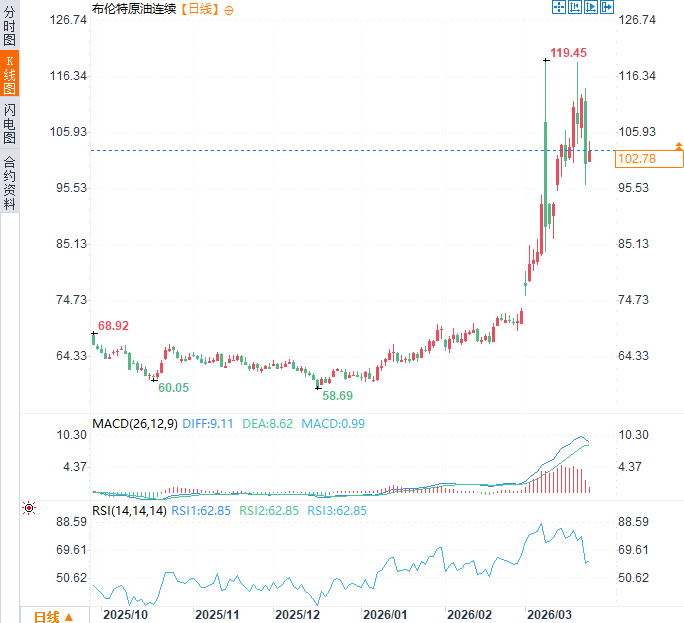
(Brent crude oil daily chart, source: EasyForex)
A Goldman Sachs report emphasizes that the conflict with Iran has triggered the largest energy supply disruption in history, which is unlikely to end in the short term, and its economic impact has expanded from an inflationary shock to a potential drag on growth. The contrast between the current Brent crude price exceeding $100 per barrel and the baseline scenario of $71 per barrel highlights the crucial role of the uncertainty surrounding its duration in the global economy and markets.
The Gulf region faces the most severe impact, while developed economies grapple with the dual pressures of inflation and growth. Overall, the persistence of the conflict will be a key variable determining the global macroeconomic outlook, and investors need to closely monitor developments in the Strait of Hormuz and the progress of diplomatic negotiations.
At 15:24 Beijing time, Brent crude oil futures were trading at $102.26 per barrel.
The report emphasizes that the US-Iran conflict has brought shipping in the Strait of Hormuz to a near standstill and damaged regional energy infrastructure, with no end in sight. Iran views this as a battle for survival, while the US needs control of the strait to claim victory.
Conflict duration analysis
Goldman Sachs, citing multiple experts, believes the conflict is unlikely to end in the short term. Sanam Vakil, director of the Middle East and North Africa program at Chatham House, stated, "All the evidence points to the conflict continuing—Iran has not yet signaled a desire for an end, and the US has not yet achieved a claimable victory." Iran hopes to gain assurances such as sanctions relief through delays.
Dennis Ross, a senior fellow at the Washington Institute for Near East Policy and a former U.S. Middle East coordinator, points out that the war could continue for several more weeks; if the U.S. controls the Strait of Hormuz, it could weaken Iran's conventional threat capabilities for at least five years, but as long as Iran controls oil exports, the U.S. cannot claim victory. Mediation is a possibility, but the conditions are not yet ripe.
Retired U.S. Lieutenant General and former Fifth Fleet Commander Kevin Donegan believes that the U.S. military has largely achieved its goal of weakening Iran's missiles, drones, and navy, but regime change is difficult to achieve without ground troops. Escort missions can ensure some navigational safety, but can only restore up to 20% of oil flows; a full restoration requires incentives and trust from Iran.
The Trump administration has repeatedly stated that the conflict will last 4-6 weeks, but political pressure (such as gasoline prices rising to $4 per gallon and the 60-day deadline for the War Powers Resolution) may limit the duration.
Energy supply shock assessment
The report states that this is the largest energy supply disruption in history: oil flow in the Strait of Hormuz plummeted from a normal 20 mb/d to 0.6 mb/d (a 97% decrease), resulting in a one-off global supply shock of 17.6 mb/d (17% of the global total). Brent crude oil prices have broken through $100 per barrel, an increase of approximately 50% compared to pre-conflict levels.
In the natural gas sector, the TTF benchmark price rose to €61/MWh (a 90% increase), and could reach €100/MWh if the conflict continues. Analysis by Goldman Sachs' commodities research team (Samantha Dart, Daan Struyven, Alexandra Paulus) shows that the price increases for refined products (such as diesel and jet fuel) are greater than those for crude oil, indicating a more severe downstream impact.
Global economic and market impact
Goldman Sachs' global economic research team points out that every 10% increase in oil prices will drag down global GDP by more than 0.1% and push up global CPI by 0.2 percentage points (with a greater impact on Asia and Europe). The current three-week disruption has already dragged down global GDP by 0.3% and increased inflation by 0.5-0.6%; if it continues for 60 days, the GDP drag could reach 0.9% and inflation could rise by 1.7%.
Kamakshya Trivedi, head of market research, believes that assets are currently pricing in an inflationary shock, but not yet a growth shock. If the disruption is prolonged, growth risk will be the "next shoe." US Treasury yields rose at the front end (the US 2-year yield rose 20-30 basis points), the dollar strengthened, and the euro and Asian currencies came under pressure.
Goldman Sachs has lowered its 2026 global economic growth forecast, raised its inflation forecast, and postponed the timing of the Federal Reserve's rate cut to September or December (with a terminal interest rate of 3-3.25%).
Regional economic impact
Farouk Soussa, head of Middle East and North Africa economic research, warned that Gulf Cooperation Council (GCC) countries will be severely impacted: non-oil GDP could fall by 2-12% (up to 12% in Kuwait), with daily losses of approximately $700 million in oil revenue.
The overall economic contraction may be greater than at any time in the past 30 years, even greater than the impact of the COVID-19 pandemic, and may leave long-term scars, affecting economic diversification and investor confidence.
Market Outlook
Baseline Scenario (Gradual Recovery): Strait traffic recovers within one month, Brent crude oil falls to $71/barrel in Q4 2026 ($9 higher than the no-conflict scenario), global GDP is dragged down by 0.3-0.5%, and inflation rises by 0.5-0.9%.
Upside risks (extended disruption): Under a 60-day disruption, the average price of Brent crude oil may reach $93 per barrel, and in an extreme scenario (continuous production loss of 2 mb/d), it may reach $110 per barrel in the fourth quarter of 2027, significantly amplifying global growth and inflation risks.
Downside risks: Faster recovery or OPEC's spare capacity could offset some of the impact, but the overall risks are skewed towards upside for oil prices and downside for growth.
(Brent crude oil daily chart, source: EasyForex)
Editor's Summary
A Goldman Sachs report emphasizes that the conflict with Iran has triggered the largest energy supply disruption in history, which is unlikely to end in the short term, and its economic impact has expanded from an inflationary shock to a potential drag on growth. The contrast between the current Brent crude price exceeding $100 per barrel and the baseline scenario of $71 per barrel highlights the crucial role of the uncertainty surrounding its duration in the global economy and markets.
The Gulf region faces the most severe impact, while developed economies grapple with the dual pressures of inflation and growth. Overall, the persistence of the conflict will be a key variable determining the global macroeconomic outlook, and investors need to closely monitor developments in the Strait of Hormuz and the progress of diplomatic negotiations.
At 15:24 Beijing time, Brent crude oil futures were trading at $102.26 per barrel.
- Risk Warning and Disclaimer
- The market involves risk, and trading may not be suitable for all investors. This article is for reference only and does not constitute personal investment advice, nor does it take into account certain users’ specific investment objectives, financial situation, or other needs. Any investment decisions made based on this information are at your own risk.