VIX options trading indicates that tail risk has not reversed, and gold is likely to experience consolidation after confirming support at $4100.
2026-03-24 16:17:32
According to the APP, Saxo Bank analysts stated, "The ongoing Middle East conflict is triggering widespread macroeconomic shocks in global markets, forcing investors to simultaneously reassess inflation, interest rates, economic growth, and liquidity conditions. Gold is being sold off as it is one of the few liquid assets that has continued to rise over the past year." Gold is pressured by concerns that high energy prices will push up inflation and dampen expectations of further interest rate cuts in the near term.

This view aligns closely with a recent report by Ole Hansen, Head of Commodity Strategy at Saxo Bank. In his March 23 client report, he emphasized, "Gold and silver are facing significant pressure as the Middle East war triggers a global macroeconomic shock, forcing investors to simultaneously reprice inflation, interest rates, growth, and liquidity." The latest spot gold price has fallen approximately 17% from its initial conflict highs, but has found strong support around $4,100, consistent with the market's assessment of tail risks rather than a trend reversal.
The current gold market is experiencing a typical "liquidity shock": high oil prices are pushing up inflation expectations, the market is pricing in a slowdown or even a pause in the Fed and major central banks' interest rate cuts, coupled with a stronger dollar and the unwinding of leveraged positions, leading to a sell-off of gold, a non-interest-bearing asset. Despite persistent geopolitical risks, Ole Hansen points out that this correction is primarily due to "crowded long position liquidation, stop-loss triggers, and institutional liquidity needs," rather than a fundamental reversal. Latest data shows that spot gold briefly touched the $4,100 mark on March 23 before rebounding rapidly. The 200-day moving average coincides with a psychological support level, forming effective buying pressure, making short-term consolidation significantly more likely than a one-sided downward trend.
The current performance of VIX options further confirms the tail risk characteristics. The CBOE Volatility Index (VIX) is currently at 26.15, a significant increase from pre-conflict levels but not yet surpassing historical panic peaks. The implied volatility curve exhibits a "short-term high, long-term decline" structure, indicating that market concerns are concentrated on geopolitical events in the past two weeks, rather than a long-term trend reversal. This option pricing logic resonates with the $4,100 support level for gold: investors have not turned bearish on a large scale, but rather hedged for tail events through the VIX while simultaneously establishing defensive positions at lower gold levels.
To visually illustrate the gold price path under different scenarios, the following table compares Saxo Bank's core viewpoints:
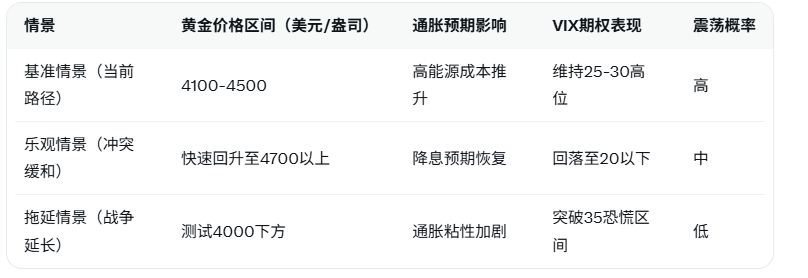
In his analysis on March 22, Ole Hansen added, "Once the current forced selling phase ends, the outlook for gold could improve rapidly." This assessment echoes the confirmation of support at $4,100: while high energy prices have suppressed expectations of interest rate cuts in the short term, central bank demand for gold and its long-term safe-haven status remain unchanged. The market is currently in a transitional period of emotional desensitization and fundamental reassessment. Investors need to be wary of the "secondary effects" of liquidity shocks, but the $4,100 level has already found multiple technical and psychological supports, making a wide range of fluctuations the most likely scenario.
Editor's Summary : Latest market dynamics and VIX options pricing indicate that while the Middle East war triggered a short-term sell-off in gold, the $4100 support level held firm, and tail risks did not escalate into a trend reversal. Saxo Bank reminds investors that the market is likely to remain volatile during this macroeconomic reassessment phase, and attention should be paid to the convergence of oil price and interest rate cut expectations.
This view aligns closely with a recent report by Ole Hansen, Head of Commodity Strategy at Saxo Bank. In his March 23 client report, he emphasized, "Gold and silver are facing significant pressure as the Middle East war triggers a global macroeconomic shock, forcing investors to simultaneously reprice inflation, interest rates, growth, and liquidity." The latest spot gold price has fallen approximately 17% from its initial conflict highs, but has found strong support around $4,100, consistent with the market's assessment of tail risks rather than a trend reversal.
The current gold market is experiencing a typical "liquidity shock": high oil prices are pushing up inflation expectations, the market is pricing in a slowdown or even a pause in the Fed and major central banks' interest rate cuts, coupled with a stronger dollar and the unwinding of leveraged positions, leading to a sell-off of gold, a non-interest-bearing asset. Despite persistent geopolitical risks, Ole Hansen points out that this correction is primarily due to "crowded long position liquidation, stop-loss triggers, and institutional liquidity needs," rather than a fundamental reversal. Latest data shows that spot gold briefly touched the $4,100 mark on March 23 before rebounding rapidly. The 200-day moving average coincides with a psychological support level, forming effective buying pressure, making short-term consolidation significantly more likely than a one-sided downward trend.
The current performance of VIX options further confirms the tail risk characteristics. The CBOE Volatility Index (VIX) is currently at 26.15, a significant increase from pre-conflict levels but not yet surpassing historical panic peaks. The implied volatility curve exhibits a "short-term high, long-term decline" structure, indicating that market concerns are concentrated on geopolitical events in the past two weeks, rather than a long-term trend reversal. This option pricing logic resonates with the $4,100 support level for gold: investors have not turned bearish on a large scale, but rather hedged for tail events through the VIX while simultaneously establishing defensive positions at lower gold levels.
To visually illustrate the gold price path under different scenarios, the following table compares Saxo Bank's core viewpoints:
In his analysis on March 22, Ole Hansen added, "Once the current forced selling phase ends, the outlook for gold could improve rapidly." This assessment echoes the confirmation of support at $4,100: while high energy prices have suppressed expectations of interest rate cuts in the short term, central bank demand for gold and its long-term safe-haven status remain unchanged. The market is currently in a transitional period of emotional desensitization and fundamental reassessment. Investors need to be wary of the "secondary effects" of liquidity shocks, but the $4,100 level has already found multiple technical and psychological supports, making a wide range of fluctuations the most likely scenario.
Editor's Summary : Latest market dynamics and VIX options pricing indicate that while the Middle East war triggered a short-term sell-off in gold, the $4100 support level held firm, and tail risks did not escalate into a trend reversal. Saxo Bank reminds investors that the market is likely to remain volatile during this macroeconomic reassessment phase, and attention should be paid to the convergence of oil price and interest rate cut expectations.
- Risk Warning and Disclaimer
- The market involves risk, and trading may not be suitable for all investors. This article is for reference only and does not constitute personal investment advice, nor does it take into account certain users’ specific investment objectives, financial situation, or other needs. Any investment decisions made based on this information are at your own risk.