Crude oil trading alert: Geopolitical sentiment premium has declined, and oil prices have entered a range-bound trading pattern. Be wary of further fluctuations.
2026-03-25 09:27:32
The recent significant correction in the international crude oil market was primarily driven by the temporary easing of tensions in the Middle East. The United States has submitted a roughly 15-point solution to the conflict to Iran, while simultaneously pushing for a ceasefire agreement of about one month, creating space for further negotiations. This development directly altered market expectations regarding the trajectory of the situation, leading to a concentrated reversal of the risk premium previously accumulated due to the escalation of the conflict.

From a market perspective, WTI crude oil prices quickly fell below the $89 mark after the news was released, indicating that funds are rapidly repricing geopolitical risks. Previously, the main reason for the rise in oil prices was market concerns about disruptions to key energy transport routes. The Strait of Hormuz handles approximately 20% of global seaborne crude oil transport ; a deterioration in the situation could substantially disrupt global supply. However, with the release of diplomatic signals, the probability of this extreme scenario has significantly decreased.
Nevertheless, the market has not completely escaped uncertainty. The ceasefire agreement has a clear phased nature, and whether the negotiations can achieve substantial results remains highly uncertain. Meanwhile, the US continues to deploy additional military forces to the Middle East, which to some extent means that the situation remains in a state of "negotiation and maneuvering. " Market sentiment is shifting from "extreme risk aversion" to "cautious observation," and volatility may therefore remain at a high level.
From a broader macroeconomic perspective, current oil price fluctuations are primarily driven by sentiment rather than fundamental changes in supply and demand. On the supply side, OPEC+ has not yet released any new policy signals, and the overall production cut framework remains stable. On the demand side, while there are signs of a global economic slowdown, there has been no significant collapse in demand. Therefore, this round of oil price declines is essentially a compression of risk premiums, rather than a supply-demand imbalance .
At the global market level, the decline in oil prices has somewhat eased inflation expectations, helping to reduce policy pressure on major economies and providing marginal support for risk asset sentiment. However, for the energy sector, short-term earnings expectations may face revision, and capital allocation may become more cautious. Investors' current focus is gradually shifting from geopolitical conflicts to the progress of subsequent negotiations, inventory changes, and demand performance in major economies.
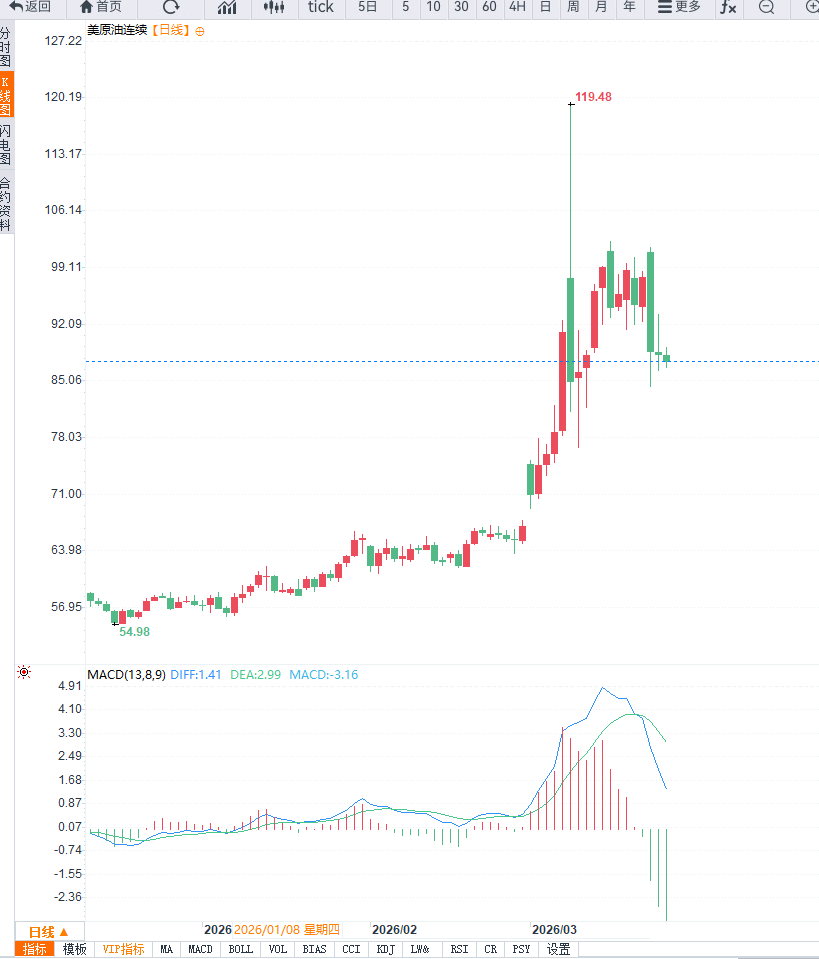
From a technical perspective, WTI crude oil prices have shown signs of a temporary top on the daily chart. Prices encountered resistance near previous highs and retreated, with momentum indicators weakening accordingly, indicating a significant decrease in upward momentum. Currently, prices are gradually entering a consolidation range, with significant resistance around $93 , corresponding to previous sentiment highs. On the downside, $83 forms key support and serves as a dividing line between bullish and bearish sentiment; a decisive break below this level could open up further downside potential.
From a 4-hour chart perspective, short-term prices are showing a downward trend with gradually weakening rebounds and consistently lower highs, indicating that bears are gradually gaining the upper hand. However, buying interest remains near the $83 area, suggesting that the market has not yet formed a unified bearish outlook. Overall, oil prices are more likely to remain within the $83-$93 range , awaiting the emergence of new fundamental drivers.
Editor's Summary : In summary, the core reason for this round of WTI price decline lies in the rapid clearing of geopolitical risk premiums, rather than a reversal of supply and demand logic. Driven by diplomacy, market concerns about escalating conflict have significantly cooled, but uncertainty remains high as negotiations are still in their early stages. In the short term, oil prices are likely to enter a period of fluctuation, limited on the upside by the decline in risk premiums and supported on the downside by fundamentals. Future price movements will depend on the evolution of the geopolitical situation and the repricing of supply and demand data. Investors should pay close attention to the progress of negotiations and the effectiveness of key support levels.
From a market perspective, WTI crude oil prices quickly fell below the $89 mark after the news was released, indicating that funds are rapidly repricing geopolitical risks. Previously, the main reason for the rise in oil prices was market concerns about disruptions to key energy transport routes. The Strait of Hormuz handles approximately 20% of global seaborne crude oil transport ; a deterioration in the situation could substantially disrupt global supply. However, with the release of diplomatic signals, the probability of this extreme scenario has significantly decreased.
Nevertheless, the market has not completely escaped uncertainty. The ceasefire agreement has a clear phased nature, and whether the negotiations can achieve substantial results remains highly uncertain. Meanwhile, the US continues to deploy additional military forces to the Middle East, which to some extent means that the situation remains in a state of "negotiation and maneuvering. " Market sentiment is shifting from "extreme risk aversion" to "cautious observation," and volatility may therefore remain at a high level.
From a broader macroeconomic perspective, current oil price fluctuations are primarily driven by sentiment rather than fundamental changes in supply and demand. On the supply side, OPEC+ has not yet released any new policy signals, and the overall production cut framework remains stable. On the demand side, while there are signs of a global economic slowdown, there has been no significant collapse in demand. Therefore, this round of oil price declines is essentially a compression of risk premiums, rather than a supply-demand imbalance .
At the global market level, the decline in oil prices has somewhat eased inflation expectations, helping to reduce policy pressure on major economies and providing marginal support for risk asset sentiment. However, for the energy sector, short-term earnings expectations may face revision, and capital allocation may become more cautious. Investors' current focus is gradually shifting from geopolitical conflicts to the progress of subsequent negotiations, inventory changes, and demand performance in major economies.
From a technical perspective, WTI crude oil prices have shown signs of a temporary top on the daily chart. Prices encountered resistance near previous highs and retreated, with momentum indicators weakening accordingly, indicating a significant decrease in upward momentum. Currently, prices are gradually entering a consolidation range, with significant resistance around $93 , corresponding to previous sentiment highs. On the downside, $83 forms key support and serves as a dividing line between bullish and bearish sentiment; a decisive break below this level could open up further downside potential.
From a 4-hour chart perspective, short-term prices are showing a downward trend with gradually weakening rebounds and consistently lower highs, indicating that bears are gradually gaining the upper hand. However, buying interest remains near the $83 area, suggesting that the market has not yet formed a unified bearish outlook. Overall, oil prices are more likely to remain within the $83-$93 range , awaiting the emergence of new fundamental drivers.
Editor's Summary : In summary, the core reason for this round of WTI price decline lies in the rapid clearing of geopolitical risk premiums, rather than a reversal of supply and demand logic. Driven by diplomacy, market concerns about escalating conflict have significantly cooled, but uncertainty remains high as negotiations are still in their early stages. In the short term, oil prices are likely to enter a period of fluctuation, limited on the upside by the decline in risk premiums and supported on the downside by fundamentals. Future price movements will depend on the evolution of the geopolitical situation and the repricing of supply and demand data. Investors should pay close attention to the progress of negotiations and the effectiveness of key support levels.
- Risk Warning and Disclaimer
- The market involves risk, and trading may not be suitable for all investors. This article is for reference only and does not constitute personal investment advice, nor does it take into account certain users’ specific investment objectives, financial situation, or other needs. Any investment decisions made based on this information are at your own risk.