The Bank of Japan signaled an interest rate hike, supporting the yen; USD/JPY remained range-bound.
2026-03-25 09:49:13
The USD/JPY pair weakened during Wednesday's Asian session, falling back to around 158.70 after a slight gain in the previous trading day. The core driver of this pullback was the Bank of Japan's latest meeting minutes, which released hawkish signals, prompting the market to reassess its monetary policy path.
The minutes revealed that several policymakers pointed out that while rising interest rates might dampen consumption, the overall financial system remains resilient. Furthermore, given that real interest rates remain deeply negative , further rate hikes would be appropriate if the economy and inflation perform as expected. This statement reinforced market confidence in the Bank of Japan's gradual exit from its easing policies.
Furthermore, the policy stance emphasizes flexibility, meaning that each meeting bases policy decisions on data rather than pre-setting a path for interest rate hikes. This "data-dependent" model implies uncertainty regarding the future pace of policy , but it also provides the market with continuous room for maneuver.
From an economic fundamentals perspective, market surveys indicate that recent Japanese economic data has weakened. The composite Purchasing Managers' Index (PMI) has declined, while core inflation has cooled due to energy subsidies, with core CPI falling below the target level for the first time in approximately four years . However, it's worth noting that cost pressures on businesses remain high, suggesting that inflation has not completely subsided.
Regarding external institutional perspectives, the Danske Bank research team believes that despite weak short-term data, the Bank of Japan still has the conditions to continue raising interest rates, and the next policy action is expected to be implemented in April. Current market pricing indicates approximately a 50% probability of a rate hike in April . Meanwhile, Brown Brothers Harriman's analysis points out that although inflation declined somewhat in February, underlying price pressures remain higher than the Bank of Japan's projected path for fiscal year 2026.
Of particular note is the outcome of Japan's spring wage negotiations, which will be a key variable. Continued wage growth will support consumption and enhance the sustainability of inflation, thus providing a more solid foundation for policy tightening. If the wage-inflation positive cycle is confirmed, it will be a significant driver of the yen's medium-term strength .
From a market perspective, the USD/JPY pair is currently maintaining a high-level consolidation pattern. On the one hand, the resilience of the US economy and interest rate levels continue to support the dollar; on the other hand, rising expectations of policy normalization in Japan are providing a floor for the yen. This interplay of bullish and bearish forces has resulted in a lack of a clear trend in the exchange rate in the short term.
From a technical perspective, on the daily chart, USD/JPY has repeatedly encountered resistance around 159, indicating strong selling pressure in that area. Momentum indicators are showing signs of weakening, suggesting a decline in upward momentum. Currently, the price remains in a high-level range, with the 159.00 level forming a key resistance . Failure to break through this level may result in a consolidation phase or even a pullback.
From a 4-hour chart perspective, the short-term trend shows a sideways consolidation pattern, with gradually lower highs indicating weakening upward momentum, while lower support levels are gradually rising, forming a converging structure. The area around 158.00 has become a crucial short-term support level ; a break below this level could trigger a further pullback to the 156-157 range. Conversely, if it reclaims 159, it could test higher levels.
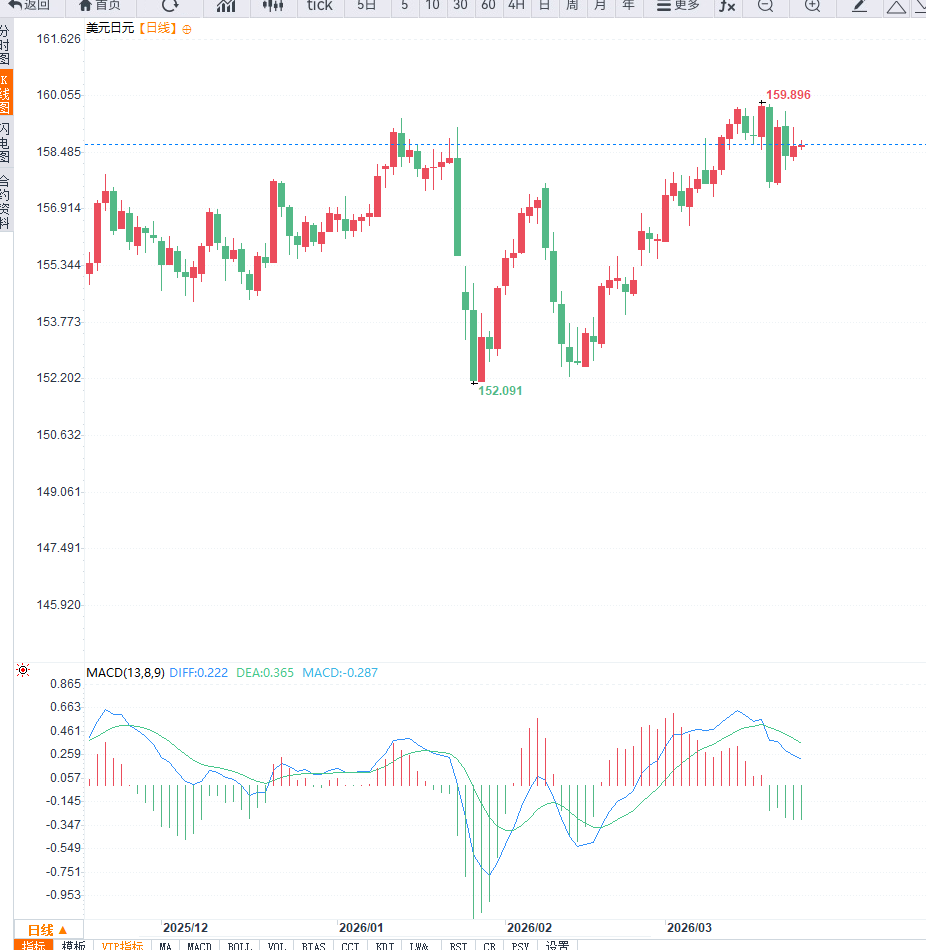
Overall, USD/JPY is more likely to remain range-bound between 158 and 159 , awaiting further guidance from the Bank of Japan's policy signals and US macroeconomic data.
Editor's Summary : The current pullback in USD/JPY is essentially a valuation correction driven by improved expectations of the Bank of Japan's policy. With real interest rates still negative, there is still room for rate hikes, and wage growth is a key variable determining the pace of policy. In the short term, the exchange rate is likely to remain volatile at high levels, but if expectations of a rate hike in April strengthen further, the yen may experience a period of recovery. The medium-term trend will depend on the interplay between the progress of Japan's policy normalization and the path of US interest rates.
The minutes revealed that several policymakers pointed out that while rising interest rates might dampen consumption, the overall financial system remains resilient. Furthermore, given that real interest rates remain deeply negative , further rate hikes would be appropriate if the economy and inflation perform as expected. This statement reinforced market confidence in the Bank of Japan's gradual exit from its easing policies.
Furthermore, the policy stance emphasizes flexibility, meaning that each meeting bases policy decisions on data rather than pre-setting a path for interest rate hikes. This "data-dependent" model implies uncertainty regarding the future pace of policy , but it also provides the market with continuous room for maneuver.
From an economic fundamentals perspective, market surveys indicate that recent Japanese economic data has weakened. The composite Purchasing Managers' Index (PMI) has declined, while core inflation has cooled due to energy subsidies, with core CPI falling below the target level for the first time in approximately four years . However, it's worth noting that cost pressures on businesses remain high, suggesting that inflation has not completely subsided.
Regarding external institutional perspectives, the Danske Bank research team believes that despite weak short-term data, the Bank of Japan still has the conditions to continue raising interest rates, and the next policy action is expected to be implemented in April. Current market pricing indicates approximately a 50% probability of a rate hike in April . Meanwhile, Brown Brothers Harriman's analysis points out that although inflation declined somewhat in February, underlying price pressures remain higher than the Bank of Japan's projected path for fiscal year 2026.
Of particular note is the outcome of Japan's spring wage negotiations, which will be a key variable. Continued wage growth will support consumption and enhance the sustainability of inflation, thus providing a more solid foundation for policy tightening. If the wage-inflation positive cycle is confirmed, it will be a significant driver of the yen's medium-term strength .
From a market perspective, the USD/JPY pair is currently maintaining a high-level consolidation pattern. On the one hand, the resilience of the US economy and interest rate levels continue to support the dollar; on the other hand, rising expectations of policy normalization in Japan are providing a floor for the yen. This interplay of bullish and bearish forces has resulted in a lack of a clear trend in the exchange rate in the short term.
From a technical perspective, on the daily chart, USD/JPY has repeatedly encountered resistance around 159, indicating strong selling pressure in that area. Momentum indicators are showing signs of weakening, suggesting a decline in upward momentum. Currently, the price remains in a high-level range, with the 159.00 level forming a key resistance . Failure to break through this level may result in a consolidation phase or even a pullback.
From a 4-hour chart perspective, the short-term trend shows a sideways consolidation pattern, with gradually lower highs indicating weakening upward momentum, while lower support levels are gradually rising, forming a converging structure. The area around 158.00 has become a crucial short-term support level ; a break below this level could trigger a further pullback to the 156-157 range. Conversely, if it reclaims 159, it could test higher levels.
Overall, USD/JPY is more likely to remain range-bound between 158 and 159 , awaiting further guidance from the Bank of Japan's policy signals and US macroeconomic data.
Editor's Summary : The current pullback in USD/JPY is essentially a valuation correction driven by improved expectations of the Bank of Japan's policy. With real interest rates still negative, there is still room for rate hikes, and wage growth is a key variable determining the pace of policy. In the short term, the exchange rate is likely to remain volatile at high levels, but if expectations of a rate hike in April strengthen further, the yen may experience a period of recovery. The medium-term trend will depend on the interplay between the progress of Japan's policy normalization and the path of US interest rates.
- Risk Warning and Disclaimer
- The market involves risk, and trading may not be suitable for all investors. This article is for reference only and does not constitute personal investment advice, nor does it take into account certain users’ specific investment objectives, financial situation, or other needs. Any investment decisions made based on this information are at your own risk.