Gold prices rebounded sharply as the ongoing Middle East situation combined with a correction in safe-haven demand. Is the bulls back in control?
2026-03-25 10:01:09
Gold prices rebounded during Asian trading hours on Wednesday, with XAU/USD rising to around $4,600, after falling to around $4,100, a near four-month low and one of its worst weekly performances since the 1980s. This volatility reflects a sharp rebalancing of the market between geopolitical risks and macroeconomic expectations.
From a news perspective, market research indicates that the US has signaled progress in negotiations with Iran, even expressing goodwill, which has somewhat alleviated market concerns about a continued escalation of the conflict. However, at the same time, a senior Iranian military advisor stated that the conflict will continue until adequate compensation is achieved. This discrepancy in information has caused market expectations to fluctuate, and geopolitical risks have not disappeared but rather entered a phase of heightened uncertainty .

Against this backdrop, gold's appeal as a traditional safe-haven asset has recovered, driving prices to rebound from their lows. However, it's important to note that this rally is not solely driven by safe-haven demand, but rather the result of multiple factors. On one hand, the previous rapid decline led to a significant oversold condition in the market, triggering a short-term corrective rebound; on the other hand, risk sentiment has improved in stages, prompting funds to reallocate to the precious metals market.
However, from a deeper perspective, the current rebound is more of a sentiment correction than a trend reversal. The core driver of gold's previous decline was rising interest rate expectations and higher real yields . The Middle East conflict pushed up energy prices, thereby strengthening inflation stickiness and indirectly weakening market expectations for a Federal Reserve rate cut. In this environment, gold, as a non-interest-bearing asset, has become less attractive.
If inflationary pressures from the war persist, investors may be more inclined to allocate to income-generating assets, such as government bonds, rather than gold. This means that the interest rate path remains the core variable determining the medium-term trend of gold , rather than simply geopolitical events.
From a market sentiment perspective, the current market is in a typical phase of alternating dominance between risk and safe-haven demand. If there are signs of easing tensions, risk assets will rise, putting pressure on gold; conversely, if the conflict escalates, safe-haven demand will rebound, supporting gold prices. Therefore, short-term gold price fluctuations will exhibit high-frequency oscillations rather than a one-sided trend.
From a technical perspective, gold rebounded rapidly after forming a temporary low near $4100 on the daily chart, but it remains in a correction phase within the previous downtrend. While momentum indicators have improved somewhat, a trend reversal signal has not yet emerged. The area around $4750 forms a key resistance level , corresponding to a previous area of dense trading and trend resistance, making a breakout difficult.
From a 4-hour chart perspective, the price exhibits a typical oversold rebound structure, with gradually rising highs but slowing momentum, indicating a weakening rebound. In the short term, there is significant selling pressure above $4600 ; if it cannot effectively hold above this level, it may fall back to test lower support levels. $4300 forms a crucial support area ; a break below this level could reopen downside potential.
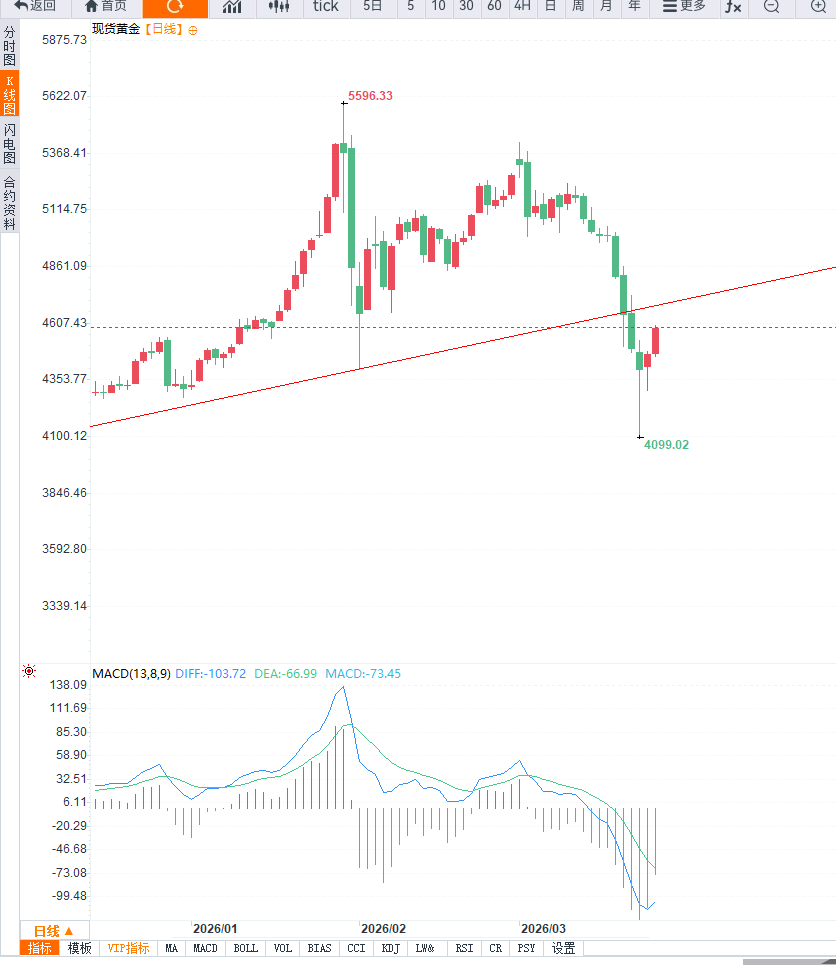
Overall, gold is more likely to maintain a wide range of fluctuations between $4,300 and $4,750 , awaiting the emergence of new macroeconomic drivers.
Editor's Summary : The current gold rebound is essentially a combination of sentiment recovery and technical rebound, rather than a trend reversal. While safe-haven demand remains somewhat supported as the geopolitical situation remains unclear, the Fed's interest rate path and the dollar's performance will truly determine the medium-term trend. Until expectations of interest rate cuts significantly improve and the dollar shows a trend of weakening, the upside potential for gold prices is limited. The market will gradually shift from geopolitical drivers to macroeconomic pricing, and a volatile trading pattern is likely to continue.
From a news perspective, market research indicates that the US has signaled progress in negotiations with Iran, even expressing goodwill, which has somewhat alleviated market concerns about a continued escalation of the conflict. However, at the same time, a senior Iranian military advisor stated that the conflict will continue until adequate compensation is achieved. This discrepancy in information has caused market expectations to fluctuate, and geopolitical risks have not disappeared but rather entered a phase of heightened uncertainty .
Against this backdrop, gold's appeal as a traditional safe-haven asset has recovered, driving prices to rebound from their lows. However, it's important to note that this rally is not solely driven by safe-haven demand, but rather the result of multiple factors. On one hand, the previous rapid decline led to a significant oversold condition in the market, triggering a short-term corrective rebound; on the other hand, risk sentiment has improved in stages, prompting funds to reallocate to the precious metals market.
However, from a deeper perspective, the current rebound is more of a sentiment correction than a trend reversal. The core driver of gold's previous decline was rising interest rate expectations and higher real yields . The Middle East conflict pushed up energy prices, thereby strengthening inflation stickiness and indirectly weakening market expectations for a Federal Reserve rate cut. In this environment, gold, as a non-interest-bearing asset, has become less attractive.
If inflationary pressures from the war persist, investors may be more inclined to allocate to income-generating assets, such as government bonds, rather than gold. This means that the interest rate path remains the core variable determining the medium-term trend of gold , rather than simply geopolitical events.
From a market sentiment perspective, the current market is in a typical phase of alternating dominance between risk and safe-haven demand. If there are signs of easing tensions, risk assets will rise, putting pressure on gold; conversely, if the conflict escalates, safe-haven demand will rebound, supporting gold prices. Therefore, short-term gold price fluctuations will exhibit high-frequency oscillations rather than a one-sided trend.
From a technical perspective, gold rebounded rapidly after forming a temporary low near $4100 on the daily chart, but it remains in a correction phase within the previous downtrend. While momentum indicators have improved somewhat, a trend reversal signal has not yet emerged. The area around $4750 forms a key resistance level , corresponding to a previous area of dense trading and trend resistance, making a breakout difficult.
From a 4-hour chart perspective, the price exhibits a typical oversold rebound structure, with gradually rising highs but slowing momentum, indicating a weakening rebound. In the short term, there is significant selling pressure above $4600 ; if it cannot effectively hold above this level, it may fall back to test lower support levels. $4300 forms a crucial support area ; a break below this level could reopen downside potential.
Overall, gold is more likely to maintain a wide range of fluctuations between $4,300 and $4,750 , awaiting the emergence of new macroeconomic drivers.
Editor's Summary : The current gold rebound is essentially a combination of sentiment recovery and technical rebound, rather than a trend reversal. While safe-haven demand remains somewhat supported as the geopolitical situation remains unclear, the Fed's interest rate path and the dollar's performance will truly determine the medium-term trend. Until expectations of interest rate cuts significantly improve and the dollar shows a trend of weakening, the upside potential for gold prices is limited. The market will gradually shift from geopolitical drivers to macroeconomic pricing, and a volatile trading pattern is likely to continue.
- Risk Warning and Disclaimer
- The market involves risk, and trading may not be suitable for all investors. This article is for reference only and does not constitute personal investment advice, nor does it take into account certain users’ specific investment objectives, financial situation, or other needs. Any investment decisions made based on this information are at your own risk.