Silver's upward trend continued after rebounding from near the 50% retracement level of its all-time high.
2026-03-25 22:18:21
On Wednesday (March 25), the first question for silver traders is: what is the current market trend? Secondly, they need to accurately identify support and resistance levels. Finally, they need to clarify their own position – are they trend traders or contrarian traders? The least worrisome issue is the relationship between silver prices and geopolitical conflicts.

Many commentators this week have claimed that gold and silver prices plummeted amid geopolitical conflicts, a claim I find rather laughable. A simple review of the first trading day after the conflict's outbreak suffices to explain: On Monday, March 2nd, silver prices surged to $96.43 before abruptly reversing course, closing down 4.74% for the day. Therefore, anyone wondering why silver prices fell so sharply on Monday simply needs to look at the candlestick charts, focusing on the price movements on March 2nd and March 10th, to see that traders consistently employed a sell-on-rallies strategy.
Since the outbreak of the conflict, silver prices have fallen by nearly $30, and at this point, dwelling on the reasons for the price decline is meaningless. However, I must retract some of my views—these interpretations surrounding the conflict might actually serve as excellent contrarian indicators.
What determines silver prices is not conflict, but the market itself.
Compared to the rebound in spot silver prices after falling to $61.00 on Monday, there was far less commentary on the connection between silver and conflict when silver prices reversed course on March 3rd. You can attribute this week's market volatility to developments in the conflict or rumors of peace talks—this is purely a matter of personal judgment; you can also consider factors such as persistently high interest rates, rising expectations of rate hikes, stagflation risks, the resignation of Federal Reserve Chairman Powell, and Kevin Warsh's appointment. Incidentally, the previously hotly debated silver supply gap and demand from artificial intelligence centers seem to have been forgotten by the market.
In 2025, all of the above factors jointly drove up silver prices, and these factors also supported the long-term bullish logic for silver before the outbreak of speculative buying—when silver prices soared from a closing price of $60.67 on December 9 to a record high of $121.67 on January 29.
$61.00: An excellent opportunity for restructuring
On March 23, silver prices hit a low of $61.00. This level is very close to the low of $60.67 on December 9, and also near the 50% retracement level of the historical high ($60.83).
In other words, the gains previously driven by speculative buying have been largely wiped out, with silver prices falling by nearly half from their historical highs. We might as well view this level as an opportunity for "repositioning"—this price level not only provides traders with a window to go long, but also allows everyone to clearly predict the upside potential of the subsequent rebound.
Some traders see this pullback to $61.00 as an excellent buying opportunity: in less than two months, silver prices have fallen to nearly half of their previous highs, making this a far more sensible decision than betting on the course of the war.
These buyers have their own logic in choosing to enter the market, the core reason being their recognition of the investment value at the current price. They may not know which fundamental event will drive silver prices up, or even care about it—because for traders, the only thing they can control is the entry point. While the aforementioned influencing factors are all beyond their control, at least they have locked in their desired entry price, and the risk of their positions is within a manageable range.
Buyers replace momentum traders
The last time silver prices fluctuated around $61.00, the rally was mainly driven by speculative momentum, with traders actively buying in daily; now, however, the buying is driven by rational buyers, and the two trading styles are fundamentally different.
Technical Outlook
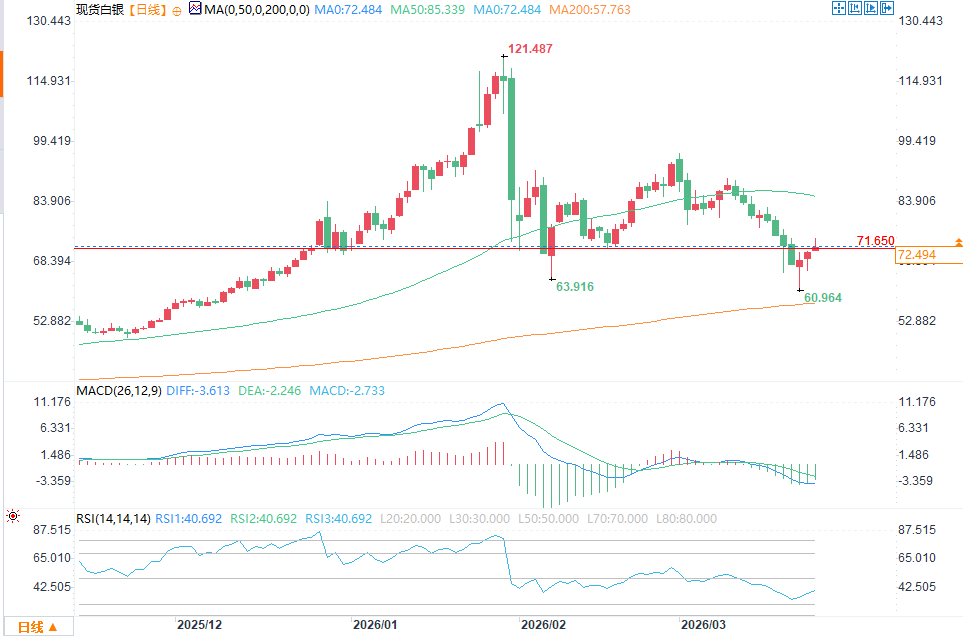
(Spot silver daily chart source: EasyTrade)
Looking at short-term trends from moving average indicators, the market is likely to enter a period of range-bound trading: the 200-day moving average at $57.82 forms a long-term support level, while the 50-day moving average at $85.47 forms a short-term resistance level. The median of the two moving averages is approximately $71.65, which will be a key indicator, determining whether silver prices continue their rebound and move towards the 50-day moving average, or whether they pull back to the vicinity of the 200-day moving average.
Many commentators this week have claimed that gold and silver prices plummeted amid geopolitical conflicts, a claim I find rather laughable. A simple review of the first trading day after the conflict's outbreak suffices to explain: On Monday, March 2nd, silver prices surged to $96.43 before abruptly reversing course, closing down 4.74% for the day. Therefore, anyone wondering why silver prices fell so sharply on Monday simply needs to look at the candlestick charts, focusing on the price movements on March 2nd and March 10th, to see that traders consistently employed a sell-on-rallies strategy.
Since the outbreak of the conflict, silver prices have fallen by nearly $30, and at this point, dwelling on the reasons for the price decline is meaningless. However, I must retract some of my views—these interpretations surrounding the conflict might actually serve as excellent contrarian indicators.
What determines silver prices is not conflict, but the market itself.
Compared to the rebound in spot silver prices after falling to $61.00 on Monday, there was far less commentary on the connection between silver and conflict when silver prices reversed course on March 3rd. You can attribute this week's market volatility to developments in the conflict or rumors of peace talks—this is purely a matter of personal judgment; you can also consider factors such as persistently high interest rates, rising expectations of rate hikes, stagflation risks, the resignation of Federal Reserve Chairman Powell, and Kevin Warsh's appointment. Incidentally, the previously hotly debated silver supply gap and demand from artificial intelligence centers seem to have been forgotten by the market.
In 2025, all of the above factors jointly drove up silver prices, and these factors also supported the long-term bullish logic for silver before the outbreak of speculative buying—when silver prices soared from a closing price of $60.67 on December 9 to a record high of $121.67 on January 29.
$61.00: An excellent opportunity for restructuring
On March 23, silver prices hit a low of $61.00. This level is very close to the low of $60.67 on December 9, and also near the 50% retracement level of the historical high ($60.83).
In other words, the gains previously driven by speculative buying have been largely wiped out, with silver prices falling by nearly half from their historical highs. We might as well view this level as an opportunity for "repositioning"—this price level not only provides traders with a window to go long, but also allows everyone to clearly predict the upside potential of the subsequent rebound.
Some traders see this pullback to $61.00 as an excellent buying opportunity: in less than two months, silver prices have fallen to nearly half of their previous highs, making this a far more sensible decision than betting on the course of the war.
These buyers have their own logic in choosing to enter the market, the core reason being their recognition of the investment value at the current price. They may not know which fundamental event will drive silver prices up, or even care about it—because for traders, the only thing they can control is the entry point. While the aforementioned influencing factors are all beyond their control, at least they have locked in their desired entry price, and the risk of their positions is within a manageable range.
Buyers replace momentum traders
The last time silver prices fluctuated around $61.00, the rally was mainly driven by speculative momentum, with traders actively buying in daily; now, however, the buying is driven by rational buyers, and the two trading styles are fundamentally different.
Technical Outlook
(Spot silver daily chart source: EasyTrade)
Looking at short-term trends from moving average indicators, the market is likely to enter a period of range-bound trading: the 200-day moving average at $57.82 forms a long-term support level, while the 50-day moving average at $85.47 forms a short-term resistance level. The median of the two moving averages is approximately $71.65, which will be a key indicator, determining whether silver prices continue their rebound and move towards the 50-day moving average, or whether they pull back to the vicinity of the 200-day moving average.
- Risk Warning and Disclaimer
- The market involves risk, and trading may not be suitable for all investors. This article is for reference only and does not constitute personal investment advice, nor does it take into account certain users’ specific investment objectives, financial situation, or other needs. Any investment decisions made based on this information are at your own risk.