A chart shows that the Baltic Dry Index has ended its losing streak, with Capesize freight rates rising slightly.
2026-03-25 22:31:06
Latest data shows that the Baltic Dry Index (BDI) was at 2001 points on March 25, 2026, up 0.60% month-on-month, marking the largest increase since March 18, 2026. Looking at the short-term charts, the BDI has seen positive growth 6 times, negative growth 5 times, and zero growth 0 times in the last 11 BDI readings. Specifically, the Panamax Freight Index (BPI) was at 1796 points, down 2.34% from the previous value; the Capesize Freight Index (BCI) was at 2915 points, up 2.50%; and the Supramax Freight Index (BSI) was at 1208 points, down 0.58%. For detailed 720-day and 10-year trend charts of the Baltic Dry Index and its three main sub-indices, please refer to the specially designed charts.
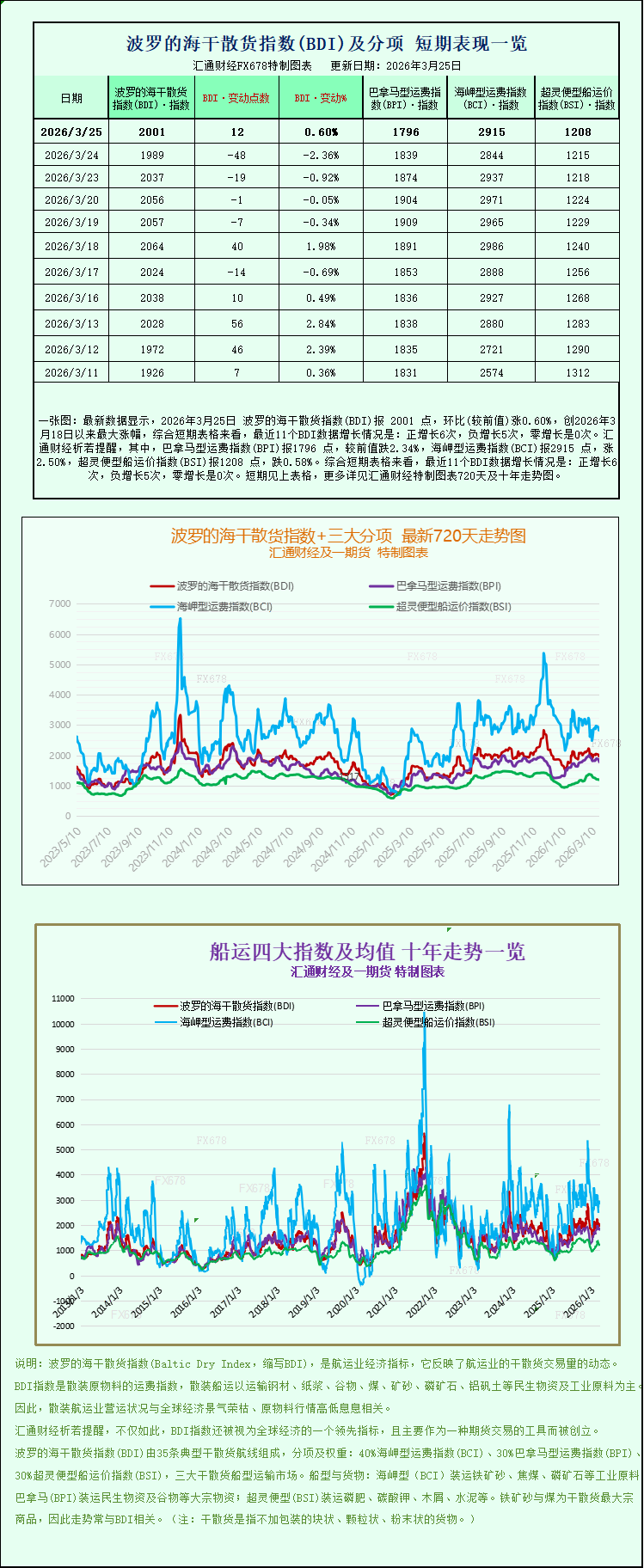
The Baltic Dry Index (BDI) officially ended its three-day decline on Wednesday, rebounding as the main driver was a slight increase in Capesize vessel freight rates, injecting a glimmer of hope into the recently sluggish dry bulk shipping market. As a core indicator of the global dry bulk shipping market, the BDI primarily monitors freight rates for ships transporting dry bulk commodities such as iron ore, coal, and grains worldwide, and its changes directly reflect the supply and demand dynamics and market conditions of the dry bulk shipping market.
Specifically, the Baltic Dry Index (BDI), which tracks freight rates for the three major dry bulk carriers—Capesize, Panamax, and Supramax—rose 12 points, or 0.7%, to close at 2001 points, ending a three-day downward trend and gradually stabilizing and rebounding. Among these, the Capesize index, a major player in the dry bulk shipping market, proved to be a key support for the index's recovery, showing strong performance on the day.
The Capesize index rose 71 points, or 2.5%, to close at 2915, driving the overall index upward. Capesize vessels primarily transport large dry bulk cargo, capable of carrying around 150,000 tons of cargo, with core commodities including basic industrial raw materials such as iron ore and coal. Driven by rising freight rates, the average daily revenue of this type of vessel also increased, rising by $645 to $22,937, resulting in some improvement in shipowner profits.
It is worth noting that iron ore futures prices, a core cargo transported by Capesize vessels, saw a slight decline on Wednesday. This followed three consecutive days of gains in iron ore futures.
Unlike the upward trend in Capesize vessels, freight rates for the other two major vessel types weakened on the day, showing varying degrees of decline. The Panamax index fell 43 points, or 2.6%, to close at 1796 points. This type of vessel primarily transports 60,000 to 70,000 tons of dry bulk cargo such as coal or grain. Affected by the decline in freight rates, its average daily revenue decreased by $386 to $16,166.
The Supramax bulk carrier index also saw a slight decline on the day, falling 7 points, or 0.6%, to close at 1208 points. This type of vessel, with its flexible transport advantages, mainly undertakes the transportation of small and medium-sized dry bulk cargo. This slight drop in freight rates reflects the continued relative weakness in the small and medium-sized dry bulk shipping market. Overall, the Baltic Dry Index's rebound was mainly driven by Capesize vessels, while the weak performance of Panamax and Supramax vessels indicates that the recovery in the dry bulk shipping market remains uneven.
The Baltic Dry Index (BDI) officially ended its three-day decline on Wednesday, rebounding as the main driver was a slight increase in Capesize vessel freight rates, injecting a glimmer of hope into the recently sluggish dry bulk shipping market. As a core indicator of the global dry bulk shipping market, the BDI primarily monitors freight rates for ships transporting dry bulk commodities such as iron ore, coal, and grains worldwide, and its changes directly reflect the supply and demand dynamics and market conditions of the dry bulk shipping market.
Specifically, the Baltic Dry Index (BDI), which tracks freight rates for the three major dry bulk carriers—Capesize, Panamax, and Supramax—rose 12 points, or 0.7%, to close at 2001 points, ending a three-day downward trend and gradually stabilizing and rebounding. Among these, the Capesize index, a major player in the dry bulk shipping market, proved to be a key support for the index's recovery, showing strong performance on the day.
The Capesize index rose 71 points, or 2.5%, to close at 2915, driving the overall index upward. Capesize vessels primarily transport large dry bulk cargo, capable of carrying around 150,000 tons of cargo, with core commodities including basic industrial raw materials such as iron ore and coal. Driven by rising freight rates, the average daily revenue of this type of vessel also increased, rising by $645 to $22,937, resulting in some improvement in shipowner profits.
It is worth noting that iron ore futures prices, a core cargo transported by Capesize vessels, saw a slight decline on Wednesday. This followed three consecutive days of gains in iron ore futures.
Unlike the upward trend in Capesize vessels, freight rates for the other two major vessel types weakened on the day, showing varying degrees of decline. The Panamax index fell 43 points, or 2.6%, to close at 1796 points. This type of vessel primarily transports 60,000 to 70,000 tons of dry bulk cargo such as coal or grain. Affected by the decline in freight rates, its average daily revenue decreased by $386 to $16,166.
The Supramax bulk carrier index also saw a slight decline on the day, falling 7 points, or 0.6%, to close at 1208 points. This type of vessel, with its flexible transport advantages, mainly undertakes the transportation of small and medium-sized dry bulk cargo. This slight drop in freight rates reflects the continued relative weakness in the small and medium-sized dry bulk shipping market. Overall, the Baltic Dry Index's rebound was mainly driven by Capesize vessels, while the weak performance of Panamax and Supramax vessels indicates that the recovery in the dry bulk shipping market remains uneven.
- Risk Warning and Disclaimer
- The market involves risk, and trading may not be suitable for all investors. This article is for reference only and does not constitute personal investment advice, nor does it take into account certain users’ specific investment objectives, financial situation, or other needs. Any investment decisions made based on this information are at your own risk.