The simultaneous troop buildup by the US and Israel may present an opportunity for a divergence between oil price fundamentals and market dynamics.
2026-03-25 21:45:30
On Wednesday (March 25) during the early Asian trading session, international oil prices experienced multiple dips and rebounds. During the session, international oil prices plunged several times, with WTI crude oil futures contracts falling by more than 5% in each of the three dips. Currently, the decline in WTI crude oil has narrowed, while Brent crude oil briefly turned positive.
As the market digests expectations that the Strait of Hormuz will soon be open to ships from certain countries, oil prices fluctuate repeatedly, influenced by concerns about the US increasing its military presence and Iran refusing to negotiate with the US on the grounds of insincerity.
Meanwhile, the Israeli government approved the mobilization of 400,000 reservists on the 25th local time. The Israeli military stated that this does not represent the actual number of reservists to be mobilized, but rather an "upper limit, which can be flexibly adjusted according to operational needs."
According to a report by Time magazine on Wednesday, a massive protest against the Trump administration's policies will take place across the United States this Saturday, potentially becoming the largest such event in U.S. history. The U.S. news portal Axios wrote that approximately 3,000 protests are expected across the country.
Judging from military movements, there is currently no indication that the US and Israel intend to halt further military operations.
Meanwhile, the United States is under pressure from midterm elections, with high financing rates and rising oil prices driving up inflation. Time is limited for the United States. This is vastly different from the low interest rates, low inflation, low government debt, and high public support that the United States enjoyed during the Iran-Iraq War. Iran is well aware of this, so accepting negotiations here is completely illogical. Delay may be the best approach.

This round of concentrated selling stemmed from the violent fluctuations in the oil market over the past 48 hours: oil prices surged after Trump threatened to strike Iranian energy facilities, but immediately turned downwards when he stated that the two countries were close to reaching an agreement.
Latest news indicates that the US has submitted a 15-point peace framework proposal to Iran through Pakistan, raising market expectations that the two sides will reach a temporary ceasefire.
Iran sent a letter to the International Maritime Organization stating that "non-hostile vessels" could pass through the Strait of Hormuz under the coordination of Iranian officials, further exacerbating downward pressure on oil prices.
Trump said negotiations were making progress and Iran was "pragmatic," but Iran has publicly denied that the two sides were having direct talks, and the confusing diplomatic signals have left the market with mixed interpretations.
Since the joint US-Israeli strike on Iran on February 28, oil exports through the Strait of Hormuz have been severely disrupted.
This shipping route carries approximately 20% of the world's oil and liquefied natural gas transportation and is also a key choke point for fertilizer trade, experiencing unprecedented supply shocks at one point.
Goldman Sachs co-head of global commodities research, Struve, emphasized that this round of supply disruptions is the most severe shock in decades, measured by global supply share, and market uncertainty has reached extreme levels.
Current oil price fluctuations have deviated from fundamental drivers and are now entirely dominated by the probability reassessment of extreme risk scenarios. Crude oil continues to be traded in the geopolitical risk premium, with investors intensively hedging against the risks of long-term supply disruptions and inventory shortages.
Goldman Sachs' benchmark forecast indicates that crude oil flow through the Strait of Hormuz is expected to gradually return to normal within four weeks starting in April.
It is worth noting that Iran is well aware of the importance of crude oil to Middle Eastern countries, so its attacks have mostly targeted refineries. Apart from Qatar's LNG plant, which will take 3-5 years to repair, even Kuwait, the worst-hit country, was only attacked for its refineries and not its oil fields. In other words, global crude oil production has theoretically not been affected, mainly due to the closure of the Strait of Hormuz.
On the fundamental side, data from the American Petroleum Institute showed that U.S. crude oil and gasoline inventories unexpectedly increased in the week ending March 20, further weighing on oil prices, especially WTI crude oil.
This also shows that large cruise ships are unwilling to take the risk of 12-20 days of transportation time to profit from crude oil price arbitrage. Oil traders still believe that Brent crude oil prices and Middle Eastern oil prices will fall within 12-20 days.
A spokesperson for Iran's Supreme Joint Military Command also warned that the oil market will continue to fluctuate wildly, and oil prices can only return to normal when the region under Iranian control is fully stable.
Despite the sharp drop in oil prices, underlying geopolitical risks in the Middle East remain high, and the physical crude oil market continues to face a supply shortage.
The Pentagon plans to deploy part of the 82nd Airborne Division to the Middle East, while Israeli officials have threatened to escalate their operations against Hezbollah in Lebanon and have not ruled out launching a ground offensive in southern Lebanon.
Meanwhile, there have been several recent instances of suspected window guidance and pre-emptive fund manipulation in the United States, resulting in heavy losses for retail investors' leveraged long positions.
The main focus remains on whether the Strait of Hormuz will be opened, or more specifically, on the struggle for final passage rights in the Strait of Hormuz. The market tends to underestimate the protracted nature of the conflict, leading to an excessive correction in oil prices.
Alternatively, the recent lukewarm oil prices are a compromise between the protracted market pricing war and the massive one-off impact of the opening of the Taiwan Strait on oil prices, because in terms of facilities, the speed of production recovery will be very fast.
From a technical perspective, WTI crude oil futures continue to consolidate around the 0.500 Fibonacci retracement level, constrained by Monday's long bearish candlestick. The candlestick pattern here is a descending three-methods pattern, which is favorable for the bears to continue testing the lows. However, if oil prices continue to test the lows, panic selling will emerge, creating a good opportunity for bulls to establish positions.
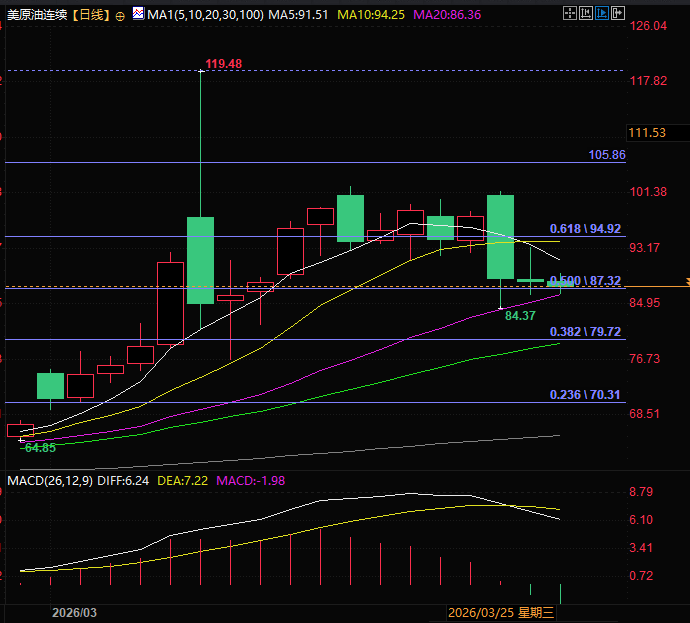
(WTI crude oil futures daily chart, source: EasyForex)
At 21:32 Beijing time, WTI crude oil futures were trading at $87.77 per barrel.
As the market digests expectations that the Strait of Hormuz will soon be open to ships from certain countries, oil prices fluctuate repeatedly, influenced by concerns about the US increasing its military presence and Iran refusing to negotiate with the US on the grounds of insincerity.
Meanwhile, the Israeli government approved the mobilization of 400,000 reservists on the 25th local time. The Israeli military stated that this does not represent the actual number of reservists to be mobilized, but rather an "upper limit, which can be flexibly adjusted according to operational needs."
According to a report by Time magazine on Wednesday, a massive protest against the Trump administration's policies will take place across the United States this Saturday, potentially becoming the largest such event in U.S. history. The U.S. news portal Axios wrote that approximately 3,000 protests are expected across the country.
Judging from military movements, there is currently no indication that the US and Israel intend to halt further military operations.
Meanwhile, the United States is under pressure from midterm elections, with high financing rates and rising oil prices driving up inflation. Time is limited for the United States. This is vastly different from the low interest rates, low inflation, low government debt, and high public support that the United States enjoyed during the Iran-Iraq War. Iran is well aware of this, so accepting negotiations here is completely illogical. Delay may be the best approach.
Signals of de-escalation between the US and Iran triggered a concentrated sell-off in oil prices.
This round of concentrated selling stemmed from the violent fluctuations in the oil market over the past 48 hours: oil prices surged after Trump threatened to strike Iranian energy facilities, but immediately turned downwards when he stated that the two countries were close to reaching an agreement.
Latest news indicates that the US has submitted a 15-point peace framework proposal to Iran through Pakistan, raising market expectations that the two sides will reach a temporary ceasefire.
Iran sent a letter to the International Maritime Organization stating that "non-hostile vessels" could pass through the Strait of Hormuz under the coordination of Iranian officials, further exacerbating downward pressure on oil prices.
Trump said negotiations were making progress and Iran was "pragmatic," but Iran has publicly denied that the two sides were having direct talks, and the confusing diplomatic signals have left the market with mixed interpretations.
Goldman Sachs warns of geopolitical risks dominating due to obstruction in the Strait of Hormuz.
Since the joint US-Israeli strike on Iran on February 28, oil exports through the Strait of Hormuz have been severely disrupted.
This shipping route carries approximately 20% of the world's oil and liquefied natural gas transportation and is also a key choke point for fertilizer trade, experiencing unprecedented supply shocks at one point.
Goldman Sachs co-head of global commodities research, Struve, emphasized that this round of supply disruptions is the most severe shock in decades, measured by global supply share, and market uncertainty has reached extreme levels.
Current oil price fluctuations have deviated from fundamental drivers and are now entirely dominated by the probability reassessment of extreme risk scenarios. Crude oil continues to be traded in the geopolitical risk premium, with investors intensively hedging against the risks of long-term supply disruptions and inventory shortages.
Goldman Sachs' benchmark forecast indicates that crude oil flow through the Strait of Hormuz is expected to gradually return to normal within four weeks starting in April.
It is worth noting that Iran is well aware of the importance of crude oil to Middle Eastern countries, so its attacks have mostly targeted refineries. Apart from Qatar's LNG plant, which will take 3-5 years to repair, even Kuwait, the worst-hit country, was only attacked for its refineries and not its oil fields. In other words, global crude oil production has theoretically not been affected, mainly due to the closure of the Strait of Hormuz.
Unexpected inventory buildup in the US further pressured oil prices.
On the fundamental side, data from the American Petroleum Institute showed that U.S. crude oil and gasoline inventories unexpectedly increased in the week ending March 20, further weighing on oil prices, especially WTI crude oil.
This also shows that large cruise ships are unwilling to take the risk of 12-20 days of transportation time to profit from crude oil price arbitrage. Oil traders still believe that Brent crude oil prices and Middle Eastern oil prices will fall within 12-20 days.
A spokesperson for Iran's Supreme Joint Military Command also warned that the oil market will continue to fluctuate wildly, and oil prices can only return to normal when the region under Iranian control is fully stable.
Geopolitical risks remain, and concerns persist about oil market volatility.
Despite the sharp drop in oil prices, underlying geopolitical risks in the Middle East remain high, and the physical crude oil market continues to face a supply shortage.
The Pentagon plans to deploy part of the 82nd Airborne Division to the Middle East, while Israeli officials have threatened to escalate their operations against Hezbollah in Lebanon and have not ruled out launching a ground offensive in southern Lebanon.
Meanwhile, there have been several recent instances of suspected window guidance and pre-emptive fund manipulation in the United States, resulting in heavy losses for retail investors' leveraged long positions.
The main focus remains on whether the Strait of Hormuz will be opened, or more specifically, on the struggle for final passage rights in the Strait of Hormuz. The market tends to underestimate the protracted nature of the conflict, leading to an excessive correction in oil prices.
Alternatively, the recent lukewarm oil prices are a compromise between the protracted market pricing war and the massive one-off impact of the opening of the Taiwan Strait on oil prices, because in terms of facilities, the speed of production recovery will be very fast.
From a technical perspective, WTI crude oil futures continue to consolidate around the 0.500 Fibonacci retracement level, constrained by Monday's long bearish candlestick. The candlestick pattern here is a descending three-methods pattern, which is favorable for the bears to continue testing the lows. However, if oil prices continue to test the lows, panic selling will emerge, creating a good opportunity for bulls to establish positions.
(WTI crude oil futures daily chart, source: EasyForex)
At 21:32 Beijing time, WTI crude oil futures were trading at $87.77 per barrel.
- Risk Warning and Disclaimer
- The market involves risk, and trading may not be suitable for all investors. This article is for reference only and does not constitute personal investment advice, nor does it take into account certain users’ specific investment objectives, financial situation, or other needs. Any investment decisions made based on this information are at your own risk.