Gold Trading Alert: Iran is still reviewing the US ceasefire proposal, hindering gold price rebound! Is this a glimmer of hope for Middle East peace or an even bigger storm?
2026-03-26 07:28:57
Amid nearly a month of ongoing conflict in the Middle East, a bombshell report ignited global financial markets: a senior Iranian official revealed that despite an initial negative reaction, Tehran is seriously evaluating the 15-point ceasefire proposal relayed by the United States through Pakistan. This is not a direct rejection, but rather a move to leave room for maneuver. Meanwhile, Israel remains skeptical of the prospects, and the Trump administration has made high-profile threats of more forceful strikes. At this critical juncture in geopolitical maneuvering, spot gold prices surged nearly 3% intraday on Wednesday (March 25), reaching near the $4,600 mark, before closing at $4,506.49, a gain of approximately 0.72%. April gold futures rose even more dramatically, 3.4% to $4,552.30. This volatility reflects not only investors' safe-haven demand amid the uncertainty of war, but also the complex tug-of-war between falling oil prices, easing inflation expectations, and the risk of military escalation. Gold, as a traditional safe-haven asset, is at the forefront of a historic turning point.
On Thursday (March 26) in early Asian trading, spot gold fluctuated narrowly and is currently trading around the $4,500 mark.
Iran's stance has become the most intriguing aspect of the current situation. A senior Iranian official explicitly told Reuters that Tehran has received the US proposal and it is currently under high-level review, although initial feedback has not been positive. This contrasts sharply with earlier reports from Iran's Press TV that the proposal had been "rejected."
More importantly, Iran has not closed communication channels and has even hinted that if negotiations proceed, the location could be Pakistan or Turkey. Pakistan, acting as an intermediary, has followed up multiple times and is awaiting a formal response. Iranian Foreign Minister Araqchi's statement on state television further clarified that exchanging information through mediators is not equivalent to direct negotiations.
These signals indicate that while Iran publicly scorns the Trump administration, it is clearly weighing the pros and cons in private—clearing its stockpile of highly enriched uranium, halting uranium enrichment, curbing its ballistic missile program, and cutting off financial support to regional allies. These terms undoubtedly touch upon Iran's core interests, but they also open a possible window for ending the war.
This "deliberation rather than rejection" stance directly alleviated market panic over the potential for an escalation of the conflict, prompting a short-term technical rebound in gold prices.
In contrast to Iran's cautious assessment, Israeli Prime Minister Netanyahu's security cabinet was far more vigilant after being briefed on the US proposal.
Three Israeli cabinet sources revealed that Israel has strong doubts about whether Iran will truly accept these harsh terms, and is even more concerned that US negotiators may make concessions on key issues. A senior Israeli defense official stated bluntly that any agreement must retain the right for Israel to launch a preemptive strike.
This is not hard to understand—Israel has launched attacks on Tehran, and Iran's retaliation has also affected Israeli and US military bases. The Israeli Foreign Ministry has further stated explicitly that it has never negotiated with the "Iranian terrorist regime" and will never do so.
This hardline stance has not only exacerbated regional tensions but also made it difficult for investors to fully believe that the dawn of peace has arrived. The rise in gold prices is partly due to the continued uncertainty stemming from this "skepticism," which reminds the market that even if ceasefire proposals are progressing, potential military conflict could still reignite at any time.
The White House's stance was even more aggressive. Spokesperson Levitt made no attempt to downplay the threat at a press conference, warning that if Tehran did not acknowledge that it had been "militarily defeated," President Trump would ensure that Iran suffered "a more devastating blow than ever before," emphasizing that this was "no bluff."
Meanwhile, the Pentagon is planning to send thousands of airborne troops to the Gulf region to supplement two Marine Corps detachments that have already departed, with the first detachment expected to arrive by the end of this month. This series of military moves clearly signals that the United States retains ample options for ground offensive operations.
Iran responded swiftly. The semi-official Tasnim News Agency, citing military sources, stated that if its territory were attacked, Iran might open a new front in the Bab el-Mandeb Strait, the entrance to the Red Sea, creating a credible threat to Yemen and Djibouti. The Speaker of the Islamic Republic of Iran's Parliament, Qalibaf, further warned that any neighboring country that assists an enemy in occupying Iranian islands would face Iranian attacks.
UN Secretary-General António Guterres stated that the region is facing a larger threat of war and called for an immediate halt to escalation and a diplomatic solution.
Under such high pressure, gold's safe-haven properties were further activated. Although oil prices fell due to hopes for a ceasefire, the reality of military buildup still made investors reluctant to sell gold easily.
The complexities of the ceasefire negotiations extend far beyond Iran. Six regional sources familiar with Iran's position revealed that Tehran has made it clear to intermediaries that any agreement must include Lebanon and directly link the end of the war to Israel's cessation of its offensive against Hezbollah.
Iran's Press TV, citing officials, emphasized that the agreement must cover all "resistance groups." Hezbollah has received assurances from Iran and hopes to use this to consolidate its political position in Lebanon. A senior Trump administration official responded that ending Iranian proxy activities and disarming Hezbollah is crucial for regional peace.
Israel, however, maintains that the attacks on Hezbollah are unrelated to the Iranian front and that it may continue its advance after the air battle ends. This Lebanese factor adds further uncertainty to the ceasefire prospects and amplifies the risk of the conflict spreading from the Gulf to the entire Middle East. Consequently, the gold market did not experience a comprehensive decline due to the single ceasefire announcement; instead, it maintained a strong rebound amidst uncertainty.
The market's reaction to this series of news was textbook. Global stock markets rebounded slightly and oil prices fell after reports on Wednesday that the US had submitted a 15-point proposal, as investors hoped that this war, which is disrupting energy supplies and driving up inflation, would end soon.
Gold exhibited a distinct technical rebound against this backdrop: the easing of oil price pressures at the start of trading reduced the likelihood of prolonged high interest rates, and consequently lowered the opportunity cost of gold as a non-interest-bearing asset.
Peter Grant, senior metals strategist at Zaner Metals, pointed out that gold not only benefited from optimism about a potential easing of hostile actions by Iran, but also received strong support from bargain hunting. Although spot gold ultimately closed up 0.72%, the intraday surge to near $4,600 fully reflected the immediate release of geopolitical risk premiums.
Meanwhile, the US dollar index rose 0.44% to 99.62, the 10-year US Treasury yield fell to 4.32%, and the two-year yield dropped to 3.875%, with the bond market's response to expectations of peace further confirming market expectations for easing inflation. However, US import prices saw their biggest increase in nearly four years in February, UK inflation remained at 3%, and expectations of a Fed rate hike have risen somewhat, making the upside potential for gold uncertain.
At a deeper level, gold price fluctuations are caught in the dual pull of inflation expectations and the interest rate environment.
On the one hand, the Middle East conflict has driven up oil prices, which could have fueled global inflation and made gold a classic hedging tool; on the other hand, the decline in oil prices brought about by the hope of a ceasefire is gradually easing the pressure on the Federal Reserve to maintain high interest rates for a long time.
If inflation concerns subside further, and the market even begins to discuss a possible interest rate cut later this year, this could be both a boon (lower holding costs) and a challenge for gold (weakening safe-haven demand).
According to the Chicago Mercantile Exchange's FedWatch tool, federal funds futures have quietly increased pricing in a 25-basis-point rate hike in December, while the hawkish shifts of the European Central Bank and the Bank of Japan are also narrowing the yield spread.
Oscar Munoz, chief macro strategist at TD Securities, believes the Federal Reserve remains in a "wait-and-see" mode, and short-term yields may remain high, but concerns about slowing economic growth will limit further upside. Against this macroeconomic backdrop, the area above $4,500 for gold is becoming a battleground for fierce competition between bulls and bears.
Currently, every subtle shift in the Middle East conflict is reshaping the logic of global asset pricing. Iran's deliberative stance, Israel's skepticism, the US military buildup, and Lebanon's chain of demands collectively construct a complex picture of "peace possible, but risks remaining." The nearly 3% surge in gold prices reflects both a concentrated release of short-term risk aversion and investors' advance positioning for long-term uncertainty.
Looking ahead, if the ceasefire negotiations make substantial progress, oil prices and inflation both decline, and expectations for a Federal Reserve rate cut rise, gold may see further rebound opportunities. However, currently, if either side misjudges the situation, leading to a continuation or escalation of the conflict, oil prices continue to surge, and expectations for a Fed rate hike rise, gold may further retrace to $4,000 or even lower. In addition, investors should also pay attention to changes in market demand for gold as a safe haven, changes in expectations for the Fed's policy outlook, and changes in market liquidity needs.
In conclusion, the gold market is currently at a crossroads. The US-proposed ceasefire offers an opportunity to de-escalate the situation, but Iran's deliberations, Israel's concerns, continued US military pressure, and the intertwining of peripheral conflicts such as Lebanon make the future direction of the Middle East situation highly uncertain.
For gold, this uncertainty is its best friend. As long as the conflict doesn't truly end, or negotiations fail to reach a clear and credible agreement, the safe-haven demand for gold will persist. Investors need to closely monitor the following: first, Iran's final official response to the US proposal; second, whether Israel will take unilateral military action; and third, whether the military standoff in the Gulf region will unexpectedly escalate. Until these key variables become clear, gold prices are likely to continue to fluctuate, searching for direction. Every twist in negotiations, every update on military deployments, could become a catalyst for a gold price breakout.
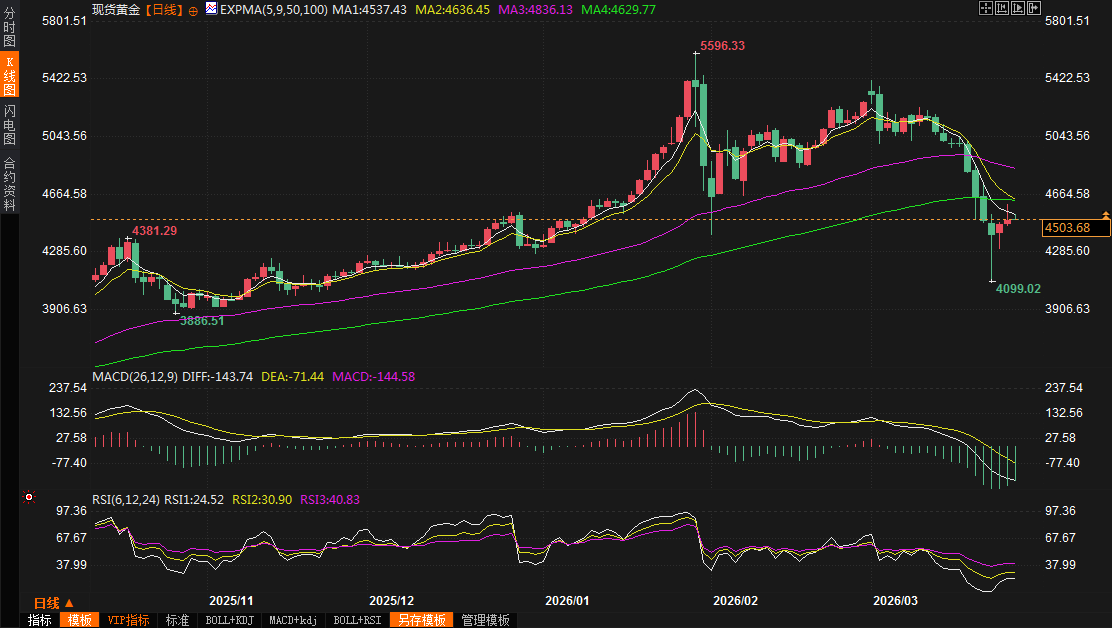
(Spot gold daily chart, source: FX678)
At 07:25 Beijing time, spot gold was trading at $4,503.68 per ounce.
On Thursday (March 26) in early Asian trading, spot gold fluctuated narrowly and is currently trading around the $4,500 mark.
Iran's delicate balancing act: deliberating on a ceasefire plan, yet rejecting the label of dialogue.
Iran's stance has become the most intriguing aspect of the current situation. A senior Iranian official explicitly told Reuters that Tehran has received the US proposal and it is currently under high-level review, although initial feedback has not been positive. This contrasts sharply with earlier reports from Iran's Press TV that the proposal had been "rejected."
More importantly, Iran has not closed communication channels and has even hinted that if negotiations proceed, the location could be Pakistan or Turkey. Pakistan, acting as an intermediary, has followed up multiple times and is awaiting a formal response. Iranian Foreign Minister Araqchi's statement on state television further clarified that exchanging information through mediators is not equivalent to direct negotiations.
These signals indicate that while Iran publicly scorns the Trump administration, it is clearly weighing the pros and cons in private—clearing its stockpile of highly enriched uranium, halting uranium enrichment, curbing its ballistic missile program, and cutting off financial support to regional allies. These terms undoubtedly touch upon Iran's core interests, but they also open a possible window for ending the war.
This "deliberation rather than rejection" stance directly alleviated market panic over the potential for an escalation of the conflict, prompting a short-term technical rebound in gold prices.
Israel's deep suspicion: The option of a preemptive strike cannot be abandoned
In contrast to Iran's cautious assessment, Israeli Prime Minister Netanyahu's security cabinet was far more vigilant after being briefed on the US proposal.
Three Israeli cabinet sources revealed that Israel has strong doubts about whether Iran will truly accept these harsh terms, and is even more concerned that US negotiators may make concessions on key issues. A senior Israeli defense official stated bluntly that any agreement must retain the right for Israel to launch a preemptive strike.
This is not hard to understand—Israel has launched attacks on Tehran, and Iran's retaliation has also affected Israeli and US military bases. The Israeli Foreign Ministry has further stated explicitly that it has never negotiated with the "Iranian terrorist regime" and will never do so.
This hardline stance has not only exacerbated regional tensions but also made it difficult for investors to fully believe that the dawn of peace has arrived. The rise in gold prices is partly due to the continued uncertainty stemming from this "skepticism," which reminds the market that even if ceasefire proposals are progressing, potential military conflict could still reignite at any time.
Aggressive US Pressure and Military Mobilization: Trump's "Hellish Threat"
The White House's stance was even more aggressive. Spokesperson Levitt made no attempt to downplay the threat at a press conference, warning that if Tehran did not acknowledge that it had been "militarily defeated," President Trump would ensure that Iran suffered "a more devastating blow than ever before," emphasizing that this was "no bluff."
Meanwhile, the Pentagon is planning to send thousands of airborne troops to the Gulf region to supplement two Marine Corps detachments that have already departed, with the first detachment expected to arrive by the end of this month. This series of military moves clearly signals that the United States retains ample options for ground offensive operations.
Iran responded swiftly. The semi-official Tasnim News Agency, citing military sources, stated that if its territory were attacked, Iran might open a new front in the Bab el-Mandeb Strait, the entrance to the Red Sea, creating a credible threat to Yemen and Djibouti. The Speaker of the Islamic Republic of Iran's Parliament, Qalibaf, further warned that any neighboring country that assists an enemy in occupying Iranian islands would face Iranian attacks.
UN Secretary-General António Guterres stated that the region is facing a larger threat of war and called for an immediate halt to escalation and a diplomatic solution.
Under such high pressure, gold's safe-haven properties were further activated. Although oil prices fell due to hopes for a ceasefire, the reality of military buildup still made investors reluctant to sell gold easily.
Hezbollah's inclusion in the agreement: Iran's bottom line and regional repercussions
The complexities of the ceasefire negotiations extend far beyond Iran. Six regional sources familiar with Iran's position revealed that Tehran has made it clear to intermediaries that any agreement must include Lebanon and directly link the end of the war to Israel's cessation of its offensive against Hezbollah.
Iran's Press TV, citing officials, emphasized that the agreement must cover all "resistance groups." Hezbollah has received assurances from Iran and hopes to use this to consolidate its political position in Lebanon. A senior Trump administration official responded that ending Iranian proxy activities and disarming Hezbollah is crucial for regional peace.
Israel, however, maintains that the attacks on Hezbollah are unrelated to the Iranian front and that it may continue its advance after the air battle ends. This Lebanese factor adds further uncertainty to the ceasefire prospects and amplifies the risk of the conflict spreading from the Gulf to the entire Middle East. Consequently, the gold market did not experience a comprehensive decline due to the single ceasefire announcement; instead, it maintained a strong rebound amidst uncertainty.
Global Market Update: Falling Oil Prices Boost Gold's Technical Rebound
The market's reaction to this series of news was textbook. Global stock markets rebounded slightly and oil prices fell after reports on Wednesday that the US had submitted a 15-point proposal, as investors hoped that this war, which is disrupting energy supplies and driving up inflation, would end soon.
Gold exhibited a distinct technical rebound against this backdrop: the easing of oil price pressures at the start of trading reduced the likelihood of prolonged high interest rates, and consequently lowered the opportunity cost of gold as a non-interest-bearing asset.
Peter Grant, senior metals strategist at Zaner Metals, pointed out that gold not only benefited from optimism about a potential easing of hostile actions by Iran, but also received strong support from bargain hunting. Although spot gold ultimately closed up 0.72%, the intraday surge to near $4,600 fully reflected the immediate release of geopolitical risk premiums.
Meanwhile, the US dollar index rose 0.44% to 99.62, the 10-year US Treasury yield fell to 4.32%, and the two-year yield dropped to 3.875%, with the bond market's response to expectations of peace further confirming market expectations for easing inflation. However, US import prices saw their biggest increase in nearly four years in February, UK inflation remained at 3%, and expectations of a Fed rate hike have risen somewhat, making the upside potential for gold uncertain.
Intertwined macroeconomic logic: Inflation hedging vs. interest rate opportunity cost
At a deeper level, gold price fluctuations are caught in the dual pull of inflation expectations and the interest rate environment.
On the one hand, the Middle East conflict has driven up oil prices, which could have fueled global inflation and made gold a classic hedging tool; on the other hand, the decline in oil prices brought about by the hope of a ceasefire is gradually easing the pressure on the Federal Reserve to maintain high interest rates for a long time.
If inflation concerns subside further, and the market even begins to discuss a possible interest rate cut later this year, this could be both a boon (lower holding costs) and a challenge for gold (weakening safe-haven demand).
According to the Chicago Mercantile Exchange's FedWatch tool, federal funds futures have quietly increased pricing in a 25-basis-point rate hike in December, while the hawkish shifts of the European Central Bank and the Bank of Japan are also narrowing the yield spread.
Oscar Munoz, chief macro strategist at TD Securities, believes the Federal Reserve remains in a "wait-and-see" mode, and short-term yields may remain high, but concerns about slowing economic growth will limit further upside. Against this macroeconomic backdrop, the area above $4,500 for gold is becoming a battleground for fierce competition between bulls and bears.
Currently, every subtle shift in the Middle East conflict is reshaping the logic of global asset pricing. Iran's deliberative stance, Israel's skepticism, the US military buildup, and Lebanon's chain of demands collectively construct a complex picture of "peace possible, but risks remaining." The nearly 3% surge in gold prices reflects both a concentrated release of short-term risk aversion and investors' advance positioning for long-term uncertainty.
Looking ahead, if the ceasefire negotiations make substantial progress, oil prices and inflation both decline, and expectations for a Federal Reserve rate cut rise, gold may see further rebound opportunities. However, currently, if either side misjudges the situation, leading to a continuation or escalation of the conflict, oil prices continue to surge, and expectations for a Fed rate hike rise, gold may further retrace to $4,000 or even lower. In addition, investors should also pay attention to changes in market demand for gold as a safe haven, changes in expectations for the Fed's policy outlook, and changes in market liquidity needs.
In conclusion: Uncertainty is gold's best friend.
In conclusion, the gold market is currently at a crossroads. The US-proposed ceasefire offers an opportunity to de-escalate the situation, but Iran's deliberations, Israel's concerns, continued US military pressure, and the intertwining of peripheral conflicts such as Lebanon make the future direction of the Middle East situation highly uncertain.
For gold, this uncertainty is its best friend. As long as the conflict doesn't truly end, or negotiations fail to reach a clear and credible agreement, the safe-haven demand for gold will persist. Investors need to closely monitor the following: first, Iran's final official response to the US proposal; second, whether Israel will take unilateral military action; and third, whether the military standoff in the Gulf region will unexpectedly escalate. Until these key variables become clear, gold prices are likely to continue to fluctuate, searching for direction. Every twist in negotiations, every update on military deployments, could become a catalyst for a gold price breakout.
(Spot gold daily chart, source: FX678)
At 07:25 Beijing time, spot gold was trading at $4,503.68 per ounce.
- Risk Warning and Disclaimer
- The market involves risk, and trading may not be suitable for all investors. This article is for reference only and does not constitute personal investment advice, nor does it take into account certain users’ specific investment objectives, financial situation, or other needs. Any investment decisions made based on this information are at your own risk.