The ongoing conflict between the US, Israel, and Iran may further increase the risk of a US recession.
2026-03-26 15:10:38
According to APP, the US economy is facing additional downward pressure due to the ongoing conflict between the US, Israel, and Iran. Several financial institutions have recently significantly increased their forecasts for a recession over the next 12 months. This adjustment is primarily due to the rapid rise in international oil prices caused by the conflict, and the resulting increase in inflation expectations and a deterioration in growth prospects. In a normal year, this baseline probability typically hovers around 20%, while the current level is already in a high warning zone, indicating that geopolitical factors are becoming the dominant risk variable.
A new model from Moody's Analytics shows the probability of a U.S. recession has risen to 48.6%, a record high in recent years. Moody's chief economist, Mark Zandi, recently stated explicitly: "Worryingly, the risk of recession is uncomfortably high and continues to rise; a recession is a real threat. If current high oil prices persist until late May or the end of the second quarter, the U.S. economy will fall into recession." His statement, based on AI-driven economic simulations, emphasizes that the rapid transmission of oil price shocks far exceeds market expectations.
To provide a clear comparison of the opinions of various institutions, the following table presents the latest forecast data:
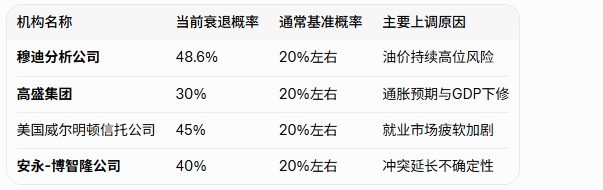
These data indicate that a recession has shifted from a "low-probability event" to a "real threat." While Goldman Sachs still views a recession as a non-baseline scenario, it has lowered its full-year GDP growth forecast and warned that persistently high oil prices will significantly dampen consumption and investment. Historical experience shows that almost all recessions are accompanied by soaring oil prices; if this conflict cannot be resolved quickly, the second quarter will be a crucial observation window.
Further analysis reveals a clear and powerful transmission chain for rising oil prices: First, it directly increases costs in gasoline, transportation, and manufacturing, thereby suppressing disposable income and corporate profits; second, it may force the Federal Reserve to be more cautious in its pace of interest rate cuts, creating a potential for stagflation; and finally, through the amplifying effect in financial markets, it leads to increased stock market volatility and a steeper yield curve. The job market has recently shown cracks, and if consumer spending slows further, rising unemployment will create a vicious cycle.
Globally, energy price volatility will also impact supply chain stability through commodity channels, imposing imported cost pressures on major economies such as large Asian countries. Investors need to closely monitor oil price trends, US second-quarter economic data, and conflict developments, as these variables will directly determine the degree to which probabilistic predictions are ultimately realized.
Editor's Summary : Multiple financial institutions' latest models unanimously point to a significant increase in geopolitically driven downside risks to the US economy, with the probability of a recession far exceeding normal levels. The sustainability of oil prices is a key variable, and the final outcome depends on the speed of conflict easing and the flexibility of monetary policy. The market needs to remain highly vigilant to cope with potential volatility.
A new model from Moody's Analytics shows the probability of a U.S. recession has risen to 48.6%, a record high in recent years. Moody's chief economist, Mark Zandi, recently stated explicitly: "Worryingly, the risk of recession is uncomfortably high and continues to rise; a recession is a real threat. If current high oil prices persist until late May or the end of the second quarter, the U.S. economy will fall into recession." His statement, based on AI-driven economic simulations, emphasizes that the rapid transmission of oil price shocks far exceeds market expectations.
To provide a clear comparison of the opinions of various institutions, the following table presents the latest forecast data:
These data indicate that a recession has shifted from a "low-probability event" to a "real threat." While Goldman Sachs still views a recession as a non-baseline scenario, it has lowered its full-year GDP growth forecast and warned that persistently high oil prices will significantly dampen consumption and investment. Historical experience shows that almost all recessions are accompanied by soaring oil prices; if this conflict cannot be resolved quickly, the second quarter will be a crucial observation window.
Further analysis reveals a clear and powerful transmission chain for rising oil prices: First, it directly increases costs in gasoline, transportation, and manufacturing, thereby suppressing disposable income and corporate profits; second, it may force the Federal Reserve to be more cautious in its pace of interest rate cuts, creating a potential for stagflation; and finally, through the amplifying effect in financial markets, it leads to increased stock market volatility and a steeper yield curve. The job market has recently shown cracks, and if consumer spending slows further, rising unemployment will create a vicious cycle.
Globally, energy price volatility will also impact supply chain stability through commodity channels, imposing imported cost pressures on major economies such as large Asian countries. Investors need to closely monitor oil price trends, US second-quarter economic data, and conflict developments, as these variables will directly determine the degree to which probabilistic predictions are ultimately realized.
Editor's Summary : Multiple financial institutions' latest models unanimously point to a significant increase in geopolitically driven downside risks to the US economy, with the probability of a recession far exceeding normal levels. The sustainability of oil prices is a key variable, and the final outcome depends on the speed of conflict easing and the flexibility of monetary policy. The market needs to remain highly vigilant to cope with potential volatility.
- Risk Warning and Disclaimer
- The market involves risk, and trading may not be suitable for all investors. This article is for reference only and does not constitute personal investment advice, nor does it take into account certain users’ specific investment objectives, financial situation, or other needs. Any investment decisions made based on this information are at your own risk.