Only when trading becomes boring will wealth start to work for you.
2026-03-27 17:56:14
Once you step into the trading market, regardless of your experience level, you will sooner or later encounter a harsh reality: the core of trading is never "accurate prediction," but "long-term survival."
You may have already studied wave theory, be able to accurately identify candlestick patterns, and even talk fluently about macroeconomic data.
You painstakingly learn 80% of the hard knowledge—market logic, indicator usage, and strategy framework—yet you still struggle and languish in the remaining 20%.
This crucial 20% has nothing to do with intelligence; it only concerns whether you can maintain mechanical execution in extremely uncertain market conditions and become a "counterintuitive" professional trader.
Most traders can quickly grasp the basic logic of the market within six months of entering the market.
They can spot resistance and support levels at a glance, skillfully switch between indicators such as MACD and RSI, and even build a seemingly complete trading system. However, this half-baked expertise is precisely the root cause of their losses.
When your knowledge base is sufficient to allow you to place orders blindly, but insufficient to support you in achieving stable profits, you are actually traveling on a "highway of losses".
In the trading market, the dividing line between profitability and mediocrity is not whose strategy is more accurate, but who can hone consistency to the extreme—strictly executing the same signals and never repeating the same mistakes. This is the core key to navigating market fluctuations.
Two scenarios are often used abroad to illustrate two different states of trading; understanding these scenarios reveals the gap between professional and amateur:
Golf-style trading (amateur approach): acting spontaneously and driven by emotions.
You understand the basic principles of the swing, but you hate the tedious repetitive practice; you are complacent when the market is going well, but complain when your position suffers a drawdown.
This lack of discipline and consistency is like struggling repeatedly in a sandpit—occasionally hitting a good shot, but never escaping the cycle of losses.
Most retail investors' trading remains at this level: placing orders based on intuition, profiting by luck, and holding onto losing positions by sheer luck.
Pilot-style trading (professional approach): Respect for the market and strict adherence to procedures.
Before takeoff, pilots will check the takeoff checklist one by one, regardless of how clear the weather is or how many times they have flown before.
Procedures are lifeblood; no step can be omitted.
In the trading market, professional traders should be like pilots: stripping away emotional interference and engraving trading rules into muscle memory.
If the signal is incorrect, remain inactive even if you miss out on a doubling opportunity; once the stop-loss line is triggered, exit the market decisively, no matter how unwilling you are.
The market is never short of opportunities; what it lacks is the resolve to stick to principles in the face of temptation and fear.
When market conditions fluctuate in real time, high-pressure environments can trigger the primal "fight or flight" instinct in humans, causing the rational brain to "shut down" instantly.
Greed will make you hesitate at the profit-taking point—even when you have reached the preset target, you fantasize about a bigger wave, and in the end you watch your profits be given back, or even turn from profit to loss.
Fear can cause you to stubbornly hold on during pullbacks—even when stop-loss rules are triggered, you hope for a market reversal, clinging to the wishful thinking of "waiting a little longer," until your position is wiped out and you regret it too late.
The gap between knowing and doing is essentially a conflict between psychological defense mechanisms and probabilistic thinking.
Top traders understand a core logic: the outcome of a single trade is random, and may result in profit or loss, but the outcome of strictly adhering to the rules a thousand times is inevitable—probability will favor those who stick to discipline.
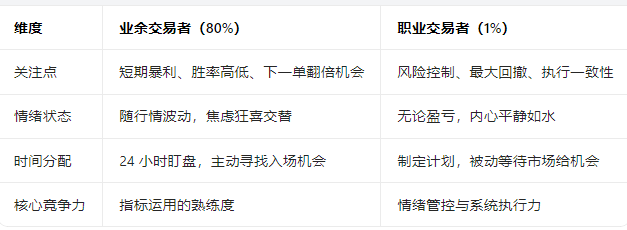
To bridge that 20% gap, you must shift from "finding the perfect strategy" to "cultivating extreme discipline".
When trading truly gets on track, your mindset will undergo a qualitative transformation:
The underlying reality of profitability has always been "boring".
As one veteran trader put it, "If your trading makes your heart race and gives you a lot of excitement, you're probably gambling."
Real profitable trades are often tedious and repetitive.
You only need to adhere to a proven process: wait for the preset signal → confirm market suitability → strictly set risk control (stop loss/take profit) → exit the market decisively when the signal disappears.
There were no unexpected surprises, no thrilling moments, only the daily repetition and perseverance.
The Path to Advancement: From Gambler to Asset Manager
Once you bridge the gap between "knowing and doing," you'll find that trading is no longer a guessing game; your mindset and understanding will undergo a fundamental upgrade.
Calm and composed: Accept probability, say goodbye to internal friction.
You no longer doubt yourself because of a single stop loss, because you know that the core of trading is "probabilistic advantage"—stop loss is part of the strategy, not proof of failure.
Just as a pilot won't abandon a flight plan because of a single turbulence, you won't abandon your trading system because of a single loss.
Protect your principal: Forgo exorbitant profits and pursue long-term gains.
You will protect your principal like you would a fortified city, and no longer indulge in the fantasy of "doubling your money overnight".
You understand that the first priority in trading is "survival." Only by preserving your principal can you be qualified to enter the market when the opportunity arises. Stable compound interest is far closer to financial freedom than short-term windfall profits.
Enjoy life: Trading is a tool, not a shackle.
You are no longer a slave to the market; you don't need to keep an eye on the market 24/7.
Trading becomes a tool for you to gain freedom—you replace staring at the screen with rules, replace anxiety with consistency, and free up time to spend with family and develop hobbies, truly realizing the original intention of "trading serving life".
Mediocre traders frantically search for the "perfect entry signal," while top traders focus on honing their "perfect self," controlling their emotions, finding the fulcrum that will be fermented by the market in the sea of information, knowing what story you are buying, believing it early, and inadvertently discovering the perfect entry opportunity in the mundane routine of behavior.
The ultimate truth of trading is never about beating the market or being faster than others, but about overcoming your own greed and fear, and using knowledge and experience to find opportunities when market sentiment is wrong.
When you stop chasing the thrill of trading and start trusting your plan and adhering to your process, profits will come as naturally as breathing—this is the ultimate answer to getting past the last 20%.
You may have already studied wave theory, be able to accurately identify candlestick patterns, and even talk fluently about macroeconomic data.
You painstakingly learn 80% of the hard knowledge—market logic, indicator usage, and strategy framework—yet you still struggle and languish in the remaining 20%.
This crucial 20% has nothing to do with intelligence; it only concerns whether you can maintain mechanical execution in extremely uncertain market conditions and become a "counterintuitive" professional trader.
The fatal "80% bottleneck zone": The most dangerous thing is to be half-understanding.
Most traders can quickly grasp the basic logic of the market within six months of entering the market.
They can spot resistance and support levels at a glance, skillfully switch between indicators such as MACD and RSI, and even build a seemingly complete trading system. However, this half-baked expertise is precisely the root cause of their losses.
When your knowledge base is sufficient to allow you to place orders blindly, but insufficient to support you in achieving stable profits, you are actually traveling on a "highway of losses".
In the trading market, the dividing line between profitability and mediocrity is not whose strategy is more accurate, but who can hone consistency to the extreme—strictly executing the same signals and never repeating the same mistakes. This is the core key to navigating market fluctuations.
Golf and Aviation: The Fundamental Difference Between Amateur and Professional Trading
Two scenarios are often used abroad to illustrate two different states of trading; understanding these scenarios reveals the gap between professional and amateur:
Golf-style trading (amateur approach): acting spontaneously and driven by emotions.
You understand the basic principles of the swing, but you hate the tedious repetitive practice; you are complacent when the market is going well, but complain when your position suffers a drawdown.
This lack of discipline and consistency is like struggling repeatedly in a sandpit—occasionally hitting a good shot, but never escaping the cycle of losses.
Most retail investors' trading remains at this level: placing orders based on intuition, profiting by luck, and holding onto losing positions by sheer luck.
Pilot-style trading (professional approach): Respect for the market and strict adherence to procedures.
Before takeoff, pilots will check the takeoff checklist one by one, regardless of how clear the weather is or how many times they have flown before.
Procedures are lifeblood; no step can be omitted.
In the trading market, professional traders should be like pilots: stripping away emotional interference and engraving trading rules into muscle memory.
If the signal is incorrect, remain inactive even if you miss out on a doubling opportunity; once the stop-loss line is triggered, exit the market decisively, no matter how unwilling you are.
The market is never short of opportunities; what it lacks is the resolve to stick to principles in the face of temptation and fear.
Why do people "understand the principles" but "fail to put them into practice"?
When market conditions fluctuate in real time, high-pressure environments can trigger the primal "fight or flight" instinct in humans, causing the rational brain to "shut down" instantly.
Greed will make you hesitate at the profit-taking point—even when you have reached the preset target, you fantasize about a bigger wave, and in the end you watch your profits be given back, or even turn from profit to loss.
Fear can cause you to stubbornly hold on during pullbacks—even when stop-loss rules are triggered, you hope for a market reversal, clinging to the wishful thinking of "waiting a little longer," until your position is wiped out and you regret it too late.
The gap between knowing and doing is essentially a conflict between psychological defense mechanisms and probabilistic thinking.
Top traders understand a core logic: the outcome of a single trade is random, and may result in profit or loss, but the outcome of strictly adhering to the rules a thousand times is inevitable—probability will favor those who stick to discipline.
Breaking the Mold: The Ultimate Execution That Rewrites the Outcome of a Trade
To bridge that 20% gap, you must shift from "finding the perfect strategy" to "cultivating extreme discipline".
When trading truly gets on track, your mindset will undergo a qualitative transformation:
The underlying reality of profitability has always been "boring".
As one veteran trader put it, "If your trading makes your heart race and gives you a lot of excitement, you're probably gambling."
Real profitable trades are often tedious and repetitive.
You only need to adhere to a proven process: wait for the preset signal → confirm market suitability → strictly set risk control (stop loss/take profit) → exit the market decisively when the signal disappears.
There were no unexpected surprises, no thrilling moments, only the daily repetition and perseverance.
The Path to Advancement: From Gambler to Asset Manager
Once you bridge the gap between "knowing and doing," you'll find that trading is no longer a guessing game; your mindset and understanding will undergo a fundamental upgrade.
Calm and composed: Accept probability, say goodbye to internal friction.
You no longer doubt yourself because of a single stop loss, because you know that the core of trading is "probabilistic advantage"—stop loss is part of the strategy, not proof of failure.
Just as a pilot won't abandon a flight plan because of a single turbulence, you won't abandon your trading system because of a single loss.
Protect your principal: Forgo exorbitant profits and pursue long-term gains.
You will protect your principal like you would a fortified city, and no longer indulge in the fantasy of "doubling your money overnight".
You understand that the first priority in trading is "survival." Only by preserving your principal can you be qualified to enter the market when the opportunity arises. Stable compound interest is far closer to financial freedom than short-term windfall profits.
Enjoy life: Trading is a tool, not a shackle.
You are no longer a slave to the market; you don't need to keep an eye on the market 24/7.
Trading becomes a tool for you to gain freedom—you replace staring at the screen with rules, replace anxiety with consistency, and free up time to spend with family and develop hobbies, truly realizing the original intention of "trading serving life".
Summarize:
Mediocre traders frantically search for the "perfect entry signal," while top traders focus on honing their "perfect self," controlling their emotions, finding the fulcrum that will be fermented by the market in the sea of information, knowing what story you are buying, believing it early, and inadvertently discovering the perfect entry opportunity in the mundane routine of behavior.
The ultimate truth of trading is never about beating the market or being faster than others, but about overcoming your own greed and fear, and using knowledge and experience to find opportunities when market sentiment is wrong.
When you stop chasing the thrill of trading and start trusting your plan and adhering to your process, profits will come as naturally as breathing—this is the ultimate answer to getting past the last 20%.
- Risk Warning and Disclaimer
- The market involves risk, and trading may not be suitable for all investors. This article is for reference only and does not constitute personal investment advice, nor does it take into account certain users’ specific investment objectives, financial situation, or other needs. Any investment decisions made based on this information are at your own risk.