Better-than-expected UK retail sales eased pressure, intensifying the sterling's divergent performance amid bullish and bearish competition.
2026-03-27 19:55:49
On Friday (March 27), during the European trading session, the British pound traded around 1.3300 against the US dollar, down 0.17%, continuing its recent tight range-bound trading pattern. The US dollar index strengthened during the same period, rebounding 0.28% to hold above the 99.50 level and approaching the 100 mark, becoming a key external factor suppressing the pound's movement. While the latest UK retail sales data for February showed a slight decline due to severe weather, the overall performance was better than market expectations, effectively boosting market confidence and confirming the resilience of UK consumer fundamentals.
Overall, UK retail sales fell 0.4% month-on-month in February, a decline from the previous month's 1.8%, but better than the market forecast of -0.7%. The indicator rose 0.7% year-on-year over the three-month period, suggesting that overall consumption remained robust during the winter. TD Securities analysts stated that while the UK retail sales data exceeded expectations, the Monetary Policy Committee is unlikely to adjust its policy stance based on this data.
Fundamental Analysis
The Bank of England's monetary policy remains the core driver determining the pound's direction. Due to persistently high inflation stickiness, the Bank of England has maintained high interest rates, and the interest rate differential between the UK and the US previously provided support for the pound. However, the Federal Reserve maintained its tightening stance and made more hawkish statements than expected. The March dot plot showed only one planned rate cut in 2026, postponed to the end of the year, pushing up US Treasury yields. Coupled with safe-haven buying triggered by Middle East geopolitical conflicts, the US dollar index strengthened temporarily, narrowing the UK-US interest rate advantage and significantly suppressing the pound.
On the economic data front, the UK's CPI rose to 0.4% month-on-month in February from -0.5%, the core CPI climbed to 3.2% year-on-year, and the retail price index slowed to 3.6% year-on-year. Various inflation indicators have remained above the central bank's 2% policy target for an extended period. Although weather factors dragged down the performance of most retail sub-sectors, the industry did not show fundamental weakness, and the resilience of consumer spending continued to be evident.
Meanwhile, the ongoing geopolitical conflicts in the Middle East, exemplified by the situation in Iran, continue to escalate, becoming a new driver of inflation. Since the beginning of the year, UK natural gas prices have surged by 77%, with a nearly 66% increase in the last 30 days. International crude oil prices have also soared, significantly raising energy costs and further exacerbating the risk of stagflation in the UK economy. Currently, there are no major adjustments to trade policy, but geopolitical uncertainties have profoundly impacted the fundamentals of the pound sterling through energy channels, while simultaneously providing safe-haven support for the US dollar, helping it continue its rebound.
Market View
Mainstream financial institutions generally believe that the better-than-expected retail data is unlikely to change the Bank of England's policy pace. TD Securities pointed out that retail sales generally weakened in February due to weather, but the medium-term trend is positive and will not trigger drastic policy adjustments by the Monetary Policy Committee; the UK GfK consumer confidence index fell to -21 in March, a new low since Liberation Day in 2025, but the decline was limited, reflecting the resilience of the consumer market.
The FXStreet analysis team noted that before the outbreak of geopolitical conflicts, UK inflation was already high, with core inflation far exceeding the policy red line. Coupled with the continued surge in energy prices, the Bank of England was deeply mired in stagflation. Meanwhile, the US dollar's periodic strong rebound further compressed the pound's upside potential and exacerbated the volatility and divergence in the exchange rate.
Industry analyst Crispus Niaga said that after inflation took effect, the pound sterling remained range-bound against the dollar, and the strength and sustainability of the dollar's rebound will be an important variable affecting short-term market trends.
Technical Analysis
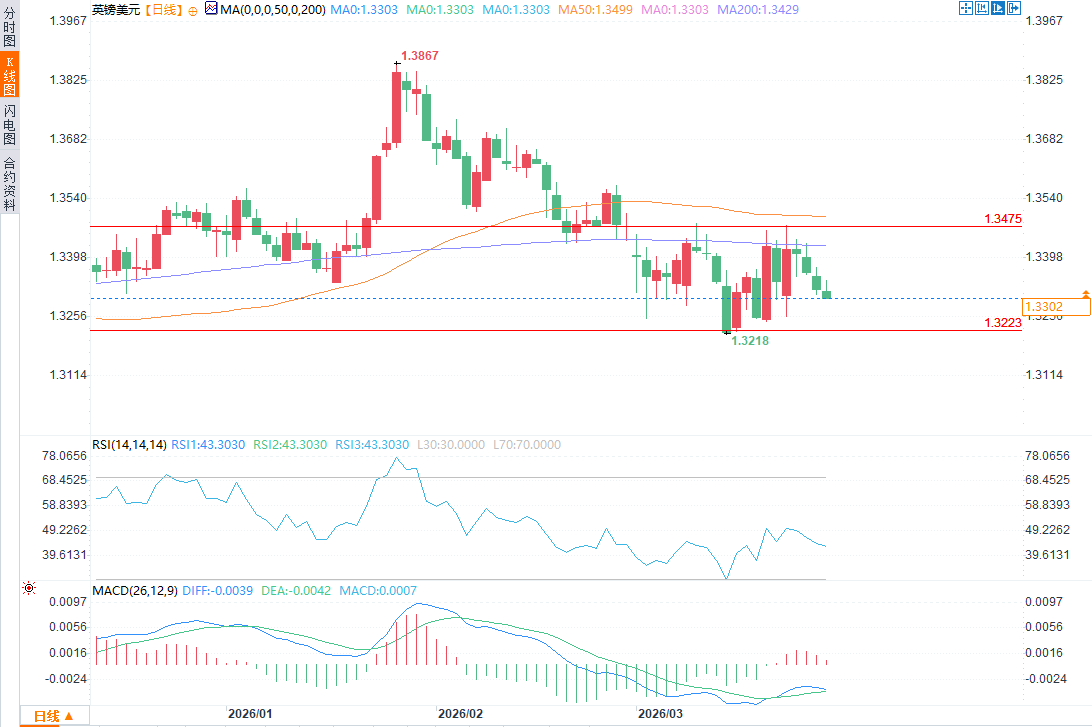
From a daily chart perspective, the GBP/USD pair closed at 1.3362 on Thursday, below this week's high of 1.3473 and significantly lower than the year's high of 1.3865. Currently, the pair has slightly broken below the 50-day moving average, and the Relative Strength Index (RSI) is below 50, indicating weak short-term upward momentum. It is expected to continue consolidating within the 1.3223-1.3475 range. A decisive break above the upper resistance level could see a move towards the psychological level of 1.3600. However, it's worth noting that if the US dollar index holds above 100 and strengthens further, it could push the pound down to test the lower support level of its trading range.
Key Reminders from the Financial Calendar
At 17:30 Beijing time on March 27, the UK's February retail sales data were officially released, showing a strong performance and becoming the core focus of the financial markets that day.
Looking ahead to next week, investors should pay close attention to public speeches by Bank of England officials, as well as key US economic data such as durable goods orders and preliminary GDP figures (the release time is subject to official announcements) – these data will directly affect the dollar's performance, which in turn will impact the pound's price. In addition, investors should closely monitor the chain reaction of Middle East developments on international energy prices and the demand for the dollar as a safe haven.
Market Outlook
Overall, UK retail consumption remained resilient, with consumer confidence declining slightly but not deteriorating. In the short term, the pound is pressured by two major negative factors: high inflation and geopolitical tensions, coupled with external pressure from the dollar's recent rebound, limiting its upside potential; however, the UK-Japan interest rate differential will provide strong medium- to long-term support. The pound/dollar pair is likely to continue its range-bound trading, while the pound/yen pair shows a clearer bullish trend. In practical terms, investors can conduct short-term trading within the 1.3223-1.3475 range, while closely monitoring Middle East geopolitical developments, the latest policy statements from the Bank of England, and key factors influencing the dollar's trajectory, such as the dollar index's performance above 100 and speeches by Federal Reserve officials.
Frequently Asked Questions
Q1: Will the positive UK retail sales data in February change the Bank of England's monetary policy?
A1: This rebound in data is merely a short-term, normal correction caused by weather disturbances and does not change the overall positive trend in winter consumption. Multiple authoritative institutions predict that the UK Monetary Policy Committee will not significantly adjust its policy as a result. Furthermore, this data does not yet reflect the negative impact of the Middle East conflict on consumption; the central bank's decisions focus more on long-term inflation trends than on single-month retail fluctuations.
Q2: Why would the Middle East conflict exacerbate the UK's stagflation crisis?
A2: Geopolitical conflicts have directly driven up the prices of natural gas and crude oil commodities. UK natural gas prices have surged 77% this year, with a nearly 66% increase in the past month. The soaring energy costs are quickly passed on to overall prices, pushing up inflation. Meanwhile, the UK economy continues to struggle, with high inflation coupled with low growth, exhibiting increasingly pronounced characteristics of stagflation, which also limits the Bank of England's ability to cut interest rates to stimulate the economy. Furthermore, the safe-haven demand triggered by the conflict has also boosted the US dollar, indirectly suppressing the pound's performance.
Q3: Consumer confidence has hit a low point, so why do we still say that British consumption is resilient?
A3: Although the GfK confidence index fell to -21, the actual decline was less than market expectations, indicating that consumers did not engage in panic-driven spending cuts. Retail data also corroborates this: even with the impact of severe weather, total consumption remained positive over the three months, demonstrating that British residents are able to adapt to a high-inflation environment and that their consumption base is solid.
Q4: What is the primary and core pressure currently suppressing the pound's performance?
A4: The core pressure stems from persistently high inflation. The Middle East conflict is driving up energy prices, further solidifying the high inflation level; meanwhile, the external pressure from the dollar's recent rebound cannot be ignored. The Bank of England faces a difficult balance between curbing inflation and boosting the economy, and the uncertainty surrounding the benchmark interest rate directly limits the pound's ability to achieve a sustained upward trend.
Q5: What key signals do the two core data points, retail sales and inflation, send to investors?
A5: Both sets of data demonstrate the resilience of the UK economy, but the inflation problem remains unresolved. Better-than-expected retail sales stabilized short-term market sentiment, while the current high inflation suggests the Bank of England is unlikely to shift to an easing monetary policy in the short term. Investors should pay attention to changes in actual purchasing power while also being wary of geopolitical black swan risks and the sustainability of the dollar's rebound. In terms of trading strategy, a range-bound trading approach should be prioritized.
Overall, UK retail sales fell 0.4% month-on-month in February, a decline from the previous month's 1.8%, but better than the market forecast of -0.7%. The indicator rose 0.7% year-on-year over the three-month period, suggesting that overall consumption remained robust during the winter. TD Securities analysts stated that while the UK retail sales data exceeded expectations, the Monetary Policy Committee is unlikely to adjust its policy stance based on this data.
Fundamental Analysis
The Bank of England's monetary policy remains the core driver determining the pound's direction. Due to persistently high inflation stickiness, the Bank of England has maintained high interest rates, and the interest rate differential between the UK and the US previously provided support for the pound. However, the Federal Reserve maintained its tightening stance and made more hawkish statements than expected. The March dot plot showed only one planned rate cut in 2026, postponed to the end of the year, pushing up US Treasury yields. Coupled with safe-haven buying triggered by Middle East geopolitical conflicts, the US dollar index strengthened temporarily, narrowing the UK-US interest rate advantage and significantly suppressing the pound.
On the economic data front, the UK's CPI rose to 0.4% month-on-month in February from -0.5%, the core CPI climbed to 3.2% year-on-year, and the retail price index slowed to 3.6% year-on-year. Various inflation indicators have remained above the central bank's 2% policy target for an extended period. Although weather factors dragged down the performance of most retail sub-sectors, the industry did not show fundamental weakness, and the resilience of consumer spending continued to be evident.
Meanwhile, the ongoing geopolitical conflicts in the Middle East, exemplified by the situation in Iran, continue to escalate, becoming a new driver of inflation. Since the beginning of the year, UK natural gas prices have surged by 77%, with a nearly 66% increase in the last 30 days. International crude oil prices have also soared, significantly raising energy costs and further exacerbating the risk of stagflation in the UK economy. Currently, there are no major adjustments to trade policy, but geopolitical uncertainties have profoundly impacted the fundamentals of the pound sterling through energy channels, while simultaneously providing safe-haven support for the US dollar, helping it continue its rebound.
Market View
Mainstream financial institutions generally believe that the better-than-expected retail data is unlikely to change the Bank of England's policy pace. TD Securities pointed out that retail sales generally weakened in February due to weather, but the medium-term trend is positive and will not trigger drastic policy adjustments by the Monetary Policy Committee; the UK GfK consumer confidence index fell to -21 in March, a new low since Liberation Day in 2025, but the decline was limited, reflecting the resilience of the consumer market.
The FXStreet analysis team noted that before the outbreak of geopolitical conflicts, UK inflation was already high, with core inflation far exceeding the policy red line. Coupled with the continued surge in energy prices, the Bank of England was deeply mired in stagflation. Meanwhile, the US dollar's periodic strong rebound further compressed the pound's upside potential and exacerbated the volatility and divergence in the exchange rate.
Industry analyst Crispus Niaga said that after inflation took effect, the pound sterling remained range-bound against the dollar, and the strength and sustainability of the dollar's rebound will be an important variable affecting short-term market trends.
Technical Analysis
From a daily chart perspective, the GBP/USD pair closed at 1.3362 on Thursday, below this week's high of 1.3473 and significantly lower than the year's high of 1.3865. Currently, the pair has slightly broken below the 50-day moving average, and the Relative Strength Index (RSI) is below 50, indicating weak short-term upward momentum. It is expected to continue consolidating within the 1.3223-1.3475 range. A decisive break above the upper resistance level could see a move towards the psychological level of 1.3600. However, it's worth noting that if the US dollar index holds above 100 and strengthens further, it could push the pound down to test the lower support level of its trading range.
Key Reminders from the Financial Calendar
At 17:30 Beijing time on March 27, the UK's February retail sales data were officially released, showing a strong performance and becoming the core focus of the financial markets that day.
Looking ahead to next week, investors should pay close attention to public speeches by Bank of England officials, as well as key US economic data such as durable goods orders and preliminary GDP figures (the release time is subject to official announcements) – these data will directly affect the dollar's performance, which in turn will impact the pound's price. In addition, investors should closely monitor the chain reaction of Middle East developments on international energy prices and the demand for the dollar as a safe haven.
Market Outlook
Overall, UK retail consumption remained resilient, with consumer confidence declining slightly but not deteriorating. In the short term, the pound is pressured by two major negative factors: high inflation and geopolitical tensions, coupled with external pressure from the dollar's recent rebound, limiting its upside potential; however, the UK-Japan interest rate differential will provide strong medium- to long-term support. The pound/dollar pair is likely to continue its range-bound trading, while the pound/yen pair shows a clearer bullish trend. In practical terms, investors can conduct short-term trading within the 1.3223-1.3475 range, while closely monitoring Middle East geopolitical developments, the latest policy statements from the Bank of England, and key factors influencing the dollar's trajectory, such as the dollar index's performance above 100 and speeches by Federal Reserve officials.
Frequently Asked Questions
Q1: Will the positive UK retail sales data in February change the Bank of England's monetary policy?
A1: This rebound in data is merely a short-term, normal correction caused by weather disturbances and does not change the overall positive trend in winter consumption. Multiple authoritative institutions predict that the UK Monetary Policy Committee will not significantly adjust its policy as a result. Furthermore, this data does not yet reflect the negative impact of the Middle East conflict on consumption; the central bank's decisions focus more on long-term inflation trends than on single-month retail fluctuations.
Q2: Why would the Middle East conflict exacerbate the UK's stagflation crisis?
A2: Geopolitical conflicts have directly driven up the prices of natural gas and crude oil commodities. UK natural gas prices have surged 77% this year, with a nearly 66% increase in the past month. The soaring energy costs are quickly passed on to overall prices, pushing up inflation. Meanwhile, the UK economy continues to struggle, with high inflation coupled with low growth, exhibiting increasingly pronounced characteristics of stagflation, which also limits the Bank of England's ability to cut interest rates to stimulate the economy. Furthermore, the safe-haven demand triggered by the conflict has also boosted the US dollar, indirectly suppressing the pound's performance.
Q3: Consumer confidence has hit a low point, so why do we still say that British consumption is resilient?
A3: Although the GfK confidence index fell to -21, the actual decline was less than market expectations, indicating that consumers did not engage in panic-driven spending cuts. Retail data also corroborates this: even with the impact of severe weather, total consumption remained positive over the three months, demonstrating that British residents are able to adapt to a high-inflation environment and that their consumption base is solid.
Q4: What is the primary and core pressure currently suppressing the pound's performance?
A4: The core pressure stems from persistently high inflation. The Middle East conflict is driving up energy prices, further solidifying the high inflation level; meanwhile, the external pressure from the dollar's recent rebound cannot be ignored. The Bank of England faces a difficult balance between curbing inflation and boosting the economy, and the uncertainty surrounding the benchmark interest rate directly limits the pound's ability to achieve a sustained upward trend.
Q5: What key signals do the two core data points, retail sales and inflation, send to investors?
A5: Both sets of data demonstrate the resilience of the UK economy, but the inflation problem remains unresolved. Better-than-expected retail sales stabilized short-term market sentiment, while the current high inflation suggests the Bank of England is unlikely to shift to an easing monetary policy in the short term. Investors should pay attention to changes in actual purchasing power while also being wary of geopolitical black swan risks and the sustainability of the dollar's rebound. In terms of trading strategy, a range-bound trading approach should be prioritized.
- Risk Warning and Disclaimer
- The market involves risk, and trading may not be suitable for all investors. This article is for reference only and does not constitute personal investment advice, nor does it take into account certain users’ specific investment objectives, financial situation, or other needs. Any investment decisions made based on this information are at your own risk.